



|
Getting your Trinity Audio player ready...
|
By: Fern Sidman
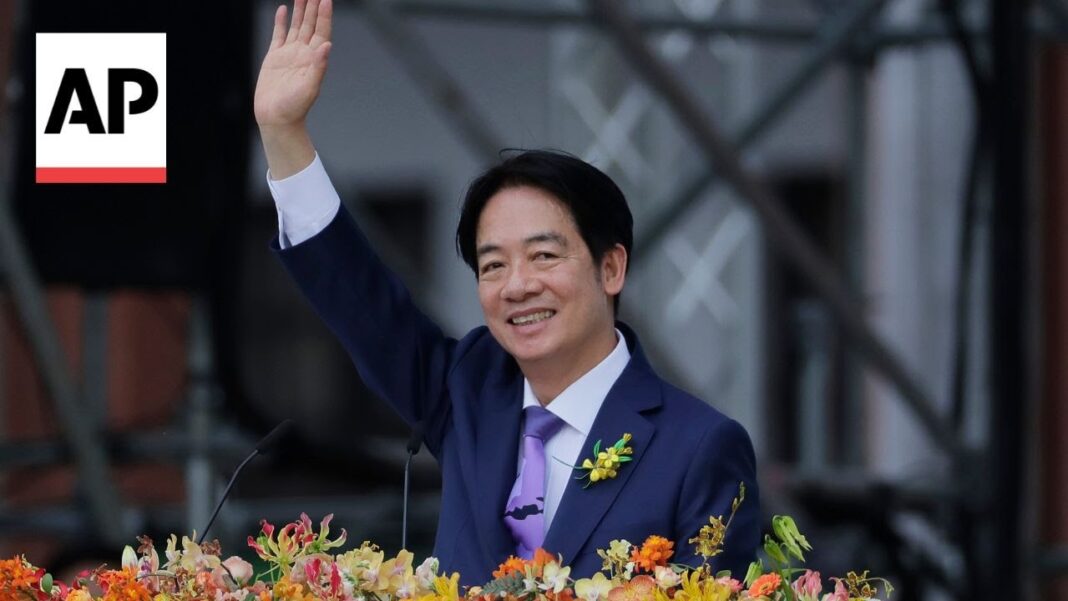
In a speech that resonated with both historical symbolism and geopolitical urgency, Taiwan President Lai Ching-te urged his nation to draw inspiration from Israel’s defensive spirit as it faces escalating pressure from China. Addressing the first-ever delegation from the American Israel Public Affairs Committee (AIPAC) to visit Taipei, Lai likened Taiwan’s struggle for self-determination to Israel’s enduring quest for security, invoking the biblical imagery of David standing against Goliath.
According to a report on Tuesday at VIN News, the AIPAC-hosted dinner—attended by more than 200 American delegates, lawmakers, and business leaders—marked a milestone in the evolving trilateral dialogue between Taiwan, the United States, and Israel. For Lai, it provided a global platform to articulate his vision of “peace through strength,” a doctrine he described as central to the preservation of democracy in the face of rising authoritarianism.
“Appeasement has never stopped authoritarian regimes,” Lai declared in remarks reported by VIN News. “Peace through strength is the path shared by Taiwan, the United States, and Israel. Our destinies are linked by our commitment to freedom, human rights, and the rule of law.”
Lai’s invocation of Israel’s defense ethos was no rhetorical flourish. He praised Israel’s unwavering commitment to protecting its sovereignty, calling the Jewish state “a model of vigilance, innovation, and courage.” In the face of existential threats, he said, Israel has demonstrated that resilience and readiness, not concessions, are the foundation of enduring peace.
“Despite persecution, the Jewish people have persevered with faith and determination — just as Taiwan continues to stand firm against threats to its sovereignty,” Lai told the audience, according to the report at VIN News. The line drew a long standing ovation from AIPAC delegates, many of whom see Taiwan’s plight through the lens of Israel’s own survival struggle.
The comparison between Taiwan and Israel—two small, technologically advanced democracies surrounded by adversaries—has gained growing traction in policy circles. Both nations have built robust defense industries, rely heavily on U.S. security support, and face relentless campaigns of disinformation and coercion from neighboring powers.
As the VIN News report noted, Lai’s speech effectively reframed Taiwan’s defense policy as part of a shared democratic mission rather than a regional standoff. “The challenges we face are not unique,” he said. “They are the same challenges that free nations confront everywhere — the defense of liberty against tyranny.”
The centerpiece of Lai’s address was his announcement of a major boost in Taiwan’s defense spending—a decision long anticipated by defense analysts. He revealed plans to raise defense expenditures to 3.32% of GDP next year, with a goal of reaching 5% by 2030.
This increase, as the VIN News report observed, highlights Taiwan’s determination to strengthen its deterrence posture amid growing incursions by China’s People’s Liberation Army (PLA) into Taiwan’s air defense identification zone.
Lai detailed the development of what he termed the “T-Dome”—a multilayered missile defense system modeled after Israel’s Iron Dome and informed by U.S. defense architecture. The system aims to protect Taiwan’s major population centers and strategic infrastructure from missile and drone attacks.
“The ‘T-Dome’ will serve as the backbone of Taiwan’s integrated defense network,” Lai said. “It reflects the lessons we have learned from Israel’s success in defending its skies and the unwavering support of our American partners.”
According to the information provided in the VIN News report, Taiwanese officials have already begun procurement talks with U.S. defense contractors and Israeli technology firms specializing in radar, interception, and command-and-control systems.
Lai emphasized that the new missile shield will be accompanied by expanded training programs, local production of precision munitions, and enhanced cyber defense capabilities—critical components of Taiwan’s evolving asymmetric defense strategy.
Beyond the military dimension, Lai underscored Taiwan’s central role in the global technology ecosystem, particularly in semiconductors, artificial intelligence, and cybersecurity. He called for deeper collaboration with both Israel and the United States in these areas, framing them as “the engines of our shared democratic future.”
“Taiwan is the world’s semiconductor hub, Israel is a global leader in cybersecurity, and the United States drives innovation and industrial strength,” Lai said, as reported by VIN News. “Together, our nations can create an alliance of innovation that fortifies freedom across continents.”
He proposed joint initiatives in AI-driven defense technology, supply chain resilience, and cybersecurity cooperation, highlighting Israel’s record of fusing civilian innovation with national defense. “We have much to learn from Israel’s integration of cutting-edge research into its security framework,” Lai added.
According to the information contained in the VIN News report, Lai’s administration is also exploring opportunities for academic partnerships and exchange programs linking Taiwanese universities with Israeli institutions such as the Technion, Weizmann Institute of Science, and Tel Aviv University. These collaborations, Lai said, would advance Taiwan’s research capabilities and deepen its intellectual ties with the global democratic community.
The AIPAC visit itself carries significant diplomatic weight. The VIN News report noted that this marks the first official mission by AIPAC to Taiwan, signaling a strengthening of unofficial ties between Taipei and pro-Israel advocates in Washington.
The delegation included former U.S. lawmakers, policy advisers, and prominent figures from America’s Jewish community, all of whom emphasized the shared values and mutual strategic interests linking the three democracies.
“We see Taiwan as a frontline democracy,” one delegate told VIN News. “Its courage mirrors Israel’s — a small nation standing tall in the face of overwhelming odds.”
Lai reciprocated the sentiment, calling AIPAC “a bridge between free peoples” and expressing gratitude for its advocacy in U.S. policy circles. “Your presence here in Taipei sends a powerful message,” he said. “It shows that the democratic world stands united against intimidation and aggression.”
Throughout the evening, Lai wove a narrative that placed Taiwan’s struggle for sovereignty within a global moral framework. Drawing parallels between Jewish perseverance and Taiwanese determination, he said that both peoples “have refused to surrender to history’s injustices.”
As the VIN News report recounted, Lai invoked the biblical metaphor of David and Goliath to illustrate Taiwan’s position in the geopolitical landscape. “Like David, Taiwan may be small,” he said, “but we wield something far greater than size or numbers: the conviction that freedom is worth defending.”
Lai’s remarks come at a sensitive time in East Asia. China has escalated its military intimidation campaign, flying record numbers of warplanes near Taiwan and conducting naval drills simulating blockades. Meanwhile, Beijing continues to isolate Taipei diplomatically, pressuring nations to withdraw recognition and curtail official engagement.
Against that backdrop, Lai’s speech served as a defiant reaffirmation of Taiwan’s identity and its refusal to succumb to coercion. “We do not seek confrontation,” he said, “but we will never accept domination.”
According to the information in the VIN News report, Lai concluded the evening with an optimistic message about the future of Taiwan–U.S.–Israel relations, predicting that cooperation among the three nations would strengthen peace and stability across the Indo-Pacific and beyond.
He called for a trilateral framework encompassing defense technology, cybersecurity, and humanitarian aid, asserting that such collaboration could serve as “a beacon of democratic solidarity” in an era defined by geopolitical uncertainty.
“Together, we can show that freedom endures — that democracies can adapt, innovate, and prevail,” Lai said. “In this century’s contest between liberty and tyranny, Taiwan, Israel, and the United States stand on the same side of history.”
The event closed with a symbolic gesture: Lai and the AIPAC delegation jointly lit a menorah, representing the light of resilience amid darkness. The moment, captured in images shared widely across social media, encapsulated the theme of Lai’s address — that the endurance of small democracies can illuminate the world’s path toward peace.
As the VIN News report observed, Lai’s remarks were not merely a statement of policy but a declaration of faith — in democracy, in alliances, and in the indomitable will of free nations to survive.

So why doesn’t Israel recognises Taiwan and does business with China?