



|
Getting your Trinity Audio player ready...
|
By: Fern Sidman
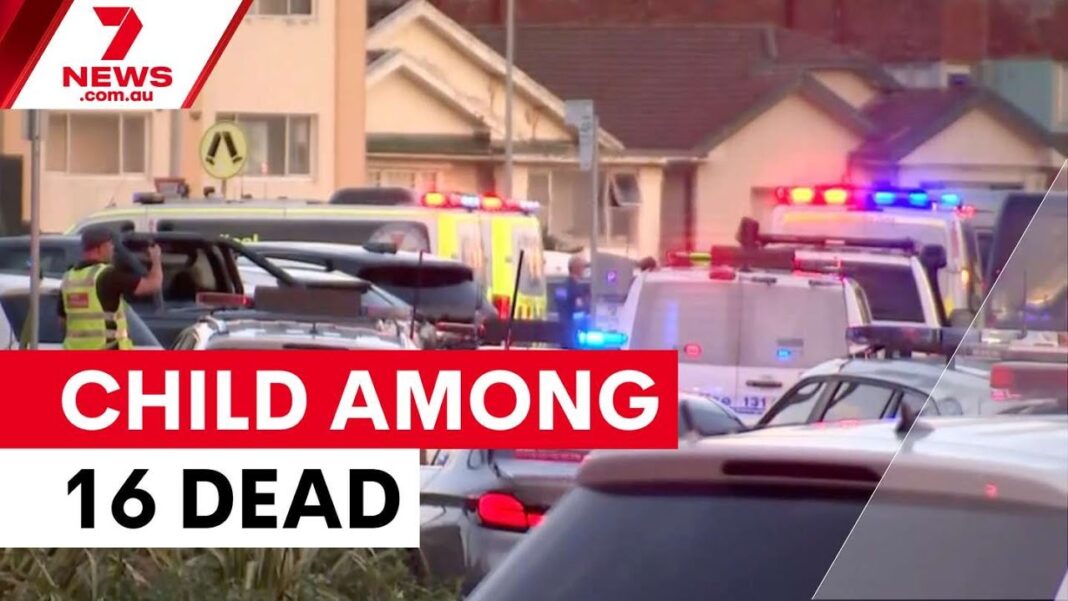
As Australia continues to grapple with the aftermath of one of the deadliest antisemitic attacks in its history, new and deeply troubling details have emerged from the investigation into the massacre that unfolded during a Hanukkah celebration in Sydney. According to a report on Sunday at Israel National News, the attack, which claimed the lives of 16 people and left dozens more wounded, is increasingly being viewed by authorities and analysts alike as a calculated act of jihadist terror aimed squarely at the Jewish community.
The revelations, released Sunday by Australian investigators and covered by Israel National News, have added a grim layer of clarity to an event that already shook Australian society to its core. What had initially appeared as an isolated act of violence is now being scrutinized as a potential extension of global extremist networks, possibly inspired or directed by Islamist terror organizations, including ISIS.
One of the two terrorists involved in the massacre has been identified as Nabid Akram. According to information cited in the Israel National News report, Akram was critically wounded during the attack after the second gunman who fired alongside him was eliminated by security forces. Investigators revealed that Akram had until recently been employed as a construction worker but had been dismissed from his job shortly before the attack, a detail that authorities are examining as part of a broader profile of radicalization and instability.
In the vehicle used by the terrorists to travel to the scene, police discovered a black flag, a symbol frequently associated with jihadist movements. This discovery has significantly intensified suspicions of ideological motivation. As Israel National News reported, Australian authorities are actively examining potential connections between the attackers and international jihadist terror organizations, with ISIS emerging as a central focus of the investigation.
Further deepening concerns, investigators disclosed that Akram originated from Pakistan. While officials have been careful to avoid drawing premature conclusions, the revelation has prompted a sweeping counterterrorism response. Shortly after the attack, dozens of police officers raided the home of the terrorist’s family, arresting two relatives for questioning. Authorities have not yet disclosed the extent of the relatives’ alleged involvement, but the arrests underscore the seriousness with which the investigation is being pursued.
Beyond the intelligence findings, the human toll of the massacre has dominated coverage by Israel National News, which has documented the anguish of families whose lives were irreparably altered in a matter of moments.
Among the murdered was Alex Kleitman, a Holocaust survivor whose death has become emblematic of the profound historical and emotional weight of the tragedy. His widow, Larissa Kleitman, offered a searing account of his final moments. Speaking through tears, she recounted how her husband instinctively rose to shield her when gunfire erupted.
“A bullet hit his head when he stood up to protect me,” she said, in remarks quoted by Israel National News. The couple, both survivors of the Holocaust, had built a life together over five decades of marriage. They immigrated to Australia from Ukraine, raised two children, and were blessed with 11 grandchildren. For them, the annual Hanukkah celebration was not merely a communal gathering but a sacred tradition—a reaffirmation of survival, faith, and continuity after unspeakable loss.
That such a tradition ended in violence has left the family, and the broader Jewish community, struggling to comprehend the enormity of the trauma.
Also among the victims was Rabbi Eli Schlanger, of blessed memory, a figure whose murder has reverberated far beyond Sydney. According to the information provided in the Israel National News report, Rabbi Schlanger held both Israeli and Australian citizenship and had served as a Chabad emissary in Sydney since 2008. Over the past 16 years, he had become a central pillar of Jewish life in the city, known for his warmth, dedication, and tireless commitment to strengthening Jewish identity.
Rabbi Schlanger was deeply engaged in global Jewish solidarity efforts. In the wake of the October 7 massacre in Israel, he partnered in commemorative initiatives honoring the victims and worked to raise awareness across continents. In recent months, as Israel National News reported, he traveled to Israel, where he visited soldiers and offered moral support during a period of profound national trauma.
His murder, therefore, has been felt not only as a personal loss but as a symbolic blow to Jewish resilience and leadership.
Rabbi Yaakov Lider, Schlanger’s uncle, provided heartbreaking testimony in an interview with Kol Barama radio, excerpts of which were cited in the Israel National News report. He described the precise moment when the attack reached his family.
“Eli organized the event together with my son-in-law,” Rabbi Lider said. “My son-in-law was sitting, Eli was standing next to him, and took a bullet to the head.”
The tragedy did not end there. Rabbi Lider revealed that his granddaughter was also wounded in the attack and is currently undergoing surgery. His voice, laden with disbelief, reflected the shock engulfing a community that had long viewed Australia as a safe haven.
“This celebration has taken place every Hanukkah for 40 years,” he said. “I don’t know how we continue from here; we are in shock. There has never been such antisemitism here.”
The massacre has ignited renewed scrutiny of the surge in antisemitic incidents across Australia, a trend that Israel National News has chronicled extensively in recent years. Jewish leaders have warned that hostile rhetoric, vandalism of synagogues, harassment of Jewish students, and aggressive demonstrations have created an environment in which violence has become increasingly conceivable.
What distinguishes the Sydney attack, however, is its scale and symbolism. The deliberate targeting of a Hanukkah celebration—a holiday defined by public expressions of faith and the triumph of light over darkness—has been widely interpreted as an attempt to terrorize Jews into retreating from public life.
Analysts speaking to Israel National News have noted that Hanukkah occupies a unique place in Jewish consciousness precisely because of its emphasis on visibility. Lighting the menorah in public spaces is both a religious commandment and a declaration of identity. That such a moment was transformed into a massacre has intensified fears that Jewish visibility itself has become a target.
Australian authorities have emphasized that the investigation remains ongoing, with counterterrorism units pursuing every possible lead. The discovery of the black flag, the arrests of family members, and the examination of international links suggest a case that may have far-reaching implications for Australia’s security apparatus.
According to the information contained in the Israel National News report, officials are also reviewing intelligence-sharing mechanisms with international partners, particularly in light of potential ISIS-inspired radicalization. The possibility that global extremist ideologies have penetrated Australian society has prompted urgent calls for policy reassessment and stronger preventative measures.
For the Jewish community, however, the questions extend beyond law enforcement. Many are asking how a country long regarded as tolerant and multicultural reached a point where such an atrocity could occur.
As funerals are being prepared and the wounded continue to receive medical care, Sydney’s Jewish community is navigating a period of profound grief. Memorials have sprung up across the city, with candles, photographs, and handwritten notes bearing witness to lives cut short.
Israel National News reported that community leaders are urging resilience alongside mourning, invoking the very message of Hanukkah itself. Yet the pain is unmistakable, especially for families like the Kleitmans, whose history embodies both the horrors of the past and the promise of renewal.
The murder of Holocaust survivors on a night commemorating Jewish survival has cast a long shadow, one that extends beyond Australia to Jewish communities worldwide. As Rabbi Lider’s words attest, the sense of shock is compounded by the realization that antisemitism, once thought to be marginal or distant, has manifested in its most lethal form.
The Sydney Hanukkah massacre stands as a defining moment for Australia and for the global Jewish community. As Israel National News has underscored in its reporting, the attack is not only a criminal act but a moral test—of leadership, of societal values, and of the willingness to confront extremism without hesitation or euphemism.
For now, the investigation continues, the community mourns, and the nation reflects. But the names of the victims, the courage of those who tried to protect loved ones, and the legacy of leaders such as Rabbi Eli Schlanger will remain etched into our collective memory.
In the words echoed repeatedly, the light of Hanukkah was challenged in Sydney—but the determination to keep it burning endures.