



|
Getting your Trinity Audio player ready...
|
By: Fern Sidman
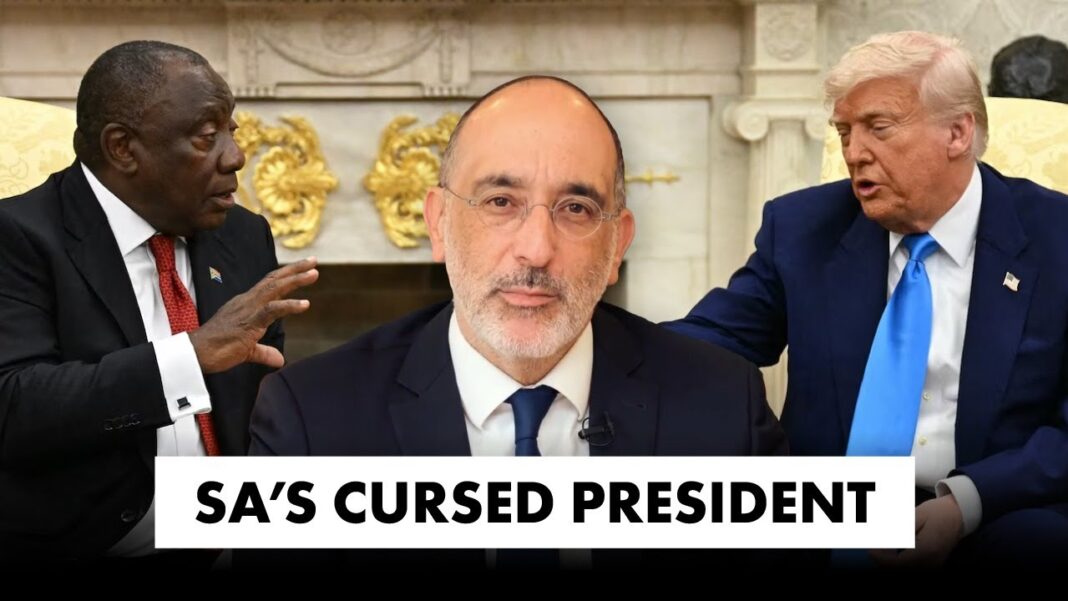
In a bold and widely discussed video statement released Sunday, South Africa’s Chief Rabbi Warren Goldstein voiced full support for President Trump’s recent condemnation of South African President Cyril Ramaphosa over his refusal to denounce the infamous “Kill the Boer” chant. According to VIN News, Goldstein not only affirmed Trump’s stance but expanded the moral conversation beyond race, calling the crisis in South Africa “a human genocide.”
Trump confronted Ramaphosa after resurfacing footage of Economic Freedom Fighters (EFF) leader Julius Malema leading chants that included calls to kill white farmers and simulate gunfire. As VIN News reported on Sunday, Malema has long courted controversy for invoking the chant, and Ramaphosa has repeatedly refused to denounce it publicly — a silence that Goldstein deemed morally indefensible.
“President Trump was right to highlight the moral aberration of the ‘Kill the Boer’ chant,” Goldstein said in the video, quoted in the VIN News report. “But he is wrong that this is only a white genocide. It is a South African genocide — a human genocide.”
Goldstein’s comments have drawn attention to the broader crisis of violence and lawlessness that has plagued South Africa since the fall of apartheid. According to the Chief Rabbi, over 650,000 people — black and white — have been murdered in South Africa since 1994, when the African National Congress (ANC) took power. As the VIN News report noted, Goldstein attributed this staggering toll not to isolated acts of hatred but to a systemic failure by the government to ensure basic safety, security, and dignity for its citizens.
In a moment of searing irony, Goldstein pointed out the hypocrisy of South Africa’s international posture, particularly its recent case against Israel at the International Court of Justice, where it accused the Jewish state of genocide. “It is poetic justice,” he said, “that the same South African government accusing Israel of ‘genocide’ at The Hague is now being accused of genocide itself — measure for measure.”
As the VIN News report highlighted, Goldstein’s remarks were not merely a defense of Israel or Trump, but a clarion call for moral clarity and accountability in a country where leadership has often chosen political expediency over principled governance. His statement, delivered in calm yet piercing tones, called for an end to rhetorical doublespeak and demanded a more honest reckoning with South Africa’s internal crises.
“The only path to a better future,” Goldstein said, “is having the courage to be honest about the failings of the present.” That includes, he insisted, rejecting dehumanizing chants — no matter the race of the intended target — and embracing a vision of South Africa rooted in justice, safety, and shared humanity.
VIN News emphasized that Goldstein’s remarks have added a powerful moral voice to a debate that has long been politicized but rarely addressed with such unflinching candor. By standing with Trump on this specific issue, while also broadening the scope to include the experiences of black victims of violence, Goldstein challenged the simplistic racial narratives that too often dominate discourse around South African politics.
While critics will undoubtedly claim that Trump’s involvement politicizes an already volatile issue, VIN News reports that Goldstein’s intervention reframes the debate as one of basic human rights, not partisan allegiance. His message: genocide is not defined by the skin color of its victims, and silence in the face of hate is complicity — whether in Tel Aviv or Pretoria.
With violence still surging and political tensions mounting ahead of South Africa’s next general election, Rabbi Goldstein’s words — amplified by VIN News and widely shared online — may prove to be a turning point in a nation struggling to reconcile its aspirations for justice with the harsh realities on the ground.

We made aliya uears ago.