



|
Getting your Trinity Audio player ready...
|
By: Fern Sidman
The geopolitical tremors emanating from the Horn of Africa have begun to reverberate far beyond its arid plains and contested coastlines, as Somalia’s President Hassan Sheikh Mohamud has issued an unusually stark warning to Israel over the prospect of a military presence in the self-declared Republic of Somaliland.
Speaking at the Al Jazeera Forum in Doha, Mohamud framed Israel’s deepening engagement with Somaliland not merely as a diplomatic affront but as a potential casus belli—an incursion into what Mogadishu regards as its sovereign domain, with ramifications for the delicate balance of power across the Red Sea corridor. As The Algemeiner reported on Monday concerning Israel’s expanding diplomatic footprint in Africa, the president’s remarks signal how swiftly Israel’s recognition of Somaliland has become entangled in broader regional anxieties.
Somaliland’s political status has long been an unresolved anomaly in international affairs. Though it has maintained de facto independence for decades, complete with its own institutions, elections and security apparatus, it remains largely unrecognized by the global community, which continues to view it as part of the Federal Republic of Somalia. Situated along the southern coast of the Gulf of Aden and abutting Djibouti, Ethiopia and Somalia proper, Somaliland occupies a geography of immense strategic consequence.
Its proximity to one of the world’s most vital maritime arteries—the Red Sea route linking the Indian Ocean to the Suez Canal—has rendered it a coveted vantage point for any power seeking influence over shipping lanes that carry a substantial share of global trade. The Algemeiner report underscored that in an era marked by the militarization of chokepoints and the proliferation of non-state threats, geography itself becomes destiny.
It is against this backdrop that Israel’s decision last year to recognize Somaliland as an independent and sovereign state has assumed outsized significance. Israel became the first country to take such a step, inaugurating what many analysts describe as a nascent but potentially transformative partnership encompassing political, security and economic cooperation. For Jerusalem, the calculus appears grounded in pragmatic security considerations.
The Houthi terrorist group in Yemen, backed by Iran, has emerged as a disruptive force in the Red Sea theater, threatening maritime traffic and projecting instability across the region. A foothold—formal or informal—in Somaliland could offer Israel enhanced situational awareness and strategic depth in countering Houthi capabilities. As The Algemeiner report noted, such an alignment would mark a significant extension of Israel’s regional security architecture, projecting its concerns far beyond the traditional Middle Eastern arena.
For Mogadishu, however, Israel’s recognition of Somaliland is experienced not as a technical diplomatic maneuver but as a profound violation of Somalia’s territorial integrity. At the Doha forum, President Mohamud did not mince words. He characterized any prospective Israeli military installation in Somaliland as devoid of legitimate defensive rationale, suggesting that it would function primarily as a springboard for external interventions. “A base is not a tourist destination,” he declared, insisting that the presence of foreign military infrastructure on Somali soil would be met with resistance. Such language reflects a broader unease among African leaders about what they perceive as the creeping normalization of unilateral border revisions, undertaken without multilateral consent.
Mohamud’s rhetoric was notably uncompromising. He pledged that Somalia would “fight to the full extent of our capacity” against any Israeli forces that might enter, framing the issue as one of national dignity and continental principle. “The African continent rejects any attempts to change borders through military force or unilateral actions,” he asserted. The Algemeiner report contextualized these remarks within Africa’s postcolonial sensitivity to border integrity—a legacy of arbitrary demarcations imposed by external powers, which many African states have sought to preserve as a bulwark against endless territorial disputes.
In this light, Somalia’s resistance to Israel’s recognition of Somaliland is less about Israel per se and more about a normative stance against any precedent that could embolden separatist movements elsewhere on the continent.
Yet Somalia’s own security posture complicates its claims to unalloyed sovereignty. For years, Mogadishu has hosted military facilities operated by foreign powers, including Turkey and Egypt, reflecting both the fragility of Somalia’s security environment and the strategic interest of external actors in the Horn of Africa. The Algemeiner report observed that such arrangements expose a certain paradox: while Somalia decries foreign military presence in Somaliland, it has simultaneously invited other powers onto its own territory to bolster its capacity against Islamist insurgents and regional threats. This duality underscores the extent to which Somalia’s sovereignty is already enmeshed in a web of external dependencies.
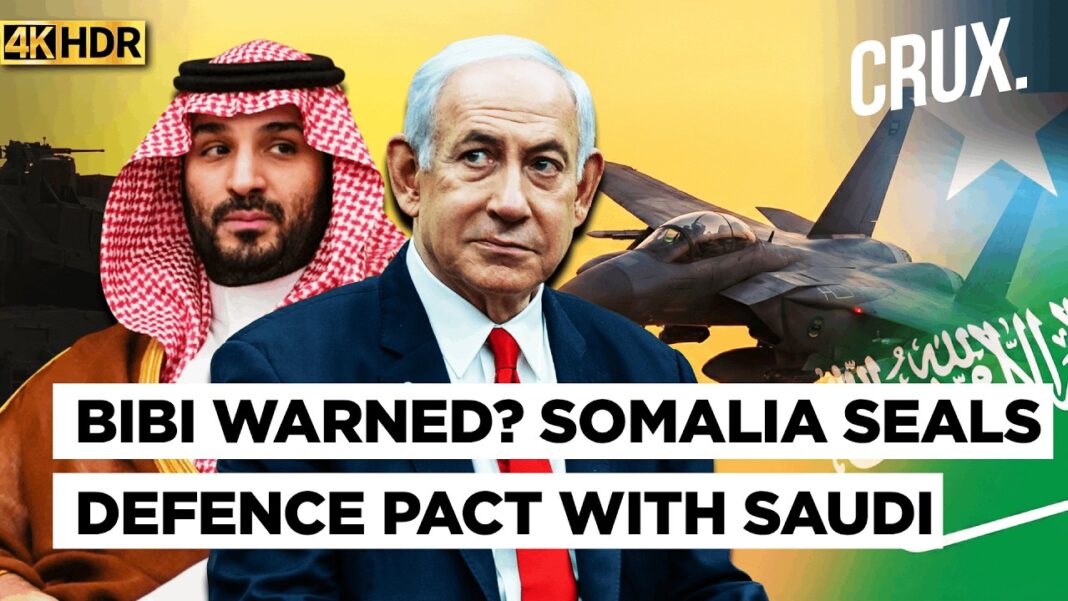
The intensification of Somalia’s regional partnerships in recent days further illustrates this dynamic. In a move widely interpreted as a countermove to Israel’s outreach to Somaliland, Mogadishu has signed a defense cooperation pact with Saudi Arabia. According to officials cited in The Algemeiner report, the agreement is designed to enhance military ties, facilitate advanced training for the Somali National Army and contribute to safeguarding the Red Sea—a corridor of mounting strategic importance to Gulf states. Though the memorandum stops short of a mutual defense treaty, analysts see it as laying the groundwork for deeper security integration between Somalia and Riyadh. This pact reflects an emerging pattern in which regional powers are recalibrating their alignments in response to Israel’s expanding presence on the African littoral.
The broader regional context is one of intensifying competition for influence across the Red Sea basin. Egypt and Turkey, both of which maintain substantial interests in Somalia, have already voiced opposition to Israel’s recognition of Somaliland, warning that it undermines Somalia’s sovereignty and risks destabilizing the Horn of Africa.
The Algemeiner reported that these objections are informed not only by solidarity with Mogadishu but by the strategic calculations of Cairo and Ankara, each of which seeks to preserve its own leverage in the region. For Egypt, the security of the Red Sea is intimately linked to the Suez Canal, a linchpin of its economy and a symbol of national prestige. For Turkey, its military presence in Somalia represents a cornerstone of its broader ambition to project influence across the Muslim world and the African continent.
Within Somaliland itself, Israel’s recognition has been greeted with cautious optimism by segments of the local leadership, who view it as a validation of their decades-long quest for international legitimacy. Somaliland’s relative stability, its record of regular elections and its functional governance structures distinguish it from many conflict-ridden neighbors. These attributes render it an attractive partner for states seeking reliable interlocutors in an otherwise volatile region.
For Israel, engagement with Somaliland thus offers both symbolic and substantive dividends: a foothold in Africa that aligns with its security imperatives and a diplomatic breakthrough in a continent where recognition and support have often been uneven.
Yet the promise of such a partnership is shadowed by the risk of exacerbating existing fault lines. Somalia’s vehement opposition underscores how Israel’s African diplomacy cannot be disentangled from the complex tapestry of regional rivalries and historical grievances. The Algemeiner report cautioned that while Israel may perceive its relationship with Somaliland as a strategic “game changer,” it also risks entangling itself in the internal politics of the Horn of Africa, where questions of legitimacy, sovereignty and recognition remain deeply contested.
The specter of militarization looms large over these developments. Although there has been no official confirmation that Israel intends to establish a military base in Somaliland, the mere possibility has been sufficient to provoke alarm in Mogadishu and beyond. In regions already saturated with foreign military footprints—from U.S. and French bases in Djibouti to Turkish facilities in Somalia—the introduction of another external actor could heighten the risk of miscalculation. The Horn of Africa, long a theater of proxy competitions during the Cold War, now finds itself once again at the intersection of global and regional power struggles.
At stake is not merely the fate of a bilateral relationship but the architecture of security in a maritime corridor that carries the lifeblood of global commerce. The Red Sea’s strategic value has only increased as instability in Yemen, piracy in adjacent waters and the weaponization of chokepoints have rendered shipping lanes more vulnerable. The Algemeiner report emphasized that any reconfiguration of power along this corridor—whether through Israeli-Somaliland cooperation or Saudi-Somali defense pacts—will reverberate through the calculations of states far beyond the immediate region.
President Mohamud’s warning, therefore, should be read not simply as an expression of Somali nationalism but as a symptom of a region in flux. As alliances are forged and recalibrated, the Horn of Africa is emerging as a critical arena in which Middle Eastern, African and global interests converge. The Algemeiner report illuminated how Israel’s diplomatic foray into Somaliland, while grounded in legitimate security concerns, has become a catalyst for broader regional realignments, drawing in actors from Riyadh to Ankara and prompting renewed assertions of sovereignty from Mogadishu.
Whether this evolving landscape yields a more stable equilibrium or descends into intensified rivalry remains an open question. What is clear, however, is that the Horn of Africa has become a crucible in which the competing imperatives of security, sovereignty and strategic ambition are being tested. The region’s future will hinge on whether its leaders and external partners can navigate these fault lines without allowing them to fracture into open conflict.
