



|
Getting your Trinity Audio player ready...
|
By: Carl Schwartzbaum
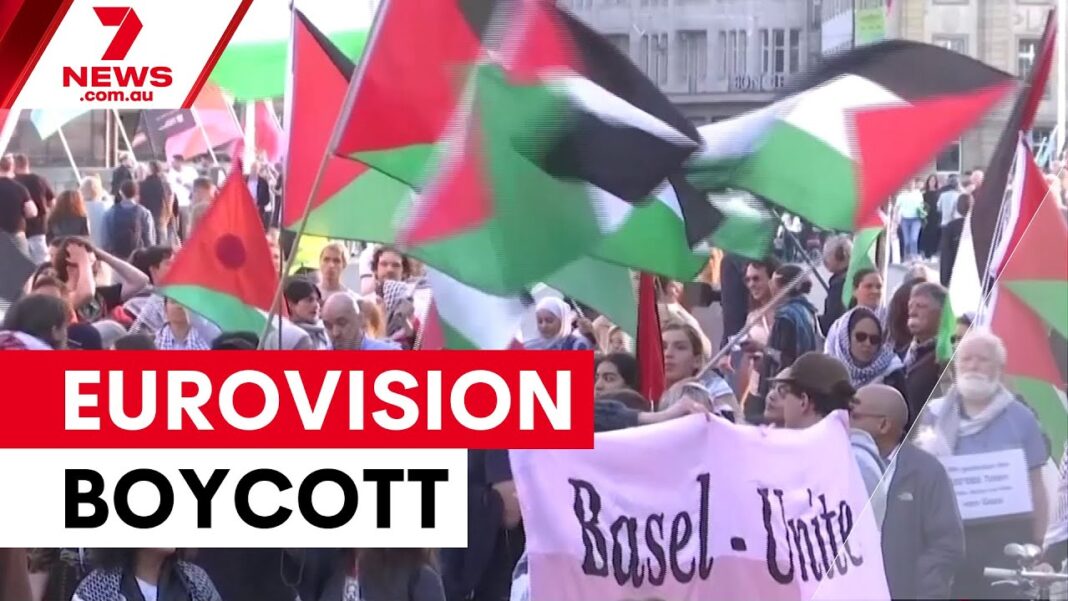
The Eurovision Song Contest, an annual celebration of music, culture, and shared European identity, is facing one of its gravest crises in decades as national broadcasters in the Netherlands and Ireland announced they will not participate in the 2026 competition if Israel remains on the roster. The decision, which comes amid Israel’s ongoing war with Hamas in Gaza, underscores the extent to which a contest that has long prided itself on transcending politics is now deeply enmeshed in them.
According to a report on Friday in The Algemeiner, Dutch broadcaster AVROTROS, which has overseen the Netherlands’ Eurovision entries since the 1950s, issued its declaration on Friday, one day after Irish broadcaster RTÉ made a similar announcement. Both statements cited Israel’s military campaign in Gaza as the reason behind their threatened withdrawal.
“AVROTROS can no longer justify Israel’s participation in the current situation, given the ongoing and severe human suffering in Gaza,” the Dutch broadcaster said in a press release. The statement added that the Netherlands’ participation in the 2026 Eurovision “will not be possible as long as Israel is admitted by the EBU [European Broadcasting Union].”
The Dutch broadcaster, which is part of the country’s public media system under the NPO umbrella, further clarified that if the EBU were to exclude Israel, it would “gladly take part” in the 2026 event. The Netherlands has a long and celebrated history with Eurovision, competing every year since the contest’s inception in 1956 and securing five victories.
Ireland followed suit a day earlier, with RTÉ Director General Kevin Bakhurst describing Israel’s presence in Eurovision as “unconscionable” amid what he called the “appalling loss of life in Gaza.” Bakhurst’s position was reinforced by Irish Minister for Public Expenditure Jack Chambers, who said he “absolutely respect[s]” RTÉ’s decision. Ireland, which has participated since 1965, remains the contest’s most successful competitor with seven wins.
As The Algemeiner report noted, these announcements represent more than symbolic gestures. They illustrate the growing willingness of European broadcasters to use cultural platforms as instruments of political protest, particularly against Israel.
The Netherlands and Ireland are not alone. Broadcasters in Spain, Slovenia, and Iceland have also threatened to boycott the 2026 competition in Vienna if Israel is allowed to participate, according to The Algemeiner report. The momentum of this campaign has placed enormous pressure on the European Broadcasting Union, which oversees Eurovision, to make a definitive ruling before its General Assembly later this year.
The EBU, in an official statement, struck a cautious tone. “We understand the concerns and deeply held views around the ongoing conflict in the Middle East. We are still consulting with all EBU members to gather views on how we manage participation and geopolitical tensions around the Eurovision Song Contest,” said Eurovision director Martin Green. “It is up to each member to decide if they want to take part in the contest and we would respect any decision broadcasters make.”
Broadcasters have until mid-December to withdraw from the 2026 competition without penalty, meaning the coming months could see additional withdrawals or threats of withdrawal if the EBU does not act.
Eurovision, despite branding itself as an apolitical celebration of unity, has always reflected the geopolitical climate of the continent. The Algemeiner report pointed out that while Eurovision’s rules technically forbid political statements during performances, the contest has repeatedly been a battleground for political expression.
For decades, controversies have swirled around participation by countries embroiled in conflicts or accused of human rights abuses. Russia, for example, was banned from the contest in 2022 following its invasion of Ukraine. The question now facing the EBU is whether Israel will face a similar fate, even though its circumstances differ in important respects.
Critics of Israel argue that its military actions in Gaza following Hamas’s October 7, 2023 atrocities—when terrorists murdered 1,200 people and abducted more than 250 into Gaza—amount to collective punishment of Palestinians. Supporters of Israel counter that the country is exercising its right to self-defense against a genocidal terrorist group and that targeting Israel in cultural spaces amounts to antisemitic double standards.
The Algemeiner has been explicit in emphasizing that while broadcasters such as RTÉ and AVROTROS cite humanitarian concerns, their decisions risk aligning with the broader cultural boycott movement that singles out Israel while ignoring atrocities in other global conflicts.
The pressure on the EBU has also come from within the artistic community. Austrian singer JJ, who won the 2025 contest in Basel with his entry “Wasted Love,” has himself called for Israel’s exclusion from the 2026 edition in Vienna. His comments further highlight how politicized the contest has become and how divided the European cultural sphere is over Israel’s presence.
According to the information provided in The Algemeiner report, such calls have been amplified by activist groups who see Eurovision as a powerful platform for protest. Yet, as many cultural observers have noted, excluding Israel from a competition founded to foster unity after World War II would set a troubling precedent that weaponizes art and entertainment for political ends.
Israel’s relationship with Eurovision has always been unique. Since first joining in 1973, Israel has won the competition four times and hosted it in Jerusalem on three occasions. Israeli entries such as Dana International’s “Diva” (1998) and Netta’s “Toy” (2018) are among the most iconic performances in Eurovision history.
For Israelis, the contest has been both a source of pride and a rare platform for cultural integration into the European community. To expel Israel, as The Algemeiner report noted, would not only deprive Israeli artists of that international stage but also signal that Jewish sovereignty is uniquely unworthy of participation in a cultural celebration of nations.
The threatened boycotts also reflect broader political divisions across Europe regarding the Israel–Hamas war. Some governments, particularly in Western Europe, have moved toward recognizing Palestinian statehood and sharply criticizing Israeli military policy. Ireland, for example, was one of the earliest Western states to support Palestinian independence, and Dublin has often been among the most vocal European critics of Israel.
By contrast, countries such as Hungary and the Czech Republic have consistently defended Israel in international forums. Their broadcasters are unlikely to join the boycott campaign, and some may resist efforts to politicize Eurovision.
As The Algemeiner report observed, the standoff over Eurovision mirrors debates in other international arenas, from sports federations to academic and cultural institutions, about whether Israel should be excluded from participation because of its military operations in Gaza.
The potential exclusion of Israel—or mass boycotts if it remains—poses a fundamental threat to Eurovision’s identity. Founded in 1956 to bring European nations together after the devastation of World War II, the contest has become one of the world’s most-watched non-sporting events, with hundreds of millions of viewers annually.
If broadcasters in multiple countries withdraw, the 2026 contest in Vienna could be one of the most divisive in Eurovision history. More significantly, as The Algemeiner report highlighted, it could entrench the perception that the contest is no longer about celebrating music and cultural diversity but about adjudicating political conflicts.
The EBU must decide before the end of 2025 whether Israel will be permitted to compete in Vienna. Its decision will almost certainly reverberate far beyond the world of music. For Israel, exclusion would deepen its sense of isolation in Europe, even as it continues to fight a war triggered by Hamas’s worst atrocities against Jews since the Holocaust. For broadcasters like RTÉ and AVROTROS, a boycott would signal to domestic audiences their willingness to put moral positions above cultural participation.
Yet, such moves risk legitimizing Hamas by punishing Israel while the terrorist group still holds dozens of hostages in Gaza and openly vows to repeat the October 7 attacks.
The coming months will reveal whether Eurovision can navigate this political minefield and preserve its founding spirit of unity through song—or whether it will become yet another arena where Israel is singled out for condemnation and exclusion.
Who needs the Irish anyway!
Keep in mind that Algemeiner is a notorious vicious antisemite propagandist.