



|
Getting your Trinity Audio player ready...
|
By: Fern Sidman
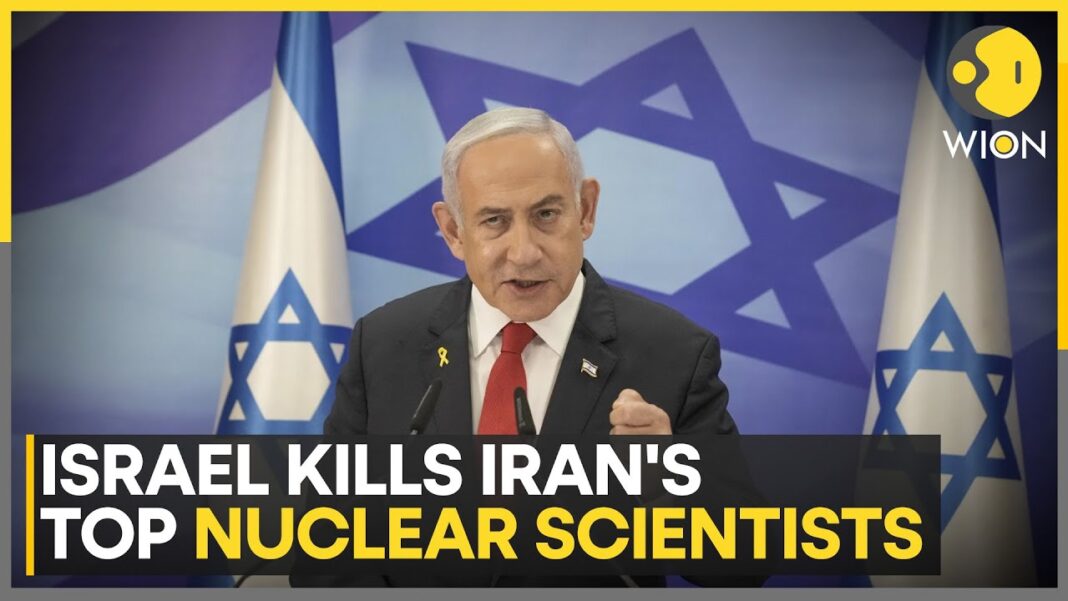
As the Israel-Iran confrontation enters its ninth day, Israeli media reported a staggering escalation in the shadow war between the two adversaries. Channel 12 News in Israel claimed on Saturday that seventeen Iranian nuclear scientists have been killed so far in Israeli military operations targeting Iran’s nuclear infrastructure and personnel.
The most recent incident, reported Friday night, centered on a targeted airstrike—carried out by an Israeli drone—on a residential building in the central Geisha neighborhood of Tehran. The strike reportedly killed a prominent figure in Iran’s nuclear program, Dr. Ithar Tabatabai Kamsha, along with his wife, Mansoura Haji Salem, and two other nuclear specialists believed to have been housed in the same complex.
While the Israeli military has not publicly confirmed the assassinations, Channel 12 asserted that the targeted apartment building was specifically used to shelter nuclear experts connected to Iran’s weapons program. Israeli Army Radio, which has closely tracked military developments since the outbreak of hostilities, reported that the drone strike was designed with precision to eliminate “key scientific operatives” involved in uranium enrichment and weapons design.
Iran’s semi-official Mehr News Agency later confirmed the deaths of Dr. Tabatabai and his wife, though it refrained from attributing responsibility to Israel and did not comment on the method or timing of the strike. According to Mehr, Dr. Tabatabai received his PhD in nuclear engineering in 2007 and had held senior technical posts in Iran’s atomic energy sector, including classified roles related to centrifuge research and plutonium reprocessing.
With this latest incident, the reported death toll of Iranian nuclear scientists now stands at seventeen, according to Israeli media accounts. At least ten of those deaths had already been acknowledged by Israeli defense officials earlier this week. These incidents are widely understood to be part of a broader Israeli strategy to disable Iran’s nuclear ambitions not only by striking physical infrastructure, but also by systematically eliminating the human expertise necessary to rebuild it.
The campaign, though officially unacknowledged by the Israeli government, appears to parallel past covert operations—most notably, the 2020 assassination of top nuclear scientist Mohsen Fakhrizadeh, which Tehran publicly blamed on Israel.
In Friday’s attack, Yedioth Ahronoth, a major Israeli daily, was among the first to name the deceased scientist. The paper described Tabatabai as “instrumental in bridging Iran’s theoretical and operational nuclear capabilities,” and noted that he had been under surveillance by Western intelligence agencies for years. The article also claimed that the Geisha neighborhood, though traditionally considered a civilian enclave, had become “a known safe house cluster for regime-linked researchers and technicians.”
Despite these reports, Iranian authorities have thus far remained publicly silent about the full extent of casualties among their nuclear scientific elite. No official statement has been issued from Iran’s Atomic Energy Organization or the Islamic Revolutionary Guard Corps (IRGC), which oversees the regime’s strategic weapons programs.
While Iran has consistently accused Israel of engaging in acts of “state terrorism,” Israel views the targeted strikes—whether carried out by drones, air raids, or cyber operations—as part of a doctrine of preemptive deterrence.
Since Israel launched its first wave of airstrikes on Iranian soil on June 13, the Jewish state has adopted a more overt approach to military engagement with Tehran. According to military analysts, the strikes are no longer surgical raids designed solely to delay Iran’s progress, but part of a broader attempt to decisively dismantle its nuclear program.
A senior Israeli defense source said this week that “Iran has crossed every red line, and the strategic calculus has changed. We are no longer in the realm of containment—we are in the realm of neutralization.”
If true, the deaths of key personnel such as Tabatabai underscore how seriously Israel views the human dimension of Iran’s nuclear infrastructure—not merely the centrifuges, bunkers, and reactors, but the technocratic minds behind them.
Iranian state media have focused their coverage on Israeli strikes that resulted in civilian casualties, including attacks on infrastructure in cities such as Isfahan and Tabriz.
While some Iranian news outlets have confirmed the deaths of individuals with technical or governmental affiliations, they have refrained from labeling them as nuclear scientists. This, according to analysts is part of an effort by Tehran to downplay the effectiveness of Israel’s targeting and to avoid the appearance of vulnerability in the upper echelons of its strategic programs.
Meanwhile, international reaction remains mixed. European leaders have expressed concern over the rapid escalation but have largely refrained from directly condemning Israel’s strikes on military and nuclear facilities. The U.S., which joined the military campaign against Iran, has remained publicly tight-lipped about its role in the elimination of Iranian scientists, though intelligence sharing between the two countries is widely assumed.
In a televised address Saturday night, President Donald Trump hailed the multinational military campaign as a “spectacular success,” noting that Iran’s key enrichment sites had been “completely and totally obliterated.” While Trump’s remarks focused on infrastructure, his veiled warnings—“There are many targets left”—may signal that more targeted killings of strategic figures are on the table.
What began as a series of precision airstrikes on nuclear facilities has now evolved into a broader campaign aimed at decapitating Iran’s nuclear brain trust. While Israel remains silent on the specifics, the pattern is unmistakable.
For Israel, the stakes remain clear. As one analyst said, “This is a war of minds as much as machines. Dismantling the program means dismantling the people who power it.”
Tehran’s response, and whether it chooses retaliation or negotiation, will define not only the course of this conflict but potentially the future of nuclear proliferation in the Middle East.
