



|
Getting your Trinity Audio player ready...
|
By: Fern Sidman
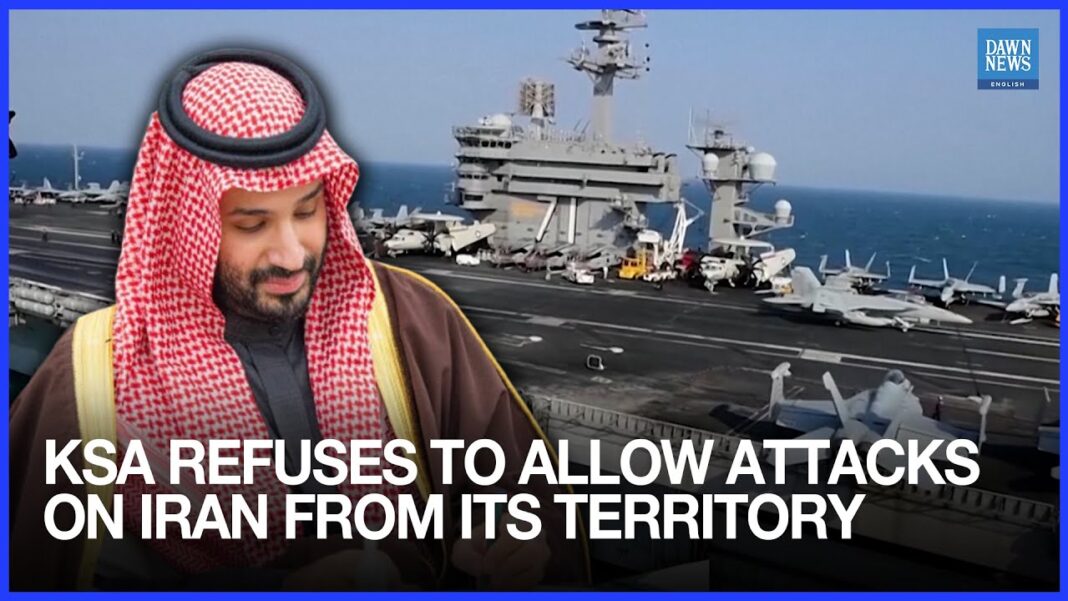
In a moment laden with geopolitical symbolism and regional consequence, Saudi Crown Prince Mohammed bin Salman told Iranian President Masoud Pezeshkian that the Kingdom “will not accept any aggression, threat or provocation against Iran,” according to an official Iranian readout of a phone call between the two leaders released on Tuesday. The statement, emerging amid escalating tensions between Tehran and Washington, represents one of the clearest public articulations yet of Riyadh’s evolving posture toward its historic rival—and signals a potentially transformative recalibration of power dynamics across the Middle East.
As World Israel News reported on Tuesday, the conversation occurred at a time of extraordinary volatility in the region, as diplomatic channels strain under the weight of military posturing, internal unrest in Iran, and growing uncertainty over American strategic intentions. The Iranian presidential office said the two leaders discussed “recent regional and international developments,” a phrase that, in diplomatic language, often conceals the gravity of the issues at hand: looming confrontation, shifting alliances, and the possibility of a broader regional destabilization.
President Pezeshkian used the call not merely as an exchange of courtesies but as a platform for pointed political messaging. According to the Iranian readout cited by World Israel News, he sharply criticized American conduct, referring to what he described as a “12-day war” and accusing Washington of acting in bad faith during diplomatic engagements.
“From the Americans’ perspective, negotiations mean ‘they talk, and we act,’” Pezeshkian said. “We engaged in dialogue with the Americans, and they launched a military attack against us in front of the entire world.” His words reflect a deep-seated narrative within Tehran’s political establishment: that Western diplomacy is instrumental rather than sincere, and that engagement serves as a prelude to coercion rather than compromise.
The Iranian president also referenced recent internal protests, expressing appreciation for what he described as the support of Islamic nations during the unrest. “We appreciate the support of Islamic countries for our people during the recent events, especially that of the Kingdom of Saudi Arabia,” he said, according to the statement cited by World Israel News. The comment is striking not only for its tone but for its symbolism: only a few years ago, Riyadh and Tehran were engaged in bitter proxy conflicts across multiple theaters, from Yemen to Lebanon to Syria.
Yet the Saudi response was even more diplomatically significant. According to the Iranian statement, Crown Prince Mohammed bin Salman declared that Saudi Arabia “will not accept any aggression, threat or provocation against Iran” and further “declares its readiness for full cooperation with Iran and other countries in the region in order to establish lasting peace and security.” For regional observers, the phrasing is unmistakable: this is not merely de-escalatory rhetoric, but a strategic declaration of intent.
Saudi Arabia’s foreign policy over the past several years has undergone a profound transformation. Where once Riyadh positioned itself as a frontline adversary of Iran, today it increasingly presents itself as a stabilizing power broker seeking regional equilibrium rather than confrontation. This shift has been visible in the Saudi-Iranian rapprochement brokered by China, in de-escalation efforts in Yemen, and in Riyadh’s broader strategy of diversifying its security and diplomatic partnerships.
Observers argue that the phone call reflects not sentiment, but calculation.
Dr. Eyal Pinko, a Middle East expert who served for more than three decades in Israeli intelligence, told The Algemeiner that Saudi Arabia understands it “cannot rely on the Americans” for arms and long-term security guarantees. According to Pinko, Riyadh is therefore adopting a more moderate posture in the region, also under pressure from France, now one of its key arms suppliers. His analysis, echoed in reporting by World Israel News, suggests that Saudi Arabia’s message to Iran is not ideological, but strategic: a hedge against uncertainty in Washington and an effort to insulate the Kingdom from the fallout of potential US-Iran confrontation.
This shift is not occurring in isolation. The World Israel News report noted that Iran itself may be recalibrating its regional posture following Israeli operations that significantly weakened Hezbollah’s senior leadership. Pinko observed that Tehran is now “spreading its bets all around, not to be on one side or another,” signaling a more cautious and diversified strategy designed to preserve influence without triggering full-scale confrontation.
The symbolism of this recalibration is particularly striking given Saudi Arabia’s previous designation of Hezbollah and Hamas as terrorist organizations—groups that function as key pillars of Iran’s regional power projection. For years, Riyadh positioned itself as a bulwark against what it viewed as Iranian expansionism, funding opposing factions in Yemen and supporting anti-Iran coalitions across the region. The current rhetoric marks a dramatic departure from that posture.
As the World Israel News report emphasized, the phone call must be understood within a broader matrix of regional realignment. The Middle East is no longer organized around simple binaries of pro-Western versus anti-Western blocs. Instead, it is increasingly defined by multipolar hedging: states pursuing overlapping partnerships, diversified security dependencies, and flexible diplomatic alignments designed to maximize autonomy rather than allegiance.
For Saudi Arabia, this means reducing reliance on Western military protection while expanding ties with China, France, Russia, and regional powers—including Iran itself. For Iran, it means seeking diplomatic insulation against isolation while consolidating internal control and external deterrence.
The implications are profound.
Saudi Arabia’s declaration that it will not accept aggression against Iran effectively signals that Riyadh does not wish to be a staging ground, silent partner, or passive enabler of military action against Tehran. While not an alliance, it constitutes a form of diplomatic shielding—one that complicates regional war planning and alters strategic calculations in Washington, Jerusalem, and beyond.
World Israel News analysts note that this posture also reflects Saudi concerns about economic vulnerability. Vision 2030, the Kingdom’s ambitious modernization and diversification program, depends on regional stability. Large-scale conflict with Iran would threaten energy markets, infrastructure, tourism, and foreign investment—all pillars of Saudi Arabia’s economic transformation agenda.
At the same time, Tehran’s rhetoric suggests a leadership eager to exploit diplomatic fractures between Washington and its traditional allies. By framing the United States as duplicitous and aggressive, Pezeshkian seeks to position Iran as a victim of Western duplicity rather than as a destabilizing actor—a narrative designed to resonate across the Islamic world.
Yet skepticism remains.
World Israel News reported that many regional analysts view the rhetoric of peace and cooperation with caution, noting that ideological contradictions and strategic rivalries have not disappeared. Saudi Arabia and Iran remain divided on core issues, from regional influence to religious authority to security architecture. What has changed is not the nature of the rivalry, but the method of managing it.
This is conflict transformation, not conflict resolution.
The Yemen war offers a revealing case study. Once a brutal proxy battlefield between Riyadh and Tehran, Yemen has increasingly become a theater of negotiated de-escalation. Saudi Arabia seeks disengagement, while Iran appears willing to moderate its posture to avoid escalation that could draw in global powers. The phone call between Mohammed bin Salman and Pezeshkian reflects this broader logic: containment over confrontation, diplomacy over proxy warfare.
For Israel, these developments carry complex implications. As World Israel News has documented, Israeli strategy has long been predicated on the assumption of regional opposition to Iran. A Saudi-Iranian thaw complicates that architecture, potentially narrowing Israel’s coalition space while increasing the importance of independent deterrence and strategic autonomy.
At the same time, Israeli officials remain skeptical of Iranian intentions, viewing Tehran’s diplomacy as tactical rather than transformational. From this perspective, Iran’s regional recalibration is seen not as ideological moderation, but as strategic camouflage.
Still, the symbolism of the Saudi message cannot be ignored.
A Saudi crown prince publicly declaring opposition to aggression against Iran marks a historic inflection point in Middle Eastern diplomacy. It reflects a region increasingly unwilling to serve as an arena for great-power confrontation and increasingly determined to shape its own security architecture.
As the World Israel News report noted, the Middle East is entering an era defined less by rigid alliances and more by strategic fluidity. Power is no longer concentrated in singular blocs but distributed across shifting coalitions, pragmatic partnerships, and overlapping interests.
The phone call between Mohammed bin Salman and Masoud Pezeshkian is not merely a diplomatic exchange—it is a signal flare of a changing regional order.
In a region long shaped by rivalry, proxy wars, and ideological absolutism, the language of “cooperation,” “peace,” and “security” now occupies center stage. Whether this rhetoric translates into durable stability remains uncertain. But its emergence alone marks a transformation in tone, strategy, and regional imagination.
As the World Israel News report observed, the Middle East is no longer simply reacting to external powers—it is actively redefining itself. And in that redefinition, yesterday’s enemies are becoming today’s negotiators, and old fault lines are being redrawn into new equations of power.
In the shadow of confrontation, a new diplomacy is taking shape—fragile, calculated, and profoundly consequential.
