



|
Getting your Trinity Audio player ready...
|
Saudi Arabia & France to Host UN-Backed Conference for Palestinian Statehood, Sidestepping Israel’s Consent
By: Fern Sidman
In what Israel Hayom has called an “unprecedented diplomatic gambit,” Saudi Arabia and France have announced plans to co-host an international conference next month in New York with the backing of the United Nations, aimed at unilaterally charting a path to Palestinian statehood—bypassing Israel entirely. The summit, scheduled for June, seeks to establish a binding roadmap with timelines and enforcement mechanisms that would pressure parties resisting the two-state framework, most notably Israel, without requiring reciprocal commitments from the Palestinians.
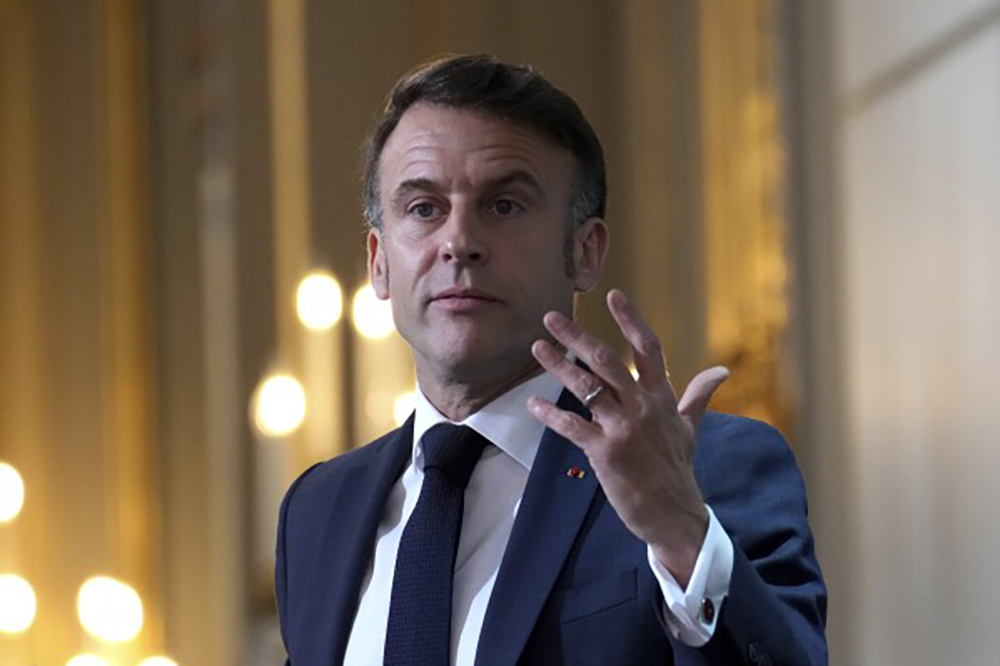
As Israel Hayom reported, the proposed initiative will convene world leaders, diplomats, and UN officials in both roundtable and plenary formats, with the intent of transforming decades of gridlocked negotiations into a unilateral action plan. French President Emmanuel Macron and Saudi Crown Prince Mohammed bin Salman are spearheading the diplomatic charge, bolstered by the active participation of UN Secretary-General António Guterres, who is expected to deliver a keynote address.
According to documents obtained by Israel Hayom, the invitation to member states makes clear that the conference “is intended to serve as a point of no return, paving the way for ending the occupation and promoting a permanent settlement based on the two-state solution.” The conference’s outcome will be a formal declaration—legally non-binding but diplomatically potent—articulating “irreversible” steps toward Palestinian sovereignty.
The plan’s most controversial feature is its commitment to implementation “regardless of the positions of the parties,” a reference understood to mean Israel. The organizers argue that Israeli non-participation cannot be allowed to block global consensus. According to the information provided in the Israel Hayom report, this breaks sharply from previous diplomatic norms, which treated bilateral Israeli-Palestinian negotiations as the cornerstone of any durable solution.
French President Macron’s vocal criticism of Israeli policy in Gaza has drawn scrutiny in recent months, and this latest initiative cements his pivot toward a more overtly pro-Palestinian foreign policy posture. The Israel Hayom report noted that Macron has sought to elevate France’s role in Middle East diplomacy as the European Union grapples with internal divisions on the conflict.
Saudi Arabia, traditionally cautious in its public engagement on the Israeli-Palestinian issue, is now placing significant diplomatic capital behind this initiative. The Kingdom’s leadership sees the conference as a chance to reclaim moral leadership in the Arab world, while also expanding its diplomatic influence beyond oil markets and security cooperation.
As detailed in the Israel Hayom report, perhaps the most radical element of the proposed framework is its enforcement clause. The conference will recommend that the UN Security Council impose sanctions on “parties acting contrary to the conference’s final document.” While the language remains broad, observers understand this to mean potential punitive measures against Israel for non-compliance, particularly in relation to settlement expansion and military activity in the Judea and Samaria region as well as Gaza.
The framework explicitly calls for a “rapid, time-limited and irreversible process” that culminates in “an independent and sovereign Palestinian state alongside Israel.” However, unlike the Oslo Accords or previous US-mediated frameworks, the Saudi-French proposal contains no stipulation for Palestinian recognition of Israel as a Jewish state or for the disarmament of terrorist organizations such as Hamas.
This signals a seismic shift: the international community may seek to bestow Palestinian statehood first, relegating issues such as recognition, demilitarization, and peace commitments to a post-statehood phase, according to the report in Israel Hayom. Critics argue that this not only sets a dangerous precedent but also rewards incitement and terrorism while weakening Israel’s security posture.
The invitation to the conference lays rhetorical blame on “both sides,” referencing the Hamas-led massacre of October 7, 2023, and Israeli military actions in Gaza. “Since October 7, there has been immense suffering of civilians on both sides, including the hostages and their families and the civilian population of Gaza,” the invitation reads.
The Israel Hayom report noted that this moral equivalence has infuriated Israeli officials and Jewish organizations worldwide. Critics point out that failing to distinguish between a democratic state defending its civilians and a genocidal terror regime like Hamas represents not only a diplomatic misstep but a gross ethical failing.
The invitation further claims that “settlement activities endanger the two-state solution,” once again placing disproportionate blame on Israel while omitting mention of continued Palestinian incitement, pay-for-slay programs, and school curricula that glorify martyrdom.
One of the most damning elements of the proposal, as highlighted in the Israel Hayom report, is that Israel is not considered a necessary party to the formulation of the roadmap. Nor are the Palestinians required to meet any basic conditions such as halting terror, recognizing Israel’s right to exist, or ceasing anti-Semitic incitement.
This deliberate exclusion undercuts Israel’s sovereignty and diplomatic agency, while treating Palestinian statehood as a foregone conclusion—disconnected from negotiations, mutual compromise, or trust-building.
By framing the conference as a “point of no return,” France and Saudi Arabia aim to codify Palestinian statehood as a global diplomatic inevitability. According to the Israel Hayom report, this undermines not only Israel’s core security interests but also decades of multilateral peace efforts premised on mutual recognition and negotiation.
A senior Israeli diplomat cited by Israel Hayom warned, “What we are witnessing is not diplomacy—it’s diplomatic coercion. This could embolden Hamas and other rejectionist groups who will see no reason to moderate their positions.”
The conference’s final statement will reportedly assert that its goal is “not to revive or relaunch an endless process but to implement, once and for all, the two-state solution.” If that is indeed the case, then the initiative represents a fundamental redefinition of international involvement in the conflict—one that may set the stage for future confrontation, not reconciliation.
The Saudi-French international conference, set for June in New York, may mark a watershed moment in global diplomacy surrounding the Israeli-Palestinian conflict. As Israel Hayom emphasized in its report, the initiative carries serious implications for regional stability, Israel’s national security, and the legitimacy of imposed solutions that bypass one of the principal parties to the conflict.
Whether this conference delivers peace or sows deeper divisions remains to be seen. But one thing is certain: the rules of the diplomatic game are changing, and Israel finds itself increasingly sidelined by a coalition of powers determined to define the future of the Middle East—without its consent.

Meaningless, without US and Israeli participation. Macron is a cuck whose own country is inundated. France First is something alien to him and undesirable. No pride and no vision.
This is a classic experiment in futility. They can meet. They can make speeches. They can declare. They can insist. They can sanction. They can do whatever they want but the so much as conceivability of a “Palestinian State” is farther away than it’s ever been. In fact, it isn’t conceivable at all. Macron, for his part, is a classic European anti-Semite in a designer suit so it’s not a surprise that he’s doubling down on something intended for one purpose and that’s to hurt Jews in one way or another. The Saudis for their part are, well, Saudis.
The statehood proponents try to reassure the Jewish public by using vague, soothing terms such as “security guarantees” and “demilitarization.” But those words are worthless. No Arab regime has ever been demilitarized, and nobody can “guarantee” Israel’s security—because there is no government on earth that will ever have the political will to step in and forcibly demilitarize or guarantee anything.