



|
Getting your Trinity Audio player ready...
|
By: Abe Wertenheim
The war in Ukraine, long viewed as a devastating but geographically contained conflict, moved into uncharted and perilous territory overnight when more than a dozen Russian drones crossed into Polish airspace, forcing NATO fighter jets to engage enemy targets over allied territory for the first time in the alliance’s history.
As The New York Times reported on Wednesday, the episode marks an inflection point: not only in the trajectory of the war, but in the risks of its expansion into direct confrontation between Russia and the West. The incursion prompted Warsaw to invoke Article 4 of the NATO treaty, the seldom-used mechanism that convenes emergency consultations whenever a member state feels its security is directly threatened.
Poland’s Prime Minister Donald Tusk offered blunt words on Wednesday when speaking of the gravity of the moment. “We are dealing with a large-scale provocation,” he declared. “The situation is serious, and no one doubts that we must prepare for various scenarios.”
According to officials cited in The New York Times report, never before had NATO air forces engaged enemy craft over alliance territory. That fact alone makes the incident a watershed. Poland’s east became the unlikely theater of the alliance’s first direct clash with Russian weaponry, even if the weapons in question were drones rather than piloted aircraft.
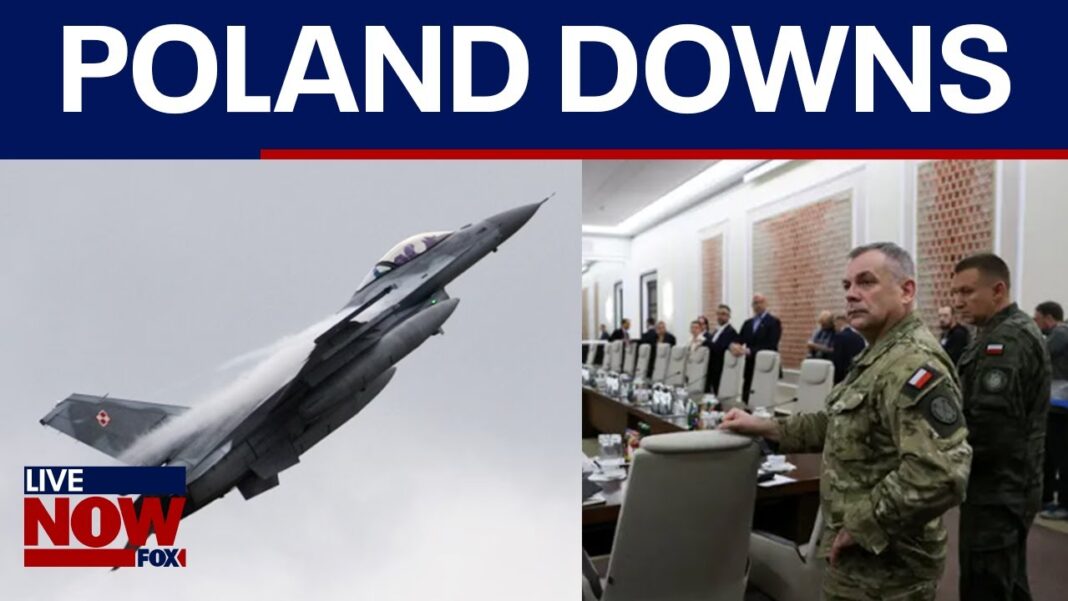
Fighter squadrons from Poland, the Netherlands, and Germany scrambled to intercept the drones, while Italian AWACS surveillance aircraft provided real-time targeting data. Patriot missile batteries also played a role. Though the Polish government has not released precise figures, Warsaw-based media reported that as many as 19 drones entered Polish territory, with an undisclosed number shot down by NATO forces.
The drones arrived amid a broader Russian barrage against Ukraine, during which, the Ukrainian Air Force reported, more than 400 unmanned aerial vehicles were launched. Whether Moscow intended for nearly twenty of them to cross into Poland or whether their appearance was accidental remains unclear.
As The New York Times report noted, Russia’s official response reflected calculated ambiguity. Kremlin spokesman Dmitri Peskov accused NATO leaders of “daily” leveling accusations against Russia without evidence, but he conspicuously did not deny that Russian drones had crossed into Poland. The Russian Defense Ministry, for its part, claimed it had “not planned” to target Poland and insisted that the country was out of range of Russian drones — a statement at odds with repeated evidence to the contrary.
Adding to the murkiness, Belarus — a close ally of Moscow and host to Russian troops — suggested that the drones may have veered off course after encountering electronic warfare countermeasures. Yet, as Polish officials quickly pointed out, the probability of nearly twenty drones simultaneously drifting into Polish territory by accident is vanishingly small.
By invoking Article 4, Poland ensured that the incident would not be dismissed as a minor border mishap. Instead, it will now be placed squarely before the North Atlantic Council, NATO’s highest decision-making body.
Since NATO’s founding in 1949, Article 4 has been invoked only seven times. Most recently, it was used by multiple allies on February 24, 2022, the very day Russia launched its full-scale invasion of Ukraine.
The decision demonstrates Warsaw’s determination to escalate the matter diplomatically. While Article 5 — NATO’s mutual defense clause — remains untouched, Article 4 consultations could pave the way for tougher alliance measures, ranging from heightened air defense patrols to joint military exercises near Poland’s eastern frontier.
The drone incident comes as Poland, a frontline NATO state with bitter historical memories of Russian domination, has already undertaken sweeping measures to fortify its defenses.
Prime Minister Tusk has vowed to double the size of the Polish military to half a million personnel. Defense spending has surged to levels unmatched anywhere else in NATO, proportionally even higher than the United States’. Just this past May, Tusk suggested that Warsaw might even pursue nuclear capabilities, a taboo subject inside the alliance but a telling sign of Poland’s growing anxiety.
General Tomasz Piotrowski, who commanded Poland’s armed forces until 2023, told Polish media that the incursion bore the hallmarks of a deliberate test. “I assess this ‘incursion’ as a deliberate test of Poland’s resilience, the cohesion of our leadership, and the awareness of our society,” he said. “It appears to be well prepared by Russia in cooperation with Belarus.”
The immediate disruption was tangible. Airspace was temporarily closed over eastern Poland, grounding flights at several airports including Warsaw Chopin, the nation’s busiest. While airspace reopened later in the day, authorities warned that delays and cancellations would persist.
Civil aviation experts told The New York Times that the sudden closures highlighted the fragile balance between civilian air traffic and escalating military operations. The image of Polish F-16s and Dutch F-35s intercepting drones over one of Europe’s busiest corridors struck many as a glimpse into a future where European skies could be increasingly militarized.
NATO Secretary General Mark Rutte condemned the incursion in unusually blunt terms. “It is absolutely reckless. It is absolutely dangerous,” he said at a Brussels news conference. Addressing Vladimir V. Putin directly, Rutte demanded: “Stop the war in Ukraine. Stop the escalating war, which he is now basically mounting on innocent civilians and civilian infrastructure. Stop violating allied airspace. And know that we stand ready, that we are vigilant, and that we will defend every inch of NATO territory.”
Yet, as The New York Times report noted, NATO also finds itself in a bind. To treat the incident as intentional risks further escalation. To dismiss it as accidental risks emboldening Moscow to probe again.
Analysts suggest the alliance may opt for a middle path: reinforcing defenses, issuing strong condemnations, but stopping short of any retaliatory strike. The overriding priority, officials said, is to deny Moscow the ability to fracture NATO unity — something Putin has sought since the invasion began.
The broader danger is not only in deliberate escalation but in miscalculation. A single drone veering toward a civilian aircraft, or debris striking Polish homes, could trigger a chain of events no one intends. NATO officials have long worried about such “horizontal escalation,” where the war spills over borders not through tanks or missiles but through accidents and provocations.
As The New York Times reported, this is precisely why Warsaw’s invocation of Article 4 is significant. It reflects a determination not to allow such incidents to pass quietly. By internationalizing the crisis, Poland is signaling that its patience is finite and that NATO must consider stronger measures to deter further incursions.
The incursion also comes at a time when Ukraine itself is under relentless aerial assault. The Ukrainian Air Force reported that Russia had launched an unprecedented 415 drones in a single night — a record that underscores both Moscow’s industrial capacity and Kyiv’s mounting air defense challenges.
For Poland, the overlap is telling. As Russia escalates its campaign to break Ukraine’s defenses, it simultaneously tests NATO’s red lines. Whether these tests are deliberate or opportunistic, the effect is the same: to keep the West guessing about Moscow’s intentions, thereby complicating NATO’s ability to calibrate its response.
Across Europe, reactions were swift. The German Defense Ministry said its Patriot batteries had been placed on maximum alert. The Netherlands confirmed that Dutch F-35s based in Poland participated in the interceptions. Italy’s AWACS aircraft, meanwhile, helped coordinate the joint defense effort, underscoring the multinational character of NATO’s rapid response.
European diplomats privately told The New York Times that while NATO’s military response had been effective, the political test was just beginning. How the alliance interprets and responds to Poland’s Article 4 request will send a signal not only to Moscow but also to member populations skeptical about deeper involvement in the war.
For the Kremlin, the incident may serve multiple purposes. It tests NATO’s cohesion, gauges Western resolve, and feeds a propaganda narrative portraying Russia as locked in existential struggle with a hostile West.
But the costs are real. By risking escalation, Moscow also risks NATO hardening its posture in ways it has previously avoided, from increased troop deployments in Eastern Europe to accelerated arms transfers to Ukraine.
As one European diplomat told The New York Times: “Putin wants to probe the seams of NATO, but if he miscalculates, he could instead cement the alliance’s unity. That is the danger of playing with fire.”
The overnight drone incursions into Poland have brought Europe perilously close to a line it has long sought to avoid: direct NATO-Russia confrontation. Though no casualties have been reported, the symbolism of NATO’s first-ever combat engagement within its own airspace is profound.
For Poland, the incursion is more than a provocation; it is a reminder of its vulnerability and a vindication of its aggressive rearmament campaign. For NATO, it is a test of unity, deterrence, and restraint. For Russia, it is both an opportunity and a gamble — one that could either unsettle the alliance or, if misjudged, galvanize it.
As The New York Times report emphasized, the incident reveals how the war in Ukraine has become impossible to contain neatly within Ukraine’s borders. Each drone, whether armed or unarmed, carries the risk of dragging Europe into a broader conflagration.
The message from Warsaw, Brussels, and Washington is clear: the alliance will not hesitate to defend its territory. Yet behind the firmness lies an unspoken anxiety: that the next drone may not miss, and the next incursion may demand a response that carries consequences far beyond Europe’s eastern frontier.
