



|
Getting your Trinity Audio player ready...
|
By: Fern Sidman
As tensions between Washington and Tehran continue to thicken the geopolitical atmosphere of the Middle East, a stark and sobering message emerged this week from Capitol Hill. Speaking before a Senate hearing, Secretary of State Marco Rubio offered an unvarnished assessment of the strategic vulnerability of American forces in the region and the logic driving the expanding U.S. military footprint. His testimony, reported on Wednesday by VIN News, underscored that the deployment of American assets across the Middle East is not symbolic posturing, but a foundational layer of defense against what U.S. officials increasingly describe as a credible and immediate Iranian threat.
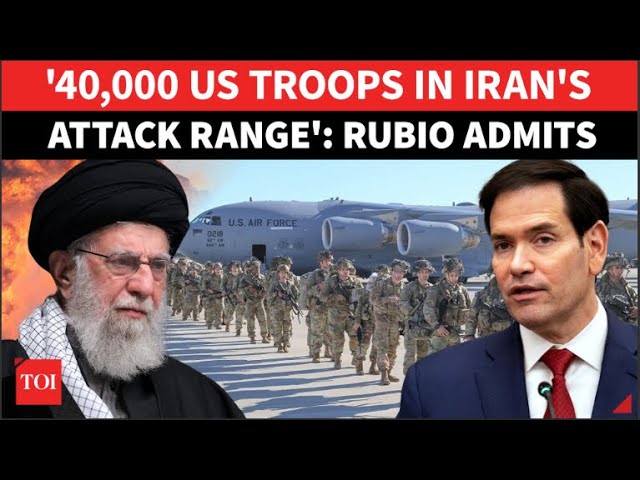
Rubio’s remarks were precise, technical, and unmistakably grave. He described the reality facing approximately 30,000 to 40,000 American service members currently stationed across eight or nine military facilities in the region. These forces, he emphasized, are not hypothetically vulnerable—they are operationally exposed. According to Rubio, every one of those installations lies within the effective strike radius of Iran’s expanding arsenal of short-range ballistic missiles and thousands of one-way attack drones, systems that have been tested, refined, and deployed by Tehran and its proxy networks across multiple conflict theaters.
“All are within reach,” Rubio told senators. “Not theoretically—in reality.” The distinction mattered. This was not strategic speculation or abstract modeling. It was an acknowledgment that the modern battlefield has erased traditional buffer zones. Geography, once a shield, is now largely irrelevant in an era defined by drone swarms, precision-guided munitions, and asymmetrical warfare.
VIN News reported that Rubio framed the current American posture in the region as a “baseline defense,” a minimum strategic necessity rather than an escalation. The concept is simple but consequential: the United States must maintain sufficient military power in the Middle East not merely to respond to an Iranian strike, but to prevent one. Deterrence, in this framework, is not reactive—it is anticipatory.
Rubio’s language reflected this doctrine with unusual clarity. He stated that the U.S. must have “enough force and power in the region just on a baseline” to defend against the possibility that the Iranian regime might decide to strike American personnel. VIN News noted that this phrasing reveals a shift from reactive containment toward proactive deterrence architecture—a strategic posture built around the assumption that escalation is not only possible, but plausible.
At the center of this doctrine, Rubio placed the authority of the presidency itself. He emphasized that President Trump “always reserves the preemptive defensive option.” This phrase carries significant doctrinal weight. It signals a security philosophy in which waiting for an attack is considered an unacceptable risk when intelligence indicators suggest imminent danger. In such a framework, preemption becomes not aggression, but defense.
This posture reflects a broader transformation in U.S. military strategy in the Middle East. For years, American deployments were framed primarily in counterterrorism terms: combating ISIS, stabilizing Iraq, and supporting allied governments against insurgent groups. Today, the strategic axis has shifted back toward state-to-state confrontation, with Iran positioned as the central adversarial actor. VIN News has consistently documented this transition, noting the increasing emphasis on missile defense systems, naval deployments, aerial surveillance, and rapid-response strike capabilities.
Iran’s military evolution has played a decisive role in this recalibration. Over the past decade, Tehran has invested heavily in asymmetric warfare technologies—particularly drones and ballistic missile systems. These tools allow Iran to project power far beyond its borders without conventional force deployments. Through proxy networks in Lebanon, Syria, Iraq, Yemen, and Gaza, Iran has built a distributed strike architecture capable of exerting pressure across the region.
VIN News has frequently reported on how this proxy network functions as an extension of Iranian strategic doctrine. Hezbollah’s missile stockpiles in Lebanon, Houthi drone attacks from Yemen, and Hamas’ terror infrastructure in Gaza all form part of what analysts describe as Iran’s “ring of fire.” Rubio’s testimony implicitly acknowledged this architecture, even as he focused specifically on direct Iranian capabilities.
The significance of his Senate remarks lies not only in their content, but in their context. The United States has recently expanded its military presence in the Middle East through naval deployments, air defense systems, and troop reinforcements. The VIN News report documented these movements, noting the arrival of carrier strike groups, missile defense batteries, and advanced surveillance platforms. Rubio’s testimony effectively framed these deployments not as escalation, but as structural necessity.
In diplomatic terms, the message is equally stark. By publicly articulating the vulnerability of U.S. forces and the readiness for preemptive action, Washington is signaling to Tehran that any direct or proxy attack on American personnel will carry catastrophic consequences. VIN News analysts have described this as a return to classical deterrence theory—where clarity, not ambiguity, is the primary stabilizing force.
At the same time, Rubio’s comments reflect the precarious balance Washington must maintain. The goal is not war, but deterrence. Yet deterrence itself requires visible readiness. This creates a strategic paradox: the more visibly prepared the United States becomes, the more the region appears militarized, increasing the risk of miscalculation. VIN News has emphasized this tension in its report, describing it as a “deterrence dilemma” that defines modern Middle Eastern geopolitics.
Rubio’s testimony also comes amid broader regional volatility. The Middle East is currently experiencing overlapping crises: the aftermath of the Gaza war, instability in Lebanon, tensions in the Red Sea, unrest in Iraq, and the ongoing conflict in Yemen. Each of these theaters intersects, directly or indirectly, with Iranian influence. Iran’s regional strategy thrives on complexity—on layered conflicts that diffuse accountability and obscure attribution.
Within this environment, the presence of U.S. forces becomes both a stabilizing anchor and a strategic liability. They deter large-scale aggression but also serve as potential targets in any escalation scenario. Rubio’s testimony acknowledged this reality without euphemism. The troops are not symbolic—they are exposed.
The Senate hearing also reflects a broader shift in American political consensus regarding Iran. While internal debates persist over diplomacy versus confrontation, there is growing bipartisan recognition that Iran’s military capabilities now represent a direct strategic threat, not merely a regional nuisance. VIN News has reported that concerns over Iran’s missile programs, drone production, and proxy coordination have united policymakers across ideological lines.
Rubio’s framing of the situation as one requiring baseline defensive strength suggests that U.S. policy is moving toward long-term strategic containment rather than episodic crisis management. This implies sustained deployments, permanent infrastructure, and enduring military commitments—elements that signal a generational security posture rather than a temporary response.
For American allies in the region, Rubio’s message carries reassurance. Countries such as Israel, Saudi Arabia, the UAE, and Jordan view Iran as a systemic threat to regional stability. VIN News has reported on the quiet security cooperation between the U.S. and these states, particularly in missile defense integration and intelligence sharing. The U.S. military presence serves as both shield and signal—a declaration that Iranian expansionism will meet organized resistance.
Yet for Tehran, the message is equally clear: the strategic window for coercive escalation is narrowing. Iran’s leadership faces internal economic pressure, domestic unrest, and growing international isolation. In such conditions, external confrontation can become a political tool. Rubio’s warning suggests that Washington is actively preparing for that possibility.
VIN News analysts have observed that the current moment represents a convergence of risk factors: technological capability, ideological hostility, proxy warfare infrastructure, and regional instability. In such an environment, deterrence becomes not merely a military doctrine, but a political necessity.
Rubio’s Senate testimony, therefore, was more than a policy statement. It was a strategic declaration—a public articulation of the new security architecture governing U.S. engagement in the Middle East. It framed American deployments not as temporary reactions, but as structural defenses against a long-term adversary.
The U.S.–Iran confrontation is no longer defined by isolated crises, but by systemic rivalry. Drone technology, missile proliferation, cyber warfare, proxy networks, and ideological confrontation now form a single integrated conflict ecosystem. Rubio’s words placed American troops squarely within that reality.
In the end, his message was as stark as it was simple: the United States is not waiting to be attacked. It is positioning itself to ensure that any attempt to strike American forces will be met not with hesitation, but with overwhelming force. In a region where perception often shapes reality, that signal may be the most powerful weapon of all.