



|
Getting your Trinity Audio player ready...
|
By Shula Rosen (unitedwithisrael)
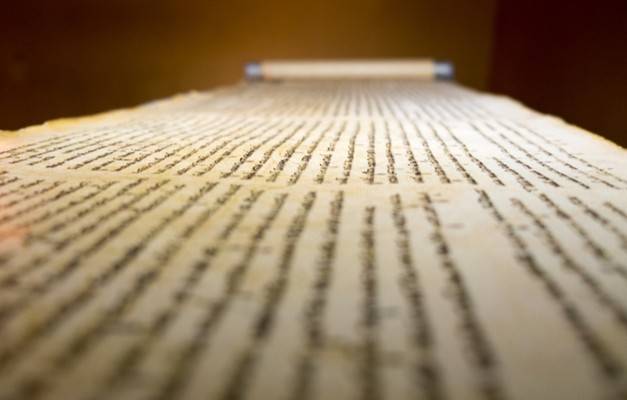
New research suggests that the Great Isaiah Scroll—one of the most important texts ever recovered from the Dead Sea Scrolls—was not produced as a single manuscript but began life as two independent scrolls that were later joined into one.
The conclusion is based on a detailed material analysis conducted by Dead Sea Scrolls scholar Marcello Fidanzio of the Università della Svizzera Italiana, who examined physical differences between the scroll’s first eight parchment sheets and its final nine.
The 7.34-meter-long manuscript, discovered in 1947 at Qumran, dates to the second century BCE and is the oldest nearly complete copy of a book from the Hebrew Bible.
“I can now show that the two parts of the scrolls present a different manufacture,” Fidanzio told The Times of Israel. “The scroll itself tells us about its pre-existing bisection and subsequent unification process.”
Previous studies focused primarily on handwriting. In 2021, an artificial intelligence analysis suggested that two scribes were involved and had deliberately aligned their styles. Fidanzio’s research instead centers on the parchment itself, pointing to differences in folding patterns, sheet layout, repairs, and overall condition that suggest separate origins.
The first section of the scroll shows both horizontal and vertical folds and extensive repairs, including stitching and leather patches. The second section, by contrast, contains only vertical folds and shows little evidence of restoration. “The hide of the first part is a hide that has lived and experienced,” Fidanzio said. “It reminds me of the skin of my 80-year-old mother. In the second part, the hide is smooth and wrinkle-free, like the skin of my 14-year-old niece.”
Radiocarbon testing did not reveal a clear chronological gap between the two sections, but Fidanzio cautioned that such tests provide broad ranges rather than precise dates, leaving open the possibility that the parts were produced years apart. He also noted that other Isaiah manuscripts among the Dead Sea Scrolls typically contain either the first or second portion of the text, not both.
Beyond its physical construction, the scroll offers insight into how biblical texts were used. Hundreds of corrections, additions, and repairs show that the manuscript remained active for generations. “This scroll reveals a lot about how its contemporaries interacted with the text,” Fidanzio told Times of Israel. “The manuscript was not static, but full of life, as it evolved together with those who were reading it.”
The research accompanies a forthcoming exhibition at the Israel Museum, where the Great Isaiah Scroll is expected to be displayed in its entirety for the first time in decades in early 2026.
