



|
Getting your Trinity Audio player ready...
|
By: Abe Wertenheim
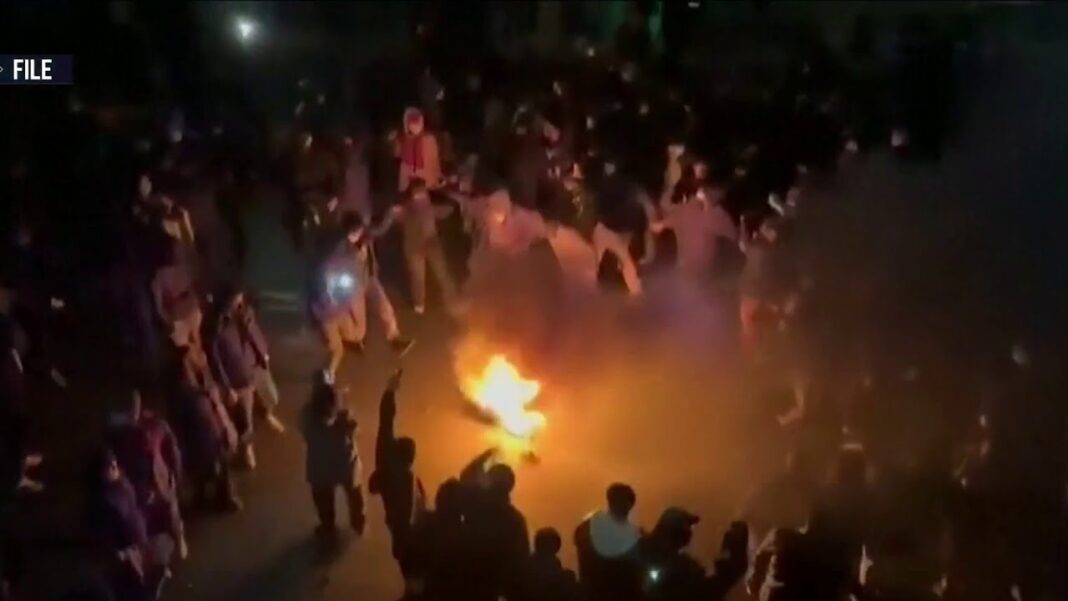
In a startling eruption of political violence within Iran’s capital, hundreds of demonstrators stormed the official Tehran residence of Palestinian Authority Ambassador Salam al-Zawawi, hurling Molotov cocktails, chanting hostile slogans, and inflicting significant damage to the compound. The Jerusalem Post reported on Sunday that the incident left the ambassador and several members of her staff injured, marking an extraordinary breach of diplomatic protocol in a city already roiled by weeks of internal unrest.
According to the details in The Jerusalem Post report, the assault unfolded on the evening of January 8 amid a broader climate of anti-government protests sweeping Iran. Approximately 200 rioters converged on the ambassadorial residence, overwhelming local security and forcing their way into the premises. Witnesses cited by Iranian outlet Asr Iran said the attackers smashed windows, set small fires, and vandalized property while shouting slogans condemning both the Iranian regime and Palestinian leadership.
The Jerusalem Post report confirmed that Ambassador al-Zawawi suffered breathing difficulties during the chaos and was later transported to a hospital for treatment. Sources familiar with the situation indicated that the ambassador experienced symptoms of suffocation after smoke filled portions of the residence. Several embassy employees were also reportedly treated for minor injuries sustained while seeking shelter from the rampaging mob.
The incident represents one of the most serious assaults on a diplomatic mission in Tehran in recent years and raises troubling questions about Iran’s ability—or willingness—to protect foreign envoys during a period of intense domestic instability.
As recounted by The Jerusalem Post, al-Zawawi, her family, and members of the embassy staff were forced to retreat to the basement of the residence as the attackers broke through exterior barriers. There they remained, anxiously awaiting the arrival of Iranian security forces.
After a prolonged delay, police units eventually arrived and extracted those trapped inside. Officials said the responders succeeded in dispersing the crowd and “confronting the attackers,” though not before extensive damage had been inflicted on the building’s interior and exterior.
Photographs circulating on Iranian social media showed shattered glass, scorched entryways, and furniture strewn about rooms once used for official diplomatic functions. The Jerusalem Post report described the scene as one of “widespread destruction,” a characterization that underscores the ferocity of the attack.
Iranian authorities have yet to release detailed information regarding arrests or charges, and as of Sunday evening no organized group had claimed responsibility for the violence.
The targeting of the Palestinian ambassador’s residence is particularly striking given Iran’s longstanding rhetorical and material support for Palestinian causes. For decades, the Islamic Republic has positioned itself as a leading champion of Palestinian resistance, making the assault on the mission both ironic and politically significant.
Analysts quoted by The Jerusalem Post suggested that the incident reflects the deepening fragmentation of Iranian society, where anger toward the regime increasingly spills over into broader expressions of frustration. Protesters in recent weeks have directed their fury not only at domestic authorities but at regional allies perceived as complicit in Tehran’s policies.
While the exact motives of the assailants remain unclear, some observers believe the attack may have been fueled by anger over Iran’s support for militant groups abroad while ordinary Iranians grapple with economic hardship at home.
The Jerusalem Post report noted that anti-regime demonstrations have intensified in several Iranian cities, with protesters accusing the government of mismanaging resources and prioritizing foreign interventions over domestic needs. Within that context, the Palestinian diplomatic mission may have been viewed as an accessible symbol of Tehran’s external entanglements.
Ambassador Salam al-Zawawi occupies a unique place in Palestinian diplomatic history. As The Jerusalem Post has previously chronicled, her appointment to Tehran in January 2022 represented the continuation of a remarkable family legacy.
Her father, Salah al-Zawawi, served as the Palestinian ambassador to Iran from February 1981 until his retirement more than four decades later. Few diplomatic posts in the modern era have been held by a single family for such an extended period. Salam al-Zawawi’s succession was seen as a testament to the longstanding and intricate ties between Tehran and Palestinian leadership.
That history lent particular poignancy to the violence that unfolded last week. What was once regarded as a stable and even symbolic posting has now become a focal point of controversy and danger.
The Jerusalem Post report emphasized that the attack on the residence was not merely a random act of vandalism but a deliberate assault on a recognized diplomatic institution—one that international law obligates host nations to safeguard.
The assault has ignited fresh debate about Iran’s capacity to maintain order as internal dissent mounts. Diplomatic conventions enshrined in the Vienna Convention on Diplomatic Relations require host countries to ensure the safety of foreign missions and personnel. Tehran’s failure to prevent such an incursion may invite international scrutiny.
Officials from the Palestinian Authority have not yet issued a detailed public statement, but sources cited in The Jerusalem Post report indicated that Ramallah is closely monitoring the situation and expects Iranian authorities to conduct a full investigation.
Regional experts warn that the episode could have ripple effects across the Middle East. If diplomatic missions in Tehran are no longer secure, other governments may reconsider the scale of their presence in Iran or demand enhanced protections for their staff.
For now, the charred walls and shattered windows of the Palestinian ambassador’s residence stand as a stark symbol of Iran’s deepening turmoil. What began as localized protests have evolved into episodes of uncontrolled violence, with foreign diplomats caught in the crossfire.
The Jerusalem Post report noted that the broader implications of the attack remain uncertain. Whether it will prove an isolated incident or the harbinger of further unrest is a question troubling both regional governments and international observers.
As Ambassador al-Zawawi recovers from her ordeal, the incident serves as a sobering reminder that in an era of rising volatility, even the most established diplomatic relationships can be abruptly upended.
For Tehran, already under intense global scrutiny, the attack represents yet another challenge to its international standing. For the Palestinians, it underscores the precariousness of relying on alliances forged in turbulent political landscapes.
And for the region as a whole the events of that January evening offer a cautionary glimpse of how quickly order can dissolve when anger and instability converge.
