



|
Getting your Trinity Audio player ready...
|
By: Fern Sidman
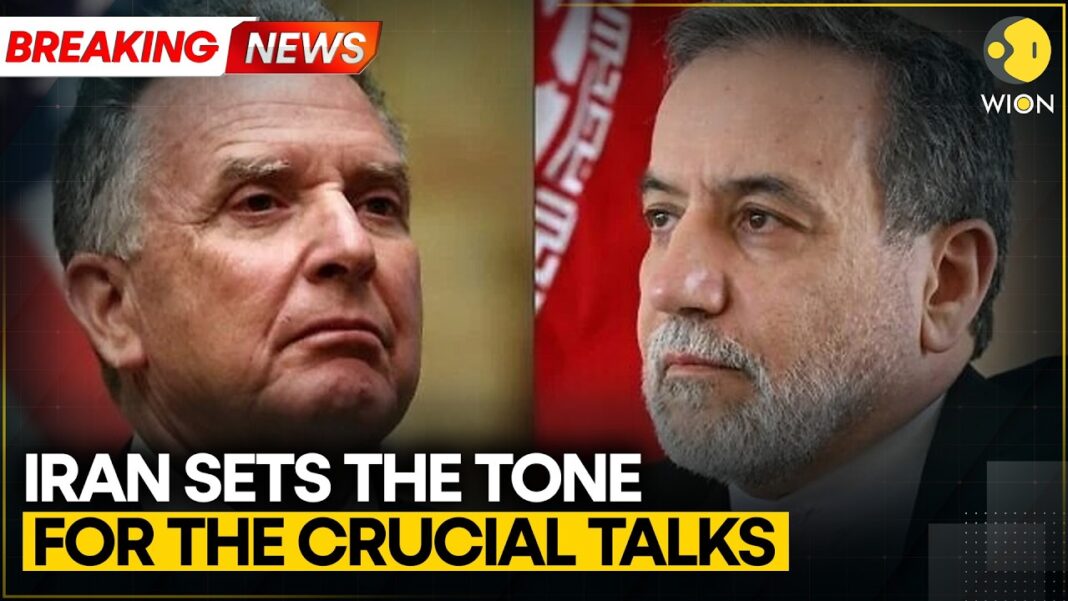
As the diplomatic spotlight returns to the Gulf of Oman, a familiar yet perilous choreography is unfolding between Tehran and Washington—one in which overtures of compromise are entwined with gestures of defiance, and where the language of negotiation is shadowed by the grammar of force. According to a report on Friday by The New York Times, Iran has signaled a conditional willingness to freeze its nuclear program for the long term in exchange for the removal of punishing international sanctions, while categorically rejecting any curtailment of its ballistic missile program, which Iranian officials continue to frame as an indispensable pillar of national defense against Israel. The juxtaposition of concession and intransigence, as portrayed by the report in The New York Times, spotlights the delicate balance now being tested in Muscat, where indirect talks have resumed amid heightened regional tension.
Iranian Foreign Minister Abbas Araghchi conveyed to his Omani counterpart that Tehran’s immediate objective is “to manage the current situation between Iran and the US and to advance negotiations,” according to statements carried by Iran’s state-linked media. The phrasing is revealing in its modesty. As The New York Times report observed, the current phase of engagement appears less about the substantive architecture of a final agreement than about stabilizing the diplomatic environment itself—preventing escalation while gauging whether a more durable negotiating framework can be constructed. This incrementalism reflects the deep scars left by previous rounds of talks, where ambitious agreements unraveled under the weight of mutual distrust and domestic political constraints on both sides.
The Iranian position, as reported by The New York Times, draws a bright red line around the ballistic missile program. Tehran has long portrayed its missile capabilities as a purely defensive measure, a deterrent necessitated by what it characterizes as existential threats from Israel and a hostile regional environment. This framing has been reiterated in Iranian media, which argue that the missile program compensates for conventional military imbalances and serves as a strategic counterweight to adversaries’ technological superiority. In this narrative, to concede on missiles would be to disarm in the face of perceived encirclement—a concession that the leadership deems politically and strategically untenable.
Yet the nuclear file tells a different story. Iran’s apparent openness to freezing its nuclear program in exchange for sanctions relief signals a recognition of the profound economic toll exacted by years of international pressure. As The New York Times has frequently documented, sanctions have constricted Iran’s access to global markets, weakened its currency, and intensified domestic economic strain. A long-term freeze, while falling short of dismantlement, would represent a significant recalibration of Tehran’s posture—one that could open pathways to economic reprieve without requiring the regime to publicly abandon what it frames as sovereign technological rights. The offer is thus both pragmatic and performative: pragmatic in its bid to alleviate economic pain, performative in its insistence on preserving symbols of strategic autonomy.
The diplomatic theater in Muscat is further complicated by the overt presence of military signaling. Iranian outlet Nournews described the talks as occurring alongside the visible presence of the commander of the U.S. Central Command, as well as equipment transfers and naval movements, portraying the moment as a fusion of negotiation and intimidation. Nournews argued that Iran would “not retreat under threat,” warning that the infusion of military posturing into the negotiating environment raises both the risks and the costs of diplomacy.
The New York Times report noted that such dual-track dynamics—talks conducted in the shadow of force—have historically produced brittle understandings, vulnerable to miscalculation and sudden rupture. The optics of simultaneous engagement and coercion risk reinforcing Tehran’s narrative that diplomacy is merely a façade for pressure, even as Washington frames deterrence as a necessary hedge against bad-faith bargaining.
Adding another layer of complexity, regional media have emphasized that the current exchanges amount to negotiations about the negotiation process itself rather than substantive bargaining over the terms of a future agreement. According to Al-Mayadeen, the parties are awaiting the opening of a subsequent phase of indirect talks, with Iran pressing for seriousness and clarity of scope. The Iranian side, it is claimed, has set a defined ceiling, limiting the agenda strictly to the nuclear issue. The New York Times report interpreted this narrowing of scope as both a tactical maneuver and a defensive reflex. By confining discussions to the nuclear dossier, Tehran seeks to prevent a cascade of demands—on missiles, regional proxies, and human rights—that could overwhelm the talks and provide domestic hardliners with ammunition to scuttle the process.
For Washington, however, the missile program and regional activities are inseparable from the nuclear question. American policymakers have long argued that any durable settlement must address the full spectrum of behaviors that they view as destabilizing. This divergence in negotiating philosophy—Tehran’s insistence on compartmentalization versus Washington’s preference for comprehensive engagement—has repeatedly bedeviled prior efforts. The current moment appears no different. Iran’s willingness to freeze its nuclear program, while meaningful, is thus embedded in a framework of constraints designed to preserve strategic leverage and domestic legitimacy.
The rhetoric emanating from Tehran also reflects an acute sensitivity to perceived coercion. Nournews’ insistence that Iran will not retreat under threat speaks to a political culture that valorizes resistance as a marker of sovereignty. The New York Times has chronicled how narratives of defiance have been central to the regime’s self-conception since the revolution, shaping both domestic legitimacy and foreign policy signaling. In this context, even pragmatic concessions must be packaged as acts of strength rather than capitulation—a communicative tightrope that complicates the already fraught task of diplomacy.
The presence of military movements alongside the talks has implications beyond optics. The New York Times report cautioned that the intermingling of negotiation and deterrence heightens the risk of misinterpretation. Naval deployments and equipment transfers, while intended to signal resolve, can be read by the other side as preludes to escalation, thereby hardening positions rather than softening them. In such an environment, the margin for error narrows. Diplomatic missteps or ambiguous signals could trigger a spiral of suspicion that derails the talks before they mature into substantive bargaining.
Within Iran, the negotiations are being framed as a test of American seriousness. Al-Mayadeen’s reporting suggests that Tehran views the current phase as a preliminary sorting of intentions: Are the talks a genuine pathway to sanctions relief, or merely a mechanism to extract concessions while maintaining pressure? The insistence on limiting the agenda to the nuclear program reflects a desire to create a manageable negotiating terrain—one in which progress can be measured and sold domestically as a tangible gain rather than a diffuse compromise across multiple fronts.
For the United States, the calculus is equally fraught. The New York Times report underscored the political sensitivities surrounding any sanctions relief, particularly in a polarized domestic climate where concessions to Iran are often portrayed as appeasement. The prospect of a long-term nuclear freeze may offer a palatable compromise—short of full normalization but sufficient to claim progress on nonproliferation. Yet the refusal to engage on missiles and regional activity leaves unresolved the very issues that animate American security concerns and those of its regional partners.
The negotiations thus unfold within a matrix of constrained possibilities. Iran offers a nuclear freeze to secure economic breathing room, while ring-fencing its missile capabilities as non-negotiable. The United States weighs the value of constraining the nuclear program against the risks of leaving other destabilizing capacities intact. The New York Times report framed this as a familiar dilemma: whether partial agreements that arrest the most acute dangers are preferable to comprehensive accords that may prove unattainable. History offers mixed lessons, with incremental deals sometimes stabilizing volatile situations, and at other times merely postponing deeper confrontations.
As the Muscat talks inch forward, the most telling indicator may be less the content of formal statements than the tone of engagement. The New York Times report emphasized that trust, once eroded, is slow to rebuild. Iran’s insistence that it will not negotiate under threat, juxtaposed with visible displays of military readiness, captures the paradox of the current moment. Diplomacy proceeds, but under conditions that continually threaten to undermine its fragile premises.
In the end, the unfolding negotiations represent a test of whether adversaries can carve out limited zones of agreement amid profound strategic rivalry. Iran’s willingness to freeze its nuclear program suggests an awareness of the unsustainable costs of isolation. Its refusal to concede on missiles reflects an equally deep-seated conviction that deterrence is the ultimate guarantor of regime survival. The United States, navigating between deterrence and engagement, faces the challenge of translating incremental progress into durable stability. The talks in Oman are less a decisive breakthrough than a precarious opening—a narrow aperture through which diplomacy might pass, if the surrounding pressures do not force it shut.
