



|
Getting your Trinity Audio player ready...
|
By: Fern Sidman
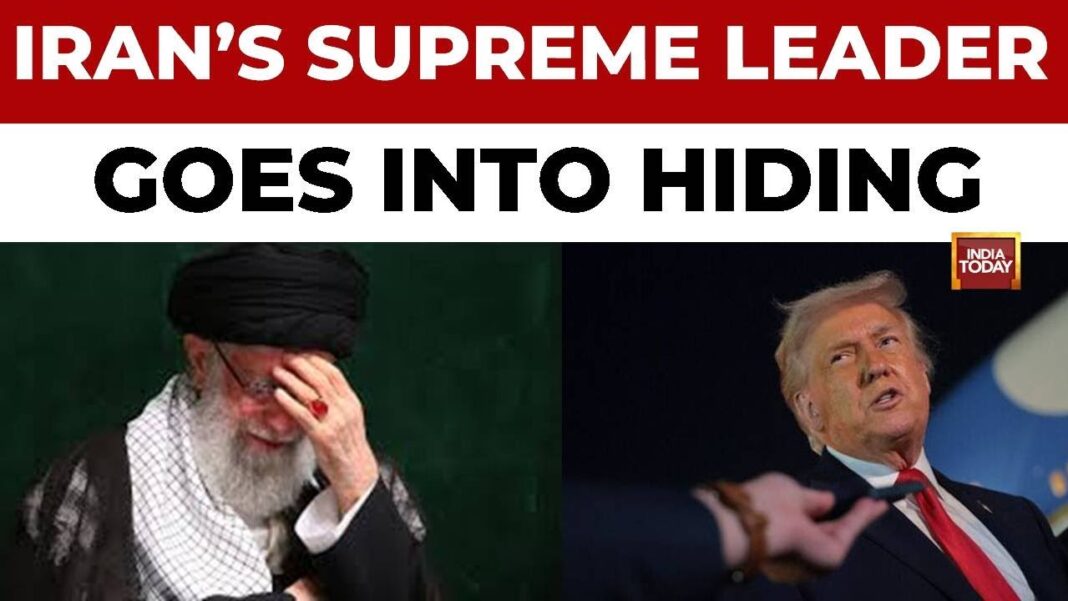
As global attention centers on a potential United States military response to the Islamic Republic of Iran, dramatic developments in Tehran underscore the gravity of the moment. According to reports first highlighted by i24News on Saturday and corroborated by other international outlets, Iran’s Supreme Leader, Ayatollah Ali Khamenei, has reportedly relocated to a fortified underground bunker in the Iranian capital — a striking symbol of escalating fears inside the clerical regime as tensions with the United States intensify.
The conditions of Khamenei’s relocation, described in intelligence and media reports as a “fortified site with interconnected tunnels,” suggest Tehran is bracing for a confrontation that has moved from diplomatic brinksmanship to palpable anxiety within the corridors of power. This move, if confirmed, reflects not only concern for the supreme leader’s personal security but also an acknowledgment of the near-historic strain in US–Iran relations.
Central to the current pressure on Iran is President Trump’s repeated public warnings and the deployment of significant US military assets toward the Middle East. “We have an armada… a massive fleet heading in that direction,” Trump told reporters in recent days, characterizing the movements of the USS Abraham Lincoln aircraft carrier strike group and accompanying destroyers as a preemptive measure in response to Tehran’s internal repression campaigns and foreign policy provocations.
This confluence of tactical military posture and political signaling has created a dramatic backdrop to one of the most volatile standoffs in recent memory between Washington and Tehran. The i24News coverage situates these developments within the broader context of a potential US strike against Iranian “key assets” over the regime’s violent crackdown on internal dissent and its nuclear ambitions, reflecting a crescendo of geopolitical tension that implicates not only the two nations but the broader Middle East and global security architecture.
The specter of an imminent US strike has its roots in Tehran’s severe repression of protesters and internal unrest that erupted late last year, partly driven by economic distress and public frustration with governance failures. Washington has publicly condemned the crackdown, and Trump’s administration has suggested that military options are within the range of responses to the regime’s actions. This background has only amplified concerns in Iranian leadership circles that the United States might broaden its military pressure beyond sanctions and diplomatic censure.
In parallel to Khamenei’s reported move underground, sources indicate a significant shift in the supreme leader’s administrative management. Reports suggest that Masoud Khamenei, his third son, has assumed day-to-day oversight of the office and is acting as a critical intermediary between the supreme leader and Iran’s executive branches and security apparatus. This development, outlined by i24News and others drawing on Iran International’s reporting, underscores a potential decentralization of operational command — albeit within the confines of a regime under siege.
The Iranian regime’s rhetoric in recent days has grown increasingly defiant and existential. Senior Iranian figures have issued warnings that any attack on Khamenei or other high-ranking leaders would be construed as a declaration of war, potentially triggering a broader regional conflagration. Iran’s parliament’s national security commission explicitly articulated this position, characterizing any strike on the supreme leader as tantamount to igniting “jihad” or a holy war — a framing intended to consolidate internal support and communicate to external audiences the high stakes involved.
Similarly, a senior Iranian official speaking anonymously to Reuters emphasized that Tehran would regard any military action as a full-scale act of war, signaling readiness to respond forcefully if provoked. This rhetoric aligns with Tehran’s long-standing strategy of deterrence, projecting strength even as it marshals its defenses and takes precautionary measures such as relocating its top leader to secure subterranean quarters.
The strategic significance of Khamenei’s underground relocation cannot be divorced from the broader military and political calculus. Iran has long invested in hardened infrastructure and subterranean facilities as part of its defense doctrine, anticipating attacks that might come from adversaries with superior conventional firepower. Videos released by state media in past months showing extensive underground missile facilities highlight this emphasis on survivability and resilience, a message both to domestic audiences and external adversaries that Iran can withstand concerted assaults.
While Tehran’s leadership may hope this posture thwarts potential strikes, it also reveals a perception of vulnerability and isolation at the highest echelons. The underground relocation — a stark image of modern power politics — reflects how deeply the imperative of self-preservation now permeates Iran’s political psyche. It also illuminates the regime’s recognition that its domestic legitimacy is intimately tied to its ability to project strength against foreign threats. This dual requirement complicates Tehran’s strategic choices, as any concession could be construed as weakness both at home and abroad.
The impending proximity of US naval assets adds urgency to these dynamics. The USS Abraham Lincoln strike group, followed by aerial defense reinforcements, suggests that Washington is prepared to respond militarily if necessary, even as Trump has publicly expressed hope that such force will be unnecessary. The ambiguity of American intentions — coupled with the transparency of its military movements — deepens the psychological pressure on Tehran’s leadership, propelling actions such as the bunker relocation.
In this context, regional and international stakeholders are watching closely. Israel, Gulf states, and NATO allies are among those evaluating potential ripple effects of a US-Iran clash. i24News reporting highlights how such a confrontation could destabilize an already volatile Middle East, drawing in proxy forces and increasing the risk of inadvertent escalation. The situation places immense diplomatic strain on countries balancing their own security interests with wider geopolitical stability.
Moreover, internal Iranian dissent continues to simmer, despite internet blackouts and state suppression tactics. The regime’s efforts to control information and maintain social order across a population weary of economic strain and political repression add another layer of complexity. The juxtaposition of internal unrest with external military threats strengthens narratives within Tehran that the regime faces enemies on multiple fronts, reinforcing its defensive posture even as it seeks to deter foreign intervention.
Ultimately, the unfolding drama in Tehran’s subterranean corridors and the surface movements of American warships illuminate a moment of profound uncertainty in international affairs. The implications of this standoff extend far beyond the immediate actors, encompassing global security architecture, alliances, and the norms governing the use of force.
As i24News reported, it becomes increasingly clear that the world stands at a crossroads where miscalculation could usher in a conflict of historic proportions — one where the instincts of deterrence and survival wield as much influence as the strategic decisions emanating from capitals thousands of miles apart.

Ayatollah Ali Khamenei in his bunker. Hitler in his bunker. His bunker did not protect Hitler. Trump should make sure that his bunker does not protect Ayatollah Ali Khamenei AND his family either.