



|
Getting your Trinity Audio player ready...
|
Rabbi Cooper Hints at Historic Shift: Syrian-Israeli Dialogue Possible Under Trump’s Mediation
By: Ariella Haviv
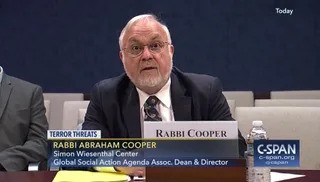
In what may signal the early contours of a seismic geopolitical realignment, Rabbi Abraham Cooper — an influential American Jewish leader and longtime interfaith envoy — told Israel National News (INN) that a direct meeting between Syrian President Ahmed al-Sharaa and Israeli Prime Minister Benjamin Netanyahu could be within reach, if spearheaded by President Donald Trump.
Rabbi Cooper, who formerly chaired the U.S. Commission on International Religious Freedom, traveled to Damascus shortly before the launch of Operation Rising Lion — Israel’s precision military campaign against Iranian nuclear and missile assets. His visit, conducted alongside evangelical leader Pastor Johnny Moore, a confidant of President Trump, reflects what INN called “a bold, backchannel diplomatic foray” aimed at thawing decades of icy hostility between Israel and Syria.
The visit came after Cooper and Moore first met Syrian Foreign Minister Asaad al-Shaibani in New York. According to the information provided in the INN report, those initial talks opened the door to the surprising Damascus meeting with al-Sharaa — Syria’s newly installed president following the sudden and still largely opaque departure of Bashar al-Assad from the political scene.
Speaking to Kan News and quoted by Israel National News, Cooper acknowledged that al-Sharaa remains an Islamist, but characterized the president’s rhetoric as strikingly pragmatic. “It’s true he’s an Islamist,” Cooper said, “but al-Sharaa speaks of a vision for his country that includes a united Syria with one army and equal rights. If he can achieve that, it would be a game-changer.”
Such measured optimism is not typically associated with Syrian-Israeli relations. The two countries have technically been in a state of war since 1948, interrupted only by occasional border skirmishes, intelligence operations, and failed diplomatic overtures. Yet Cooper insists that, under the right conditions, those hostilities could give way to cautious engagement — especially with American leadership.
“The only quick path,” Cooper told INN, “would be if someone named Donald Trump invited both leaders — Israel’s Prime Minister and Syria’s President — to Washington to sit together for a few hours. That could change everything.” Cooper’s invocation of Trump is deliberate: the president has long styled himself as a dealmaker-in-chief, having already brokered the Abraham Accords between Israel and several Arab states.
Trump’s unique position — trusted by Israel’s security establishment and respected, or at least feared, across the Middle East — could, in Cooper’s view, catalyze a diplomatic breakthrough that traditional channels have consistently failed to produce. The Israel National News report echoed this sentiment, noting that “no sitting U.S. president has been more uniquely poised to bridge irreconcilable gaps through sheer force of personality and leverage.”
Cooper’s mission to Damascus was not limited to theoretical diplomacy. According to the information contained in the INN report, he proposed immediate, practical collaboration between Israel and Syria on humanitarian matters. These included joint efforts to locate missing persons, explore water management solutions, and share agricultural technologies. These relatively uncontroversial areas, Cooper suggested, could serve as low-risk confidence-building measures.
One emotionally charged appeal, in particular, stood out: Cooper asked al-Sharaa for assistance in recovering the remains of legendary Israeli spy Eli Cohen, executed in Damascus in 1965 after infiltrating Syria’s political elite. According to INN, the rabbi thanked the Syrian leader for already transferring parts of Cohen’s personal archive to his family — a rare gesture of goodwill from a regime historically hostile to Israel.
That symbolic act, along with al-Sharaa’s stated desire to “resolve the conflict with Israel,” suggests a subtle but potentially significant pivot in Syrian policy. “We intend to continue advancing this,” Cooper told Israel National News, describing al-Sharaa’s tone as “measured, sincere, and focused on the future.” While no official policy shift has been announced, the very fact that such dialogue is occurring — and being reported on the record — marks a dramatic departure from Syria’s traditional intransigence.
The report at Israel National News contextualized this development within the broader shifts occurring across the Middle East in the wake of Iran’s weakening regional grip following Operation Rising Lion. With Tehran now reeling from Israeli and American strikes on its nuclear infrastructure, Syria may be recalibrating its strategic alliances — potentially moving out of Iran’s orbit in favor of a more nuanced, regionally integrated posture.
Israeli officials have yet to comment officially on Cooper’s visit, though political insiders cited by Israel National News believe that Prime Minister Netanyahu is aware of the overtures and monitoring the situation closely. A Netanyahu-al-Sharaa meeting, once unthinkable, is now “on the edge of plausible,” one senior security source told INN on condition of anonymity.
Whether or not such a summit materializes, Rabbi Cooper’s outreach has already reshaped the diplomatic landscape. His advocacy for unofficial ties between Israel and the Arab world — spanning previous engagements with Gulf leaders, Moroccan officials, and even outreach to Indonesia — now includes the most improbable candidate of all: Syria.
As the Israel National News report indicated, “In a region where history often repeats itself in cycles of vengeance and silence, even the faintest signal of dialogue — when amplified by credible mediators and historic opportunity — may set the stage for a different kind of future. Cooper’s visit to Damascus may be one of those signals.”
Indeed, in a Middle East perpetually on the brink, the whispers of peace may matter just as much as the declarations of war.

Another leftist antisemite anti-Israel “rabbi”.
Have TJV readers ever watched “Democracy Now!” ?
A slick “Pallywood” production by the vile Jew-hating Israel-hating scum with antisemite communist Amy Goodman.
(The entire channel can’t seem to find a non-freakish looking presenter.)