



|
Getting your Trinity Audio player ready...
|
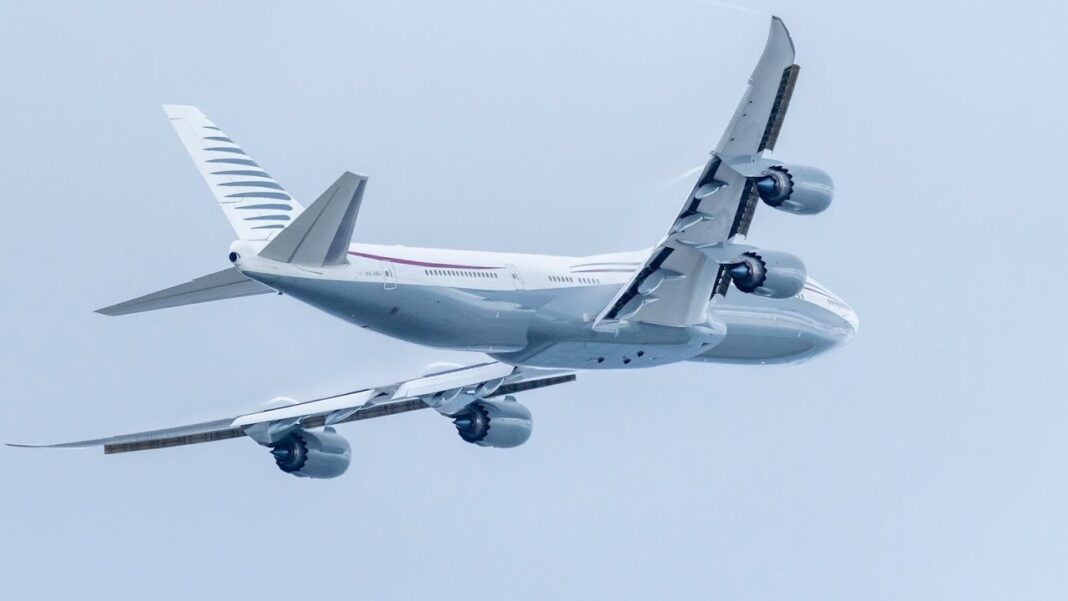
President Donald Trump is reportedly preparing to accept temporary use of a luxury Boeing 747-8 jumbo jet from the ruling family of Qatar during his upcoming trip to the Middle East, in a move that has sparked intense legal and ethical scrutiny, according to a report that appeared on Associated Press.
The aircraft, which is one of the most advanced private long-haul jets in the world, is said to be under consideration as a stopgap presidential plane, filling the gap left by the delayed delivery of two new, specially equipped Air Force One aircraft under production by Boeing. While the Qatari government has acknowledged discussions regarding the potential transfer of the jet to the U.S. government for presidential use, they deny that it constitutes a gift and emphasized that no final decision has been made.
“The possible transfer of an aircraft for temporary use as Air Force One is currently under consideration between Qatar’s Ministry of Defense and the US Department of Defense,” Qatari media attaché Ali Al-Ansari said in a statement provided to the Associated Press. “But the matter remains under review by the respective legal departments, and no decision has been made.”
According to ABC News, which first reported the story, President Trump is expected to use the Qatari aircraft as his presidential plane through the end of his second term, which concludes in January 2029. After that, ownership of the jet will reportedly transfer to the foundation overseeing his planned presidential library.
Such an arrangement has raised serious concerns about violations of the Constitution’s Emoluments Clause, which prohibits federal officeholders from accepting gifts or “emoluments” from foreign governments without explicit consent from Congress. Legal experts told the Associated Press that even if labeled a temporary loan or defense-to-defense transfer, the arrangement could still fall afoul of constitutional safeguards meant to prevent foreign influence.
“This is outrageous,” said Kathleen Clark, a professor of government ethics at Washington University School of Law, in an interview with the Associated Press. “Trump believes he will get away with this because he has built a presidency around self-enrichment and legal ambiguity. But the Emoluments Clause is clear: he cannot accept gifts from foreign governments without congressional approval.”
Clark also told the Associated Press that, “This is the logical, inevitable, unfortunate consequence of Congress and the Supreme Court refusing to enforce the Emoluments Clause. Trump is signaling, yet again, that he can blur the lines between his private interests and public office—without consequence.”
According to internal legal analysis prepared by White House attorneys and seen by ABC News, administration officials believe the jet’s use would be legal under existing defense cooperation frameworks—particularly if the aircraft is classified as a “temporary loan” for national security purposes.
Still, critics see the move as part of a larger pattern of President Trump leveraging the powers of his office to personally benefit. The Associated Press report noted that this incident joins a growing list of ethics controversies surrounding the Trump administration’s ties to foreign governments, many of which have included financial entanglements or foreign hospitality.
“Nothing says ‘America First’ like Air Force One, brought to you by Qatar,” quipped Senate Minority Leader Chuck Schumer, in a sharp rebuke to Trump’s nationalist messaging. “It’s not just bribery, it’s premium foreign influence—with extra legroom.”
While Qatar’s government has publicly denied that the aircraft is a gift, the Associated Press report noted that the symbolism of a U.S. president flying aboard a Qatari-supplied plane is not lost on observers, particularly given the regional and strategic implications. Trump’s Middle East itinerary—his first extended foreign trip of his second term—includes stops in Qatar, Saudi Arabia, and the UAE, three nations that have jockeyed for influence in Washington.
The move could be interpreted as a diplomatic favor or even a strategic signal of alignment, especially as Qatar seeks to maintain strong U.S. military and political ties amid ongoing regional tensions with Iran and its Gulf neighbors.
“This jet isn’t just a plane—it’s a statement,” said one Middle East analyst who spoke with the Associated Press. “Whether or not it’s officially called a gift, the optics of President Trump climbing aboard a Qatar-owned aircraft are unmistakable.”
The decision also comes against the backdrop of longstanding delays in Boeing’s production of the two new presidential aircraft, originally slated for delivery well before the end of Trump’s second term. Boeing has reportedly lost billions of dollars on the project, pushing delivery of the first new Air Force One to 2027 and the second to 2028, according to the information provided in the Associated Press report.
Trump’s team, frustrated by the timeline, is seeking a near-term solution—hence the interest in the Qatari Boeing 747-8, which could be quickly retrofitted with secure communications systems and other critical modifications by the U.S. Air Force. However, experts told the Associated Press that even with upgrades, the Qatari plane would lack many of the built-in, military-grade defense and resilience systems of the traditional Air Force One fleet.
White House officials are expected to discuss the potential aircraft transfer during Trump’s upcoming trip, but the legal and political ramifications are far from settled. Any final arrangement will likely require additional interagency review and could face legal challenges if critics argue it violates federal ethics laws or the Constitution.
In the meantime, the Associated Press reports that the Trump administration is moving forward with plans to inspect and outfit the Qatari jet, while quietly working to preempt criticism and media scrutiny. Whether or not Congress will intervene—or whether Qatar will officially retract the offer—remains to be seen.
The Qatari jet, originally built for VIP transport, lacks many of the robust survivability features that make Air Force One a unique airborne command center. As the Associated Press reported, the existing Air Force One aircraft—two heavily modified Boeing VC-25As—are equipped with radiation shielding, antimissile technology, and a classified array of secure communication systems that allow the president to direct military operations from anywhere in the world, even under nuclear threat.
A former U.S. official, speaking to the Associated Press on condition of anonymity, acknowledged that some countermeasures and communication upgrades could be added quickly to the Qatari aircraft. However, the jet would remain less capable than the current VC-25As—or the long-delayed VC-25B replacements under construction by Boeing. Crucially, neither the Qatari aircraft nor the new VC-25Bs will include air-to-air refueling capabilities, a major feature of the current fleet.
The aircraft in question is believed to be similar to a 13-year-old Boeing 747-8 that Trump personally toured in February while it was parked at Palm Beach International Airport, not far from his Mar-a-Lago estate, as per the Associated Press report. That tour, captured in photos and shared widely online, now appears to have foreshadowed Trump’s intention to use the jet as his presidential aircraft.
Complicating matters further is the Trump family’s rapidly growing business footprint in the Middle East, particularly in Qatar. According to a Democast.tv report, the Trump Organization announced a $5.5 billion real estate development deal in Qatar just days before the planned aircraft transfer was reported. The project, a Trump-branded golf resort in Simaisma, includes 3,600 villas, 3,000 apartments, a 400-room hotel, and a waterfront promenade. The development is a partnership with Qatari Diar, the real estate arm of Qatar’s government, and Saudi-backed Dar Global.
The ethical red flags are hard to miss. Eric Trump, now a top executive in the Trump Organization, praised the project publicly, while Steve Witkoff, Trump’s Middle East envoy, has personal financial ties to Qatar dating back to a $623 million hotel sale in 2016, as previously reported by Israel Hayom.
Critics argue this web of personal business interests, official diplomatic roles, and foreign policy decisions creates an unacceptable conflict of interest—especially as Qatar plays a central role in mediating with Hamas amid the ongoing Israel-Gaza conflict.
“Trump profits from Qatar while Israel fights,” read a pointed post from @TimesofIsrael on X, echoing growing concern within both foreign policy circles and pro-Israel advocacy groups.
The America First Policy Institute, in an April 28 memo, warned that the arrangement may misalign U.S. priorities, favoring Gulf investment and optics over Israel’s security interests.
White House officials, when pressed by the Associated Press, insist that President Trump’s actions are above board. They cite a voluntary ethics agreement released by the Trump Organization in January 2025, which bars direct deals with foreign governments. However, that same agreement allows deals with private companies overseas—a major departure from the stricter agreement signed during Trump’s first term, which banned all foreign dealings.
Critics say the current policy is toothless, especially in countries like Qatar, where the line between public and private enterprise is blurred, and state-affiliated entities dominate business.
“It’s absurd to say that you’re avoiding conflicts by refusing to work with governments, but then turning around and cutting deals with state-owned enterprises,” one ethics watchdog told the Associated Press. “In autocracies, that’s the same thing.”
White House Press Secretary Karoline Leavitt, speaking on Friday, dismissed concerns about Trump’s trip, telling reporters it was “ridiculous” to suggest the president was acting for personal benefit. However, the Associated Press reported that partisan criticism continues to mount—not just over potential foreign entanglements, but the national security implications of relying on a non-military aircraft for presidential transport.
Some security analysts warn that using a less secure aircraft—even with retrofitted countermeasures—could expose the U.S. president to unacceptable risks during a time of heightened global tension, especially with conflict brewing in the Middle East and rival powers like China and Russia watching closely.
The Trump administration insists that the Qatari plane is not a gift and that all proper legal channels are being followed. But as the Associated Press reported, the optics and underlying dynamics of this arrangement raise serious constitutional, ethical, and strategic questions.
When the commander-in-chief boards a foreign government’s aircraft, while his family signs billion-dollar deals with that same government, it’s not just bad optics—it’s a challenge to the foundational principles of transparency, accountability, and the separation of public power from private gain.
As Trump prepares to depart for the Middle East, the aircraft on the tarmac may be painted red, white, and blue—but the shadow of foreign influence, legal ambiguity, and business entanglements looms large over the fuselage.
The American people, and Congress, must decide: Is this the future of presidential power—or its privatization?