



By: Tzirel Rosenblatt
Violent unrest broke out in the heart of Amsterdam on Sunday night as pro-Hamas Arab activists mounted aggressive demonstrations against performances by IDF Chief Cantor Shai Abramson, turning what was intended to be a cultural and musical event into a flashpoint of political rage and intimidation. According to a report on Sunday at Israel National News, the disturbances drew attention to a growing concern among Jewish communities across Europe that cultural expression linked to Israel—no matter how apolitical in nature—is increasingly being targeted as a proxy for broader ideological hostility.
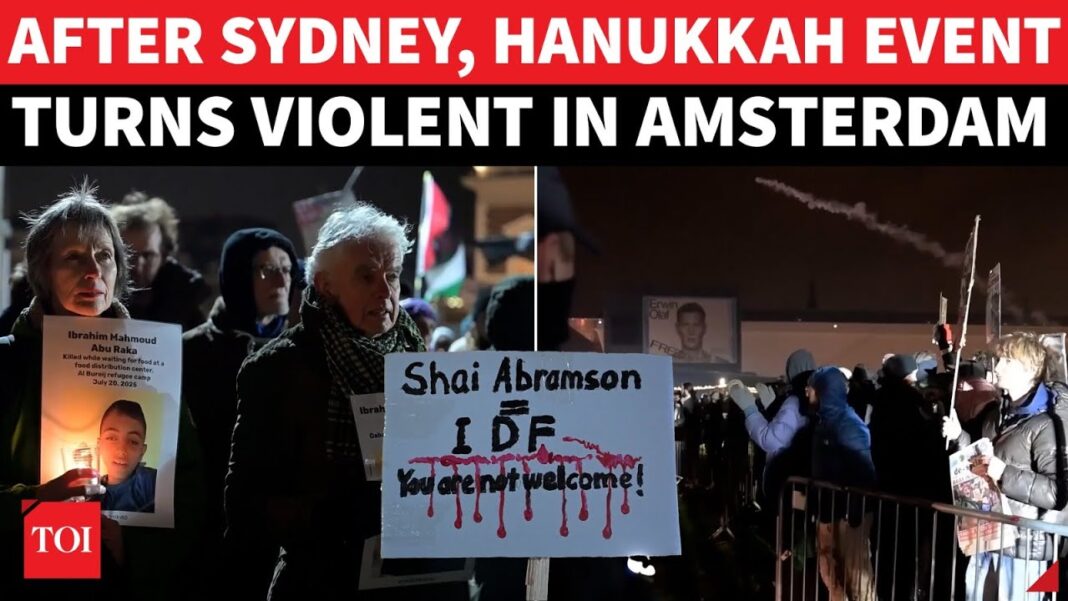
The demonstrations were centered around two high-profile locations in the Dutch capital. One protest took place outside the iconic Concertgebouw concert hall, where Abramson was scheduled to perform. Dutch police authorized a limited demonstration of up to 30 participants at the venue, ostensibly to ensure public order. Simultaneously, a far larger protest unfolded nearby at Museumplein, also sanctioned by authorities, where hundreds of demonstrators gathered under banners and placards denouncing Israel in incendiary language, Israel National News reported.
The protests followed the cancellation of one of Abramson’s concerts earlier amid mounting pressure from activist groups objecting to his affiliation with the Israel Defense Forces. Abramson’s role as Chief Cantor of the IDF—a position rooted in religious and ceremonial tradition rather than military command—became the focal point for opposition. As the Israel National News report emphasized, the controversy was not about music or artistic content, but about the singer’s identity and symbolic association with the Jewish state.
Dutch media outlets cited by Israel National News reported that demonstrators at Museumplein waved anti-Israel signs bearing slogans such as “child killers,” while a prominent banner accused the Concertgebouw itself of complicity, declaring: “Shame on Concertgebouw, you have blood on your hands.” The rhetoric, critics argued, crossed the boundary from political protest into collective vilification, implicating both a cultural institution and a Jewish performer in alleged crimes without evidence or legal standing.
As the concert proceeded inside the Concertgebouw under heightened security, tensions escalated outside. A group of protesters reportedly hurled smoke grenades and forcibly breached police barricades, triggering clashes with law enforcement and prompting an emergency response. The Israel National News report noted that this marked a sharp escalation from authorized protest to outright disorder, raising questions about the adequacy of policing measures and the willingness of authorities to enforce the limits of lawful demonstration.
The violence drew swift condemnation from Jewish communal leaders in the Netherlands. Hanan Hertzberger, chairman of the umbrella organization of Dutch Jewry, described the events as a calculated provocation aimed squarely at the Jewish community. Speaking to media outlets cited by Israel National News, Hertzberger rejected claims that the protests were a legitimate expression of concern over policy, arguing instead that they constituted harassment of Jews under the guise of political activism.
“Abramson sings songs; he is not accused of crimes against humanity,” Hertzberger said. “This is simply harassment of Jews.” His remarks, highlighted prominently by Israel National News, captured a sentiment increasingly voiced across Europe: that the line between criticism of Israel and hostility toward Jews is being deliberately blurred, with cultural figures becoming convenient targets.
Indeed, Abramson’s performances were not political rallies but musical events, intended to showcase liturgical and traditional repertoire. Yet as Israel National News has repeatedly documented in recent months, Jewish artists, academics, and institutions with even tangential links to Israel are facing mounting pressure, cancellations, and protests, often accompanied by language that demonizes rather than debates.
The Amsterdam unrest also revived scrutiny of Europe’s broader struggle to balance freedom of expression with the protection of minority communities. While Dutch authorities emphasized that both protests had initially received police approval, critics questioned whether permitting large demonstrations so close to Jewish cultural events was prudent given the predictable risk of escalation. The Israel National News report noted that similar scenarios have unfolded in other European capitals, where authorized protests quickly devolved into intimidation or violence.
For many observers, the symbolism of the location was particularly troubling. Museumplein, a public square associated with art, culture, and remembrance—including proximity to institutions commemorating the Holocaust—became the stage for slogans that Jewish leaders say echo historic patterns of collective blame. As the Israel National News report observed, the optics of accusing a concert hall of having “blood on its hands” for hosting a Jewish cantor resonated deeply and painfully within the Dutch Jewish community.
The incident also highlighted the increasingly precarious position of Jewish life in Europe. While the Netherlands has long prided itself on tolerance and pluralism, Jewish leaders warned that the normalization of such protests risks eroding that legacy. They argued that when chants and banners equate Jewish performers with violence, it sends a chilling message to Jews about their place in public life.
Dutch police have not yet released a full accounting of arrests or injuries resulting from the disturbances, but officials confirmed that investigations are ongoing. Israel National News reported that authorities are reviewing footage of the smoke grenades and barricade breaches to determine whether criminal charges will be filed against participants who exceeded the bounds of lawful protest.
For Abramson, the controversy surrounding his concerts has cast an unexpected shadow over what was meant to be a celebration of music and spirituality. Supporters argue that his targeting reflects a broader phenomenon in which Israeli identity—religious, cultural, or artistic—is increasingly treated as inherently political and therefore fair game for confrontation.
As Israel National News reported, the events in Amsterdam are not an isolated episode but part of a wider pattern unfolding across Europe, where tensions surrounding the Middle East are playing out on local streets with alarming intensity. Jewish leaders are urging governments to draw clearer distinctions between legitimate political discourse and actions that intimidate or endanger minority communities.
Whether the violence in Amsterdam will prompt a reassessment of protest policies or security protocols remains to be seen. What is clear, according to Israel National News, is that the clash surrounding Shai Abramson’s performances has become emblematic of a deeper struggle—one over whether Jewish cultural expression can still find safe and unchallenged space in Europe’s public square.