



|
Getting your Trinity Audio player ready...
|
By: Fern Sidman- Jewish Voice News
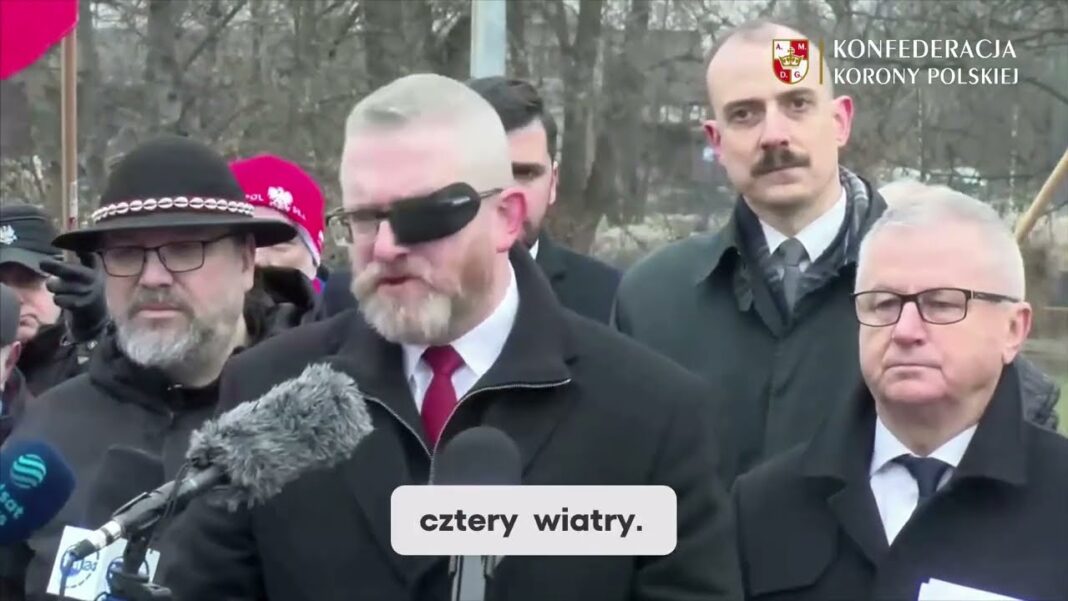
Poland was thrust into an unexpected and deeply unsettling controversy this weekend after Grzegorz Braun—a far-right MP and leading figure in the fringe Confederation of the Polish Crown party—delivered a barrage of inflammatory, openly antisemitic remarks outside the Auschwitz-Birkenau memorial site. As VIN News reported on Monday, Braun’s comments have triggered a wave of national and international condemnation, exposing dangerous undercurrents of extremism that continue to challenge Poland’s attempts to strengthen Jewish life and confront its historical responsibilities.
Braun, who spoke on Saturday near the grounds of the former Nazi death camp, accused Jews of demanding “special treatment” in modern Poland and alleged that the police and state authorities “cater to them” at the expense of ethnic Poles. His rhetoric, delivered with conspicuous defiance, coincided with the Polish government’s rollout of a historic 2025-2030 program to combat antisemitism, revitalize Jewish communal institutions, and educate citizens about the Holocaust. The report at VIN News noted that government officials view the initiative as an essential step in reaffirming democratic values at a time when extremist narratives threaten to regain traction across parts of Europe.
But Braun’s tirade was more than a critique of policy. It was a sweeping denunciation of Jewish presence in Poland altogether. Declaring “Poland is for Poles,” he insisted that Jews and other minorities “have their own countries,” implying that their continued presence poses a threat to the nation’s cultural fabric. In one of the moments that most outraged observers, Braun mocked efforts to support Jewish cultural revival—comparing it, as the VIN News report recounted, to “inviting a dangerous neighbor to move in next door.” This analogy, steeped in centuries-old tropes, was immediately recognized by historians, activists, and diplomats as a revival of rhetoric that once fueled violence and exclusion.
His provocations did not end there. Braun vowed that if his party ever gained political power, it would dismantle the International Auschwitz Council—a body tasked with safeguarding the memory and educational mission of the Auschwitz-Birkenau memorial. He pledged to cut its funding and legal authority, effectively gutting the institution that preserves one of the most important Holocaust sites in the world. According to the information provided in the VIN News report, Braun justified his position by asserting that the grounds of the former extermination camp have become “effectively an extraterritorial zone,” suggesting that the sites no longer belong to Poland and therefore should not be a national priority. Critics said the claim echoes extremist conspiracy narratives that seek to delegitimize Holocaust remembrance efforts.
The political and moral backlash was immediate. Justice Minister and Prosecutor General Waldemar Zurek publicly announced he would pursue legal action against the MP, declaring in a statement reported by VIN News that “antisemitic rhetoric has no place in Poland and undermines our nation’s dignity.” Zurek accused Braun of exploiting Auschwitz—the most notorious symbol of the horrors perpetrated on Polish soil during World War II—for political theater. “Turning this sacred site of memory into a political playground is an act of reckless provocation,” Zurek said, warning that Braun’s behavior harmed not only Poland’s Jewish citizens but also the country’s international standing.
Braun is no stranger to incendiary conduct. As the VIN News report indicated, he gained international attention in 2021 when he attempted to extinguish a Hanukkah menorah displayed in the Polish parliament—a shocking moment captured on video and widely condemned by Jewish organizations around the world. His political record includes opposing restitution for Holocaust survivors and making remarks that appeared to minimize Nazi crimes, statements barred under Polish law. In recent years, opponents in parliament have tried—unsuccessfully—to strip him of parliamentary immunity so he could face criminal charges. With Saturday’s outburst, many expect new attempts to remove his protections.
Despite his extremist posture and rhetorical brutality, Braun has acquired a surprisingly large following. The VIN News report noted that he finished fourth in this year’s presidential race, a performance that shocked mainstream parties and illustrated the growing appeal of hard-right populism in certain segments of Polish society. His party, though still considered fringe, has leveraged economic discontent, cultural anxieties, and anti-EU sentiment to gain visibility.
Political analysts say Braun’s remarks must be viewed not as isolated provocations but as part of a broader ideological project bent on rewriting or distorting Poland’s role in the Holocaust. While most Poles recognize the immense suffering their country endured under Nazi occupation, some nationalist factions have attempted to sanitize uncomfortable chapters of history—particularly the documented instances of collaboration, pogroms, or societal hostility toward Jews. Braun’s reference to Auschwitz as an “extraterritorial zone” plays into that revisionist narrative, implying that Holocaust remembrance is somehow imposed by outside forces rather than rooted in Poland’s own history.
Jewish organizations, both domestic and international, reacted with alarm. The Auschwitz Memorial itself issued a statement urging Polish authorities to stop the politicization of historical sites. Several Jewish leaders told VIN News that Braun’s comments struck a painful chord, especially given Poland’s delicate efforts to rebuild Jewish communal life after the near-annihilation of Polish Jewry during the Holocaust. Many expressed concern that such rhetoric, if left unchecked, could embolden extremists and intimidate Jewish residents.
The timing of Braun’s tirade is particularly sensitive. The Polish government recently unveiled a sweeping national plan aimed at combating antisemitism, promoting Holocaust education, restoring neglected Jewish heritage sites, and supporting Jewish cultural institutions. The initiative, which VIN News reported is scheduled to launch in 2025, represents an ambitious acknowledgment of the state’s responsibility to foster tolerance and commemorate its Jewish past. For officials spearheading the effort, Braun’s comments directly undermine these goals and risk sending a message to the international community that Poland is divided over fundamental questions of historical truth and democratic values.
But perhaps most disturbing is Braun’s deliberate choice of location. Auschwitz-Birkenau is not merely a historical landmark; it is the site where over 1.1 million people—predominantly Jews—were systematically murdered. It is a place of mourning, education, and solemn remembrance. To use its gates as a stage for nationalist slogans and xenophobic attacks is, as commentators told VIN News, profoundly disrespectful to the victims, their descendants, and the global community.
Legal scholars say Braun’s comments could potentially violate Polish laws prohibiting hate speech and the denial or trivialization of Nazi crimes. Judicial authorities are now examining whether his remarks meet the threshold for prosecution. If they determine they do, it would mark one of the most significant legal actions taken against a sitting MP in recent years. The Justice Ministry has signaled that it will not allow parliamentary immunity to shield what it views as incitement and bigotry.
In the broader European context, Braun’s tirade reflects a troubling resurgence of ethno-nationalist rhetoric across the continent. Similar narratives have gained visibility in Hungary, Slovakia, Germany, and elsewhere, often accompanied by antisemitic undertones or explicit hostility toward minority groups. As the VIN News report stressed, Poland’s mainstream leaders overwhelmingly reject such ideology, but its persistence calls attention to the need for vigilance.
For Jewish communities in Poland—small but slowly rebuilding after generations of trauma—the episode is a painful reminder of lingering prejudice. Many Jewish leaders emphasized to VIN News that while antisemitism is not mainstream in Polish society, extremist voices like Braun’s create an atmosphere of fear and uncertainty. They urge the Polish government to respond not only with legal mechanisms but with strong, unequivocal moral condemnation.
Ultimately, Braun’s outburst poses a profound challenge for Poland: how to reconcile its efforts to promote tolerance and historical truth with the existence of political actors willing to exploit the darkest chapters of its history for personal gain. As VIN News reported, the nation stands at a crossroads—determining whether voices of hate will be confronted decisively, or allowed to muddy the moral and historical clarity that Auschwitz has come to symbolize.
In the days ahead, all eyes will be on Warsaw to see whether the rhetoric heard outside Auschwitz will be met with the seriousness it demands. For many, including the survivors and descendants whose memories are bound to that place, the answer will signal whether Poland’s commitment to remembrance is genuine—or vulnerable to the pressures of extremism.