



|
Getting your Trinity Audio player ready...
|
By: Justin Winograd
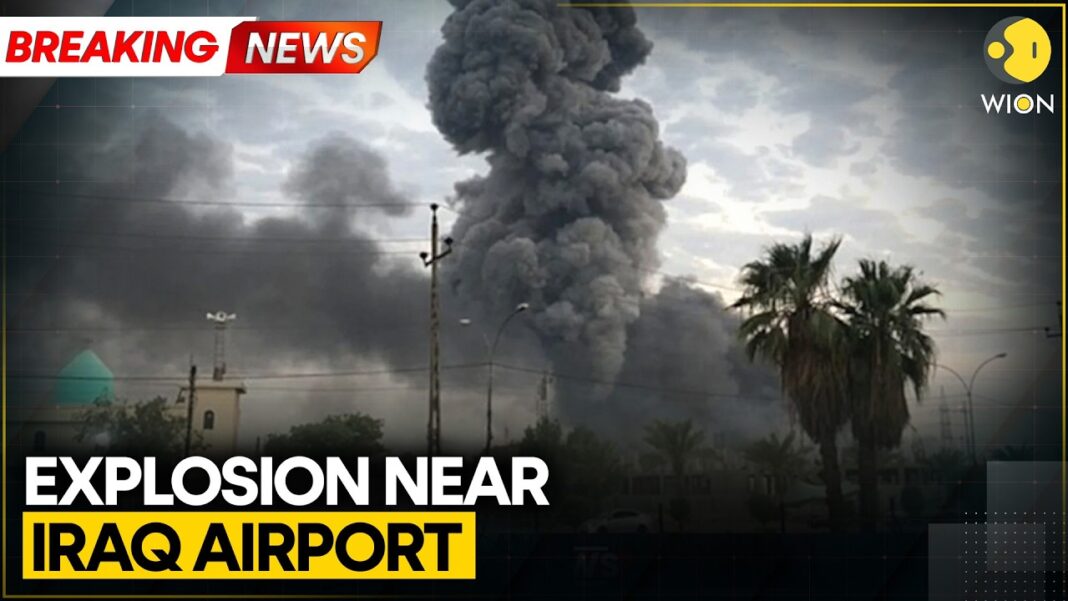
Thick plumes of black smoke billowed above Erbil International Airport on Sunday, casting an ominous pall over the capital of Iraq’s Kurdistan region amid reports of Iranian drone and ballistic missile attacks. According to a report on Sunday at Iraqi News, initial accounts from the scene indicated that at least one drone and one ballistic missile struck near the airport complex, an area known to host U.S. personnel and to serve as a strategic hub during periods of regional instability.
The reported strike unfolded against the backdrop of escalating hostilities between Iran on one side and the United States and Israel on the other. The Iraqi News report noted that the purported attack on Erbil coincided with Iranian strikes targeting U.S. bases and other facilities in Iraq, suggesting a deliberate widening of the confrontation into Iraqi territory. The airport, which has previously been a focal point during times of regional conflict, once again appears to have become a symbolic and strategic target.
Witnesses described seeing dense columns of smoke rising from the vicinity of the airport, a facility that functions not only as a civilian gateway to northern Iraq but also as a logistical node with military significance. Iraqi News reported that early information pointed to impacts occurring near the airport perimeter rather than directly within passenger terminals, though the absence of immediate official confirmation left critical details uncertain.
Erbil International Airport has long occupied a sensitive position within Iraq’s geopolitical landscape. The autonomous Kurdistan region has cultivated close ties with Western governments, and the airport complex houses foreign personnel, including American forces involved in advisory and security missions. The Iraqi News report emphasized that during previous rounds of regional tension, the area had been targeted by rockets and drones attributed to Iranian-backed militias or Iranian forces themselves.
The current episode appears to mark a continuation, if not an intensification, of that pattern. Iraqi News cited reports suggesting that Iranian forces have expanded their retaliatory campaign to include multiple locations across Iraq in response to recent U.S. and Israeli military actions against Iranian targets. The strike near Erbil underscores the extent to which Iraq remains an arena for proxy and direct confrontations among regional and global powers.
As of Sunday afternoon, Iraqi authorities had not issued comprehensive statements detailing casualties or the extent of structural damage. Officials were still assessing the aftermath and that the situation remained fluid. Emergency services were reportedly deployed to the area, though access restrictions and security protocols limited independent verification.
The uncertainty surrounding casualties reflects the complexity of the security environment. In past incidents involving Erbil, initial reports have often been followed by revised assessments as authorities gain access to impact sites and review surveillance data. The Iraqi News report stressed that the absence of immediate confirmation should not be interpreted as evidence of minimal damage, but rather as a reflection of ongoing investigative procedures.
The strike’s broader implications are significant. Iraq, already grappling with internal political divisions and economic challenges, finds itself again at the crossroads of external rivalries. Iraqi News has consistently highlighted the delicate balance Baghdad must maintain between its relationships with Tehran and Washington. The targeting of a site associated with U.S. personnel places additional strain on that equilibrium.
For the Kurdistan Regional Government, the incident presents both security and political challenges. Erbil has sought to position itself as a relatively stable enclave within Iraq, attracting investment and maintaining international engagement. Previous attacks on the airport have disrupted flights and heightened anxiety among residents and expatriates alike. Whether Sunday’s reported strike will lead to temporary closures or travel advisories remains to be seen.
Strategically, the use of drones and ballistic missiles reflects evolving military tactics. The Iraqi News report observed that Iranian capabilities in unmanned aerial systems and missile technology have expanded in recent years, enabling strikes at varying ranges with differing payloads. The combination of drone and missile deployment suggests an intent to maximize both psychological impact and operational reach.
The regional context further amplifies concerns. Iranian strikes on U.S. facilities in Iraq risk drawing the country deeper into a broader confrontation. Previous escalations have led to retaliatory measures, including targeted operations against militia infrastructure and diplomatic engagements aimed at de-escalation. The current trajectory, however, appears fraught with heightened volatility.
International observers are closely monitoring developments. The presence of U.S. personnel at or near Erbil International Airport elevates the stakes, potentially prompting diplomatic protests or defensive responses. In past episodes, statements from Washington have followed swiftly once casualty assessments were completed.
For residents of Erbil, the immediate concern centers on safety and stability. The sight of smoke rising from a major infrastructure site evokes memories of earlier conflicts and the fragility of security gains. Iraqi News reported that local authorities were urging calm while reinforcing security measures around key installations.
The fluid nature of the situation complicates definitive analysis. With no rapid official confirmation regarding the precise targets or the scope of damage, much remains speculative. Further information is likely to emerge as investigators examine debris and review surveillance footage.
In the broader geopolitical tableau, the reported strike on Erbil International Airport serves as a stark reminder of Iraq’s vulnerability to external rivalries. As tensions between Iran and its adversaries escalate, Iraqi territory once again becomes a stage for confrontation.
The coming hours will be critical in determining whether Sunday’s events represent an isolated incident or the opening of a more sustained campaign affecting Iraqi soil.
For now, the image of thick black smoke over Erbil stands as a potent symbol of a region once again teetering on the edge of deeper conflict, with Iraq caught in the crosscurrents of forces far beyond its borders.
