



|
Getting your Trinity Audio player ready...
|
Paris Police Arrest Four After Anti-Israel Mob Turns Philharmonic Stage Into Political Battlefield
By: Fern Sidman – Jewish Voice News
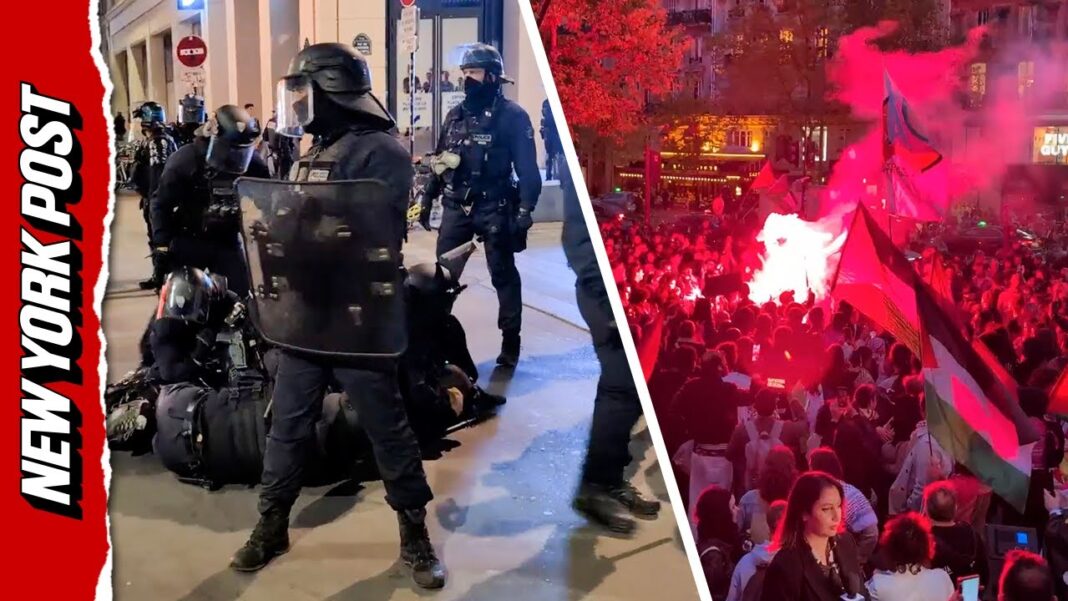
The Paris Philharmonic, one of France’s most venerated cultural institutions, became the scene of chaos and political agitation Thursday night when pro-Palestinian activists violently disrupted a concert by the Israel Philharmonic Orchestra. The incident, which unfolded inside the Philharmonie de Paris complex in the 19th arrondissement, was described by witnesses as both alarming and deeply symbolic of the surge in antisemitic activism targeting Jewish and Israeli cultural expressions across Europe.
As The Jewish News Syndicate (JNS) reported on Saturday, French police moved swiftly to arrest four suspects—three women and one man—on charges including violence, property destruction, and organizing an unauthorized protest. Authorities confirmed that the suspects remain in custody pending formal charges. The disturbance, though brief, underscored a rising pattern of anti-Israel demonstrations invading spaces of art, academia, and culture throughout Western Europe since the onset of the Gaza conflict last year.
According to detailed accounts gathered by JNS, the disruptions began shortly after 8:40 p.m., when the orchestra, under the baton of Lahav Shani, Israel’s 36-year-old prodigious music director, had just begun its rendition of Ludwig van Beethoven’s Piano Concerto No. 5, the beloved “Emperor Concerto.”
A woman suddenly stood up mid-performance and shouted, “Israel murders!” before throwing dozens of yellow leaflets into the audience. The pamphlets bore incendiary slogans such as “Israel, you play the symphony of your genocidal army,” echoing the language of the Boycott, Divestment, and Sanctions (BDS) campaign that has sought to isolate Israel in the cultural sphere.
Security staff quickly escorted the protester from the hall, and the orchestra resumed. Yet within minutes, a second interruption erupted—a man ignited a red flare on a balcony, sending sparks and smoke across the tiered auditorium. As the fire threatened to spread, ushers rushed to contain the incident, with one visibly in tears, witnesses told JNS.
“There were screams, and people were terrified. It could have been catastrophic,” one concertgoer, who attended the performance with her teenage son, said in comments relayed to JNS. “We came for music and were instead thrown into a scene of chaos and aggression.”
Despite three separate disruptions, the orchestra continued the performance, earning a standing ovation at the finale for their resilience.
French Interior Minister Laurent Nuñez denounced the attack in a statement posted on X (formerly Twitter), writing: “I strongly condemn the actions committed last night during a concert at the Philharmonie de Paris. Nothing can justify them. I thank the Paris police for the rapid arrest of several perpetrators and for containing the demonstrators outside.”
Nuñez’s remarks, as noted in the JNS report, reflect the French government’s growing unease over the intensification of antisemitic incidents in the cultural domain. The Philharmonie de Paris itself issued a formal complaint to police, condemning what it called “serious and deliberate acts of provocation that endangered public safety and violated artistic freedom.”
France 24, also cited in the JNS report, confirmed that the Philharmonie filed charges for “endangering lives” and “unauthorized intrusion,” while security forces bolstered patrols around Jewish cultural venues in Paris in response to the attack.
The French branch of the Boycott, Divestment and Sanctions (BDS) movement, alongside several other radical anti-Israel groups, had in recent weeks called for the concert’s cancellation, arguing that the Israeli Philharmonic’s performance represented “cultural propaganda for a genocidal state.”
As the JNS report observed, these efforts form part of a wider European campaign to impose a “cultural boycott” of Israel, targeting artists, scholars, and performers perceived as symbols of the Jewish state. From university lecture halls to theater stages, the same rhetoric—branding Israeli institutions as complicit in “apartheid” or “colonialism”—has become a leitmotif of the radical Left’s cultural warfare.
In September, for instance, organizers of a classical music festival in Belgium canceled a performance by the Munich Philharmonic, led by the very same conductor, Lahav Shani. Their justification? His “unclear position vis-à-vis the genocidal regime in Tel Aviv.” The decision drew scathing criticism from European Jewish organizations, which called it “a grotesque act of cultural censorship.”
The attack at the Philharmonie is the latest in a disturbing series of anti-Israel provocations targeting Jewish and Israeli artists since the outbreak of the October 7, 2023 Hamas massacre, which left 1,200 Israelis dead and triggered a prolonged conflict in Gaza. As JNS has documented extensively, these incidents mark the spread of a new antisemitic vocabulary—one disguised as “political activism.”
Concerts, art exhibits, and film screenings with even a tangential connection to Israel have been disrupted or canceled under pressure from activists. In one case, a student film festival in Berlin withdrew a documentary about Holocaust survivors because its director refused to sign an anti-Israel pledge demanded by organizers. In another, Jewish musicians in London were heckled with chants of “Free Palestine” mid-performance.
As JNS noted in an editorial earlier this month, these acts reveal a chilling pattern: “When orchestras are silenced, museums are censored, and Jewish artists are shouted down, the language of cultural engagement gives way to intimidation—a modern echo of the book burnings of old.”
France, home to Europe’s largest Jewish community, has witnessed an alarming resurgence of antisemitic incidents since the Gaza conflict began. According to data cited in the JNS report, the French Interior Ministry recorded a 300 percent increase in antisemitic offenses in 2024 alone. From synagogue vandalism to verbal assaults on Jewish students, the atmosphere of hostility has seeped into all facets of public life.
The Philharmonie incident, as observers told JNS, encapsulates the growing tension between France’s historic commitment to artistic freedom and the radicalized rhetoric of anti-Israel activism. “It is no longer about protesting policies,” one Parisian cultural critic said. “It is about erasing Jewish presence—whether on the concert stage or in public life.”
That erasure, experts warn, represents a moral and civilizational crisis for Europe. The conflation of Israel with evil—combined with the normalization of anti-Zionist slogans that veer into antisemitic incitement—has made cultural spaces battlegrounds in an ideological war.
Through it all, the Israel Philharmonic Orchestra, founded in 1936 by Polish violinist Bronisław Huberman to provide a haven for Jewish musicians fleeing Nazi Europe, remains an enduring emblem of resilience. Its performance in Paris—interrupted, attacked, and yet ultimately triumphant—was a powerful reminder of that legacy.
The audience’s final ovation, described in the JNS report as “prolonged and deeply emotional,” carried a symbolic weight beyond music: a statement of solidarity with Israel, and a rebuke to those who would turn art into a weapon of hate.
In a post-concert message shared by JNS, a Philharmonic spokesperson expressed gratitude to French authorities and concertgoers alike: “We came to share beauty and humanity through music. We will not be intimidated by those who seek to silence either.”
As Europe confronts its mounting cultural and political divisions, Thursday night’s events in Paris serve as a microcosm of a broader moral test: whether societies that once vowed “Never Again” will allow the resurgence of bigotry cloaked in the rhetoric of liberation.
The JNS report observed, “When the chords of Beethoven must compete with the chants of hate, the question is no longer merely about Israel. It is about whether civilization itself still knows how to listen.”
The Philharmonie’s flames were swiftly extinguished. The ideological fire behind them, however, continues to burn unche
Punishment should be far greater than it probably will be. It’s a tribute to the concert goers that they didn’t stampede.