



|
Getting your Trinity Audio player ready...
|
Pakistan’s Defense Chief Slams Israel as “Evil” and a “Cancer”
By: Fern Sidman
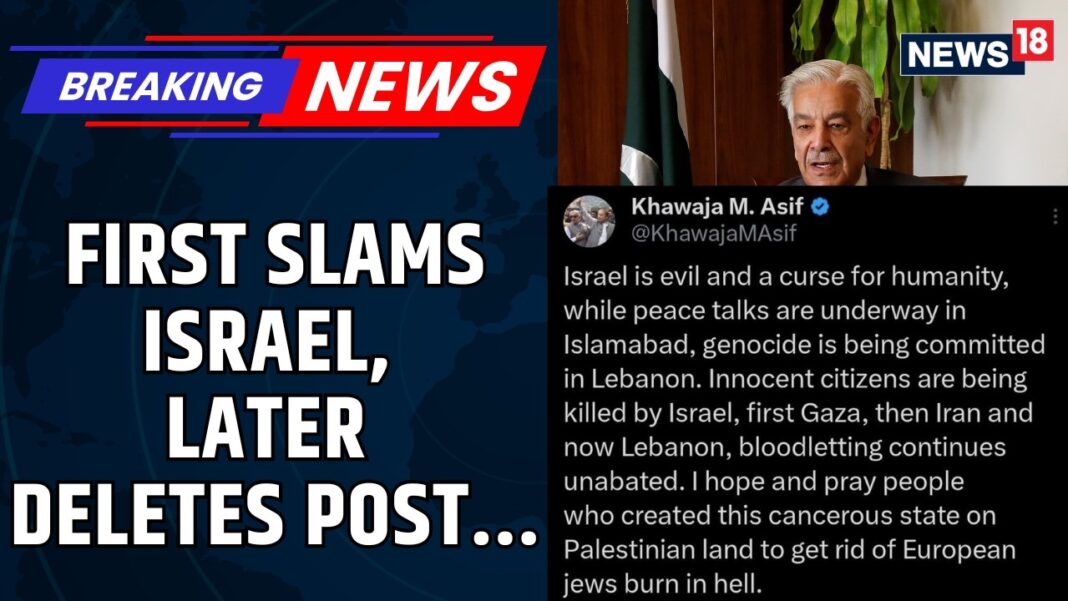
In a moment that has cast a shadow over already delicate diplomatic efforts in the Middle East, Pakistan’s Defense Minister Khawaja Asif ignited a firestorm of controversy with a series of inflammatory remarks targeting Israel, prompting swift and forceful condemnation from senior Israeli officials. The episode, unfolding against the backdrop of ongoing ceasefire discussions and heightened regional tensions, underscores the precarious intersection of rhetoric and diplomacy in one of the world’s most volatile geopolitical arenas.
According to a report on Thursday by Israel National News, Asif issued a sharply worded statement on social media in which he denounced Israel in sweeping and provocative terms, even as Pakistan positioned itself as a mediator in negotiations involving the United States and Iran. His comments came at a time when diplomatic channels remain strained and military activity continues across multiple fronts, including Israel’s ongoing operations against Hezbollah in Lebanon.
The Pakistani defense minister’s remarks were notable not only for their severity but also for their timing. As ceasefire discussions were reportedly being facilitated in Islamabad, Asif publicly castigated Israel, accusing it of committing atrocities and framing its actions as part of a broader pattern of violence extending from Gaza to Iran and Lebanon.
As reported by Israel National News, Asif described Israel in highly derogatory language, asserting that it represents a malign force on the global stage. He further alleged that Israeli military operations were responsible for widespread civilian casualties, claims that have long been contested and are central to the broader narrative battle surrounding the region’s conflicts.
Such rhetoric, issued by a senior official of a state seeking to mediate peace, immediately raised questions about Pakistan’s neutrality and its capacity to serve as a credible interlocutor in high-stakes negotiations.
Israel’s response was both swift and unequivocal. Foreign Minister Gideon Sa’ar condemned the remarks in the strongest possible terms, characterizing them as “blatant antisemitic blood libels” and emphasizing their incompatibility with the principles of diplomatic engagement.
As detailed in the Israel National News report, Sa’ar underscored the gravity of labeling the Jewish state in such terms, arguing that such language implicitly calls for its destruction. His statement reflected a broader concern within the Israeli government that incendiary rhetoric can legitimize hostility and undermine efforts to achieve stability.
“Israel will defend itself against terrorists who vow its destruction,” Sa’ar declared, reaffirming the country’s longstanding commitment to safeguarding its sovereignty and security in the face of external threats.
The Israeli Prime Minister’s Office echoed this sentiment, describing Asif’s comments as “outrageous” and wholly incompatible with the responsibilities of a nation seeking to facilitate peace. The statement emphasized that calls for Israel’s annihilation are unacceptable under any circumstances, particularly when issued by officials of a government engaged in diplomatic mediation.
The controversy has cast doubt on the viability of Pakistan’s role as a mediator in the ongoing negotiations between the United States and Iran. Diplomatic mediation requires not only logistical coordination but also a perception of impartiality, a quality that has been called into question by Asif’s remarks.
As the Israel National News report highlighted, the juxtaposition of Pakistan’s mediation efforts with its defense minister’s rhetoric presents a paradox that may complicate the already arduous process of conflict resolution. The effectiveness of any mediator depends on the trust of all parties involved, and public statements that appear to favor one side risk eroding that trust.
The incident must also be understood within the broader context of escalating tensions across the region. Israel’s military operations against Hezbollah in Lebanon, ongoing concerns about Iran’s strategic ambitions, and the complex interplay of regional alliances have created an environment in which rhetoric can have tangible consequences.
Statements such as those made by Asif can exacerbate tensions, providing fodder for hardline elements and potentially influencing public opinion in ways that hinder diplomatic progress. As noted by Israel National News, the language used by political leaders carries significant weight, particularly in a region where historical grievances and ideological divisions run deep.
The episode serves as a stark reminder of the power of language in international relations. Words, especially when spoken by senior officials, can shape narratives, influence perceptions, and, in some cases, alter the course of events. In this instance, the use of highly charged and derogatory language has not only provoked outrage but also introduced an additional layer of complexity to an already fraught diplomatic landscape.
For Israel, the remarks are viewed not merely as criticism but as part of a broader pattern of delegitimization. Israeli officials have long argued that such rhetoric contributes to an environment in which hostility toward the Jewish state is normalized, thereby complicating efforts to achieve lasting peace.
The potential ramifications of this controversy extend beyond the immediate diplomatic sphere. At a time when multiple conflicts intersect and alliances are in flux, maintaining a degree of rhetorical restraint is often seen as essential to preventing further escalation.
As the Israel National News report observed, the introduction of inflammatory language into the diplomatic arena risks undermining the delicate balance required to sustain negotiations. It may also embolden actors who seek to disrupt peace efforts, thereby prolonging instability.
The clash between Pakistan’s defense minister and Israeli leadership highlights the challenges inherent in pursuing diplomacy amid deeply entrenched divisions. It underscores the necessity of aligning words with the responsibilities of statecraft, particularly for nations seeking to play a mediating role.
As the situation continues to unfold, the incident stands as a cautionary tale about the consequences of incendiary rhetoric in a region where tensions are perpetually close to the surface. As reported by Israel National News, the path to peace is fraught with obstacles—many of which are exacerbated, rather than alleviated, by the careless use of language.
In the final analysis, the episode serves as both a reflection of the current geopolitical climate and a reminder of the enduring importance of measured, responsible discourse in the pursuit of stability and reconciliation.
