



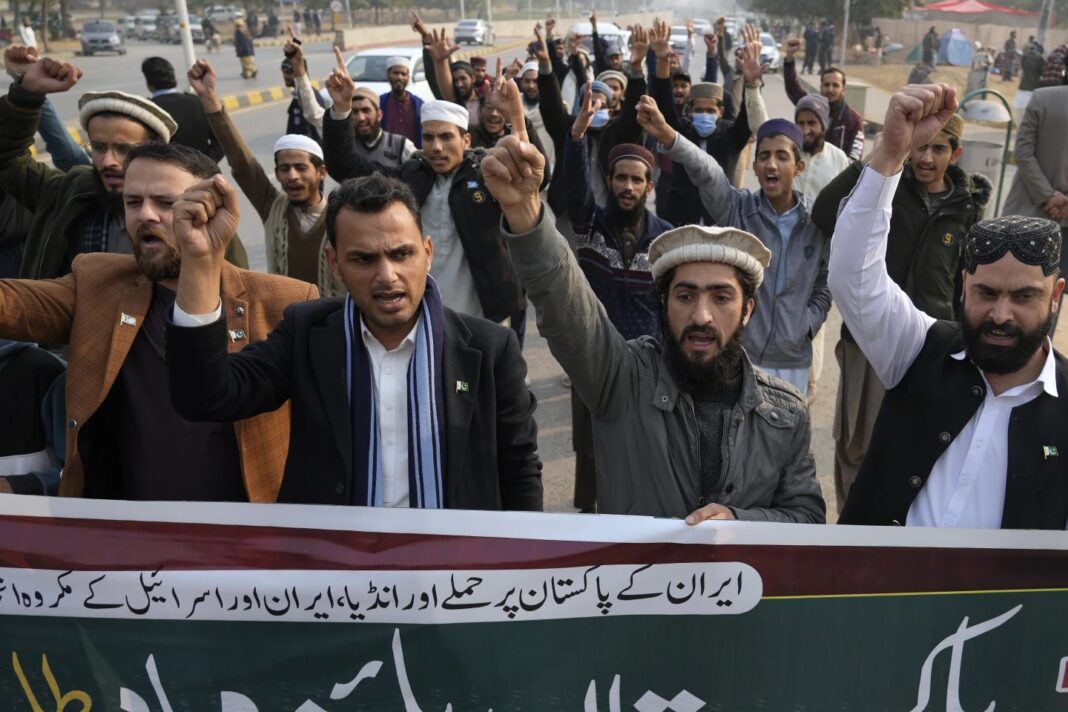
|
Getting your Trinity Audio player ready...
|
(AP) — Pakistan launched airstrikes against alleged militant hideouts inside Iran on Thursday, killing at least nine people as it retaliated for a similar attack by Iran two days earlier and raising tensions between the neighbors at a time of escalating conflict in the region.
Pakistan releases footage of guided artillery strikes conducted against Iran today targeting Baluchi forces. pic.twitter.com/z3RkZAhldE
— Clash Report (@clashreport) January 18, 2024
The unprecedented attacks by both Pakistan and Iran on either side of their border appeared to target Baluch militant groups with similar separatist goals. The countries accuse each other of providing a haven to the groups in their respective territories.
The flare-up between Iran and Pakistan comes as the Middle East remains unsettled by Israel’s war with Hamas in the Gaza Strip, and on the heels of Iranian airstrikes late Monday in Iraq and Syria. Those airstrikes were in retaliation for a suicide bombing in Iran by Islamic State militants in early January that killed over 90 people.
Iran attacks alleged militant bases in Pakistan; Islamabad says ‘unprovoked’ strikes kill 2 children Iran and nuclear-armed Pakistan have long regarded each other with suspicion over militant attacks, but analysts say this week’s tit-for-tat strikes were at least partially in response to internal political pressures.
Iran is dealing with unrest against its theocracy and has faced pressure for action ever since the Islamic State suicide bombing. It is also seeking to flex military power at a time when militant groups it supports in the region — Hamas in Gaza, Hezbollah in Lebanon and Houthi rebels in Yemen — are engaged in the Israeli-Palestinian conflict.
Pakistan, meanwhile, could not leave Tuesday’s airstrikes by Iran unchallenged, and it faces a crucial February general election in which its military is a powerful political force.
“The government and military have been under immense pressure,” said Abdullah Khan, an analyst at the Pakistan Institute for Conflict and Security Studies. “Iran celebrated (Tuesday’s) attack in its media and the Pakistani public perception of a strong army is not as it used to be, so it had to respond.”
Pakistan’s Foreign Ministry described its attack Thursday as “a series of highly coordinated and specifically targeted precision military strikes.”
The ministry said in a statement it had “credible intelligence of impending large scale terrorist activities” and pledged “unflinching resolve to protect and defend its national security against all threats.”
Pakistan’s military described using drones, rockets, and “standoff weapons” in the attack. Standoff weapons are missiles fired from aircraft at a distance — likely meaning Pakistan’s fighter jets didn’t enter Iranian airspace.
Pakistan’s caretaker Prime Minister Anwaarul-Haq-Kakar cut short his trip to the World Economic Forum in Davos, Switzerland, to return home. Kakar, who has not commented since the attack, is expected to meet Friday with the heads of Pakistan’s armed forces, its intelligence chief and other senior government officials.