



|
Getting your Trinity Audio player ready...
|
By: Fern Sidman
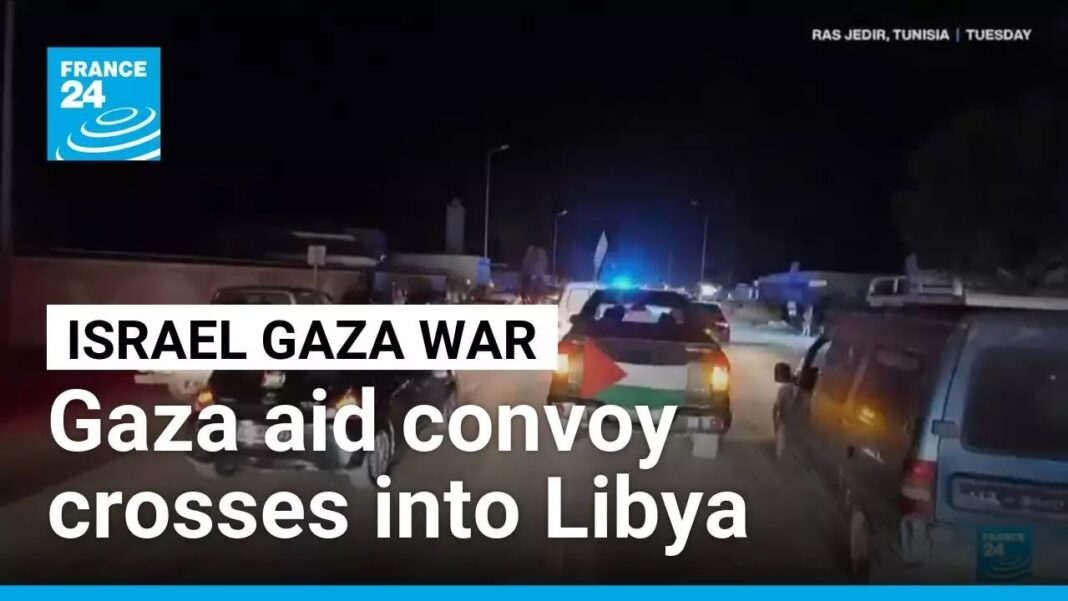
In a growing wave of international pro-Hamas activism, more than 7,000 protesters from five North African nations—Mauritania, Morocco, Algeria, Tunisia, and Libya—have launched a bold overland protest convoy with the stated goal of delivering humanitarian aid to the Gaza Strip via the Rafah crossing. The initiative, known as the Maghreb Resilience Convoy, began its journey on Monday from the Tunisian capital and has since crossed into Libya, according to a report on Tuesday in The Jerusalem Post.
Comprised of roughly 300 vehicles, the convoy aims to arrive at the Rafah border terminal by mid-June, coinciding with the broader Global March to Gaza scheduled for June 15. Organizers describe the convoy as part of a coordinated humanitarian and political effort to “break the siege on Gaza” and pressure regional governments—especially Egypt—to open access for critical humanitarian supplies.
The Jerusalem Post report noted that the convoy features a diverse cross-section of civil society actors, including physicians, university students, legal professionals, and ordinary citizens. Participating groups, such as Joint Action Coordination for Palestine based in Tunisia and Libyans for Palestine, emphasize that their goal is not merely symbolic but logistical: they aim to physically deliver food, medical supplies, and other essential aid to the embattled residents of Gaza, where the humanitarian situation has deteriorated sharply amid ongoing hostilities.
The convoy has branded itself under the name Soumoud—Arabic for “steadfastness”—a reference frequently used by Hamas agitators to connote endurance in the face of siege or occupation. Images shared online by participants and regional media outlets show convoys of trucks and passenger vehicles decorated with Palestinian flags and placards reading “Open Rafah Now” and “Aid, Not Arms.”
The Maghreb Resilience Convoy represents the North African component of a larger, highly publicized international campaign known as the Global March to Gaza. According to organizers cited in The Jerusalem Post report, the broader event will bring together approximately 2,500 activists from more than 50 countries, all of whom intend to converge in Egypt’s northern Sinai region before undertaking a 48-kilometer, three-day march from Al Arish to the Rafah border terminal.
The protest march, set to span June 15–17, is being promoted as a non-violent expression of international solidarity with Gaza’s purportedly besieged population and a coordinated demand for Egypt to permanently open the Rafah crossing to humanitarian assistance.
March organizers say they intend to remain in Rafah until June 19, although they acknowledge that this plan is contingent on receiving authorization from Egyptian authorities.
“We aim to negotiate the opening of the Rafah terminal with the Egyptian authorities, in collaboration with NGOs, diplomats, and humanitarian institutions,” read a joint statement from the Tunisian and Libyan organizing committees.
As The Jerusalem Post has previously reported, the Egyptian government has come under increased international pressure to open the Rafah crossing, Gaza’s only direct link to the outside world that bypasses Israel. While Cairo has occasionally opened the crossing for short-term humanitarian purposes, it remains largely sealed, citing security concerns related to the Egyptian military’s battle with jihadist insurgents in the Sinai Peninsula.
Egypt’s cooperation—or lack thereof—will be pivotal in determining whether either the convoy or the Global March will be able to reach their final destination. Organizers say they are in ongoing contact with Egyptian authorities and regional humanitarian organizations to ensure safe passage. However, no formal clearance has been announced.
Despite the logistical uncertainty, The Jerusalem Post reported that the march has galvanized widespread support among pro-Hamas, pro-terror networks in Europe and the Middle East. Activist groups such as Students for Justice in Palestine (SJP) Amsterdam have announced plans to fly into Cairo to join the march. The group has reportedly launched a fundraising campaign to cover travel costs, calling attention to the extent to which the Rafah march has gained traction as a focal point for global activism.
While the organizers maintain that the objective is purely humanitarian, Israeli and Egyptian authorities remain wary of such demonstrations. As The Jerusalem Post has noted in its coverage, previous “flotilla” and overland aid missions—most notably the 2010 Gaza flotilla incident involving the Mavi Marmara—have often served dual purposes: the delivery of aid and the staging of political protest against Israel and its allies.
Critics argue that the current convoy, while presenting itself as a humanitarian campaign, is in fact a highly politicized action that risks inflaming regional tensions. The report in The Jerusalem Post explained that Israeli security officials have historically expressed concern that convoys and marches of this nature may attempt to provoke confrontations or create scenes for global media consumption that place blame squarely on Israel and its partners.
Still, organizers maintain that the Maghreb Resilience Convoy is explicitly nonviolent and intends to cooperate fully with local and international authorities. The logistics of moving such a large caravan across multiple borders—particularly those between Tunisia, Libya, and Egypt—remain complicated, especially given the unstable political environments in Libya and parts of Egypt.
The Jerusalem Post report noted that this new push for Gaza aid convoys comes at a time when regional tensions are already heightened. Fighting continues in and around the Rafah area, and negotiations involving Israel, Hamas, the United States, and regional powers such as Egypt and Qatar have made little progress toward a lasting ceasefire.
Moreover, the optics of mass Arab solidarity with Gaza—particularly if amplified by large-scale international coverage of the march—could place Egypt and other moderate Arab regimes in a difficult diplomatic position. On one hand, they face pressure from domestic populations sympathetic to the Hamas cause; on the other, they must navigate strategic alliances with Western governments and Israel.
Whether or not the convoy or the Global March reaches its intended destination, the organizers have already succeeded in attracting substantial attention from activists and the international press. The Jerusalem Post reported that if allowed to proceed, the actions at Rafah may become one of the most significant global demonstrations of support for Gaza since the October 7 Hamas attack on Israel and the subsequent military response.
For now, all eyes remain on Egypt’s response. The next two weeks will determine whether the Maghreb Resilience Convoy becomes a humanitarian breakthrough—or another flashpoint in a long-running regional conflict.