



|
Getting your Trinity Audio player ready...
|
By: Fern Sidman
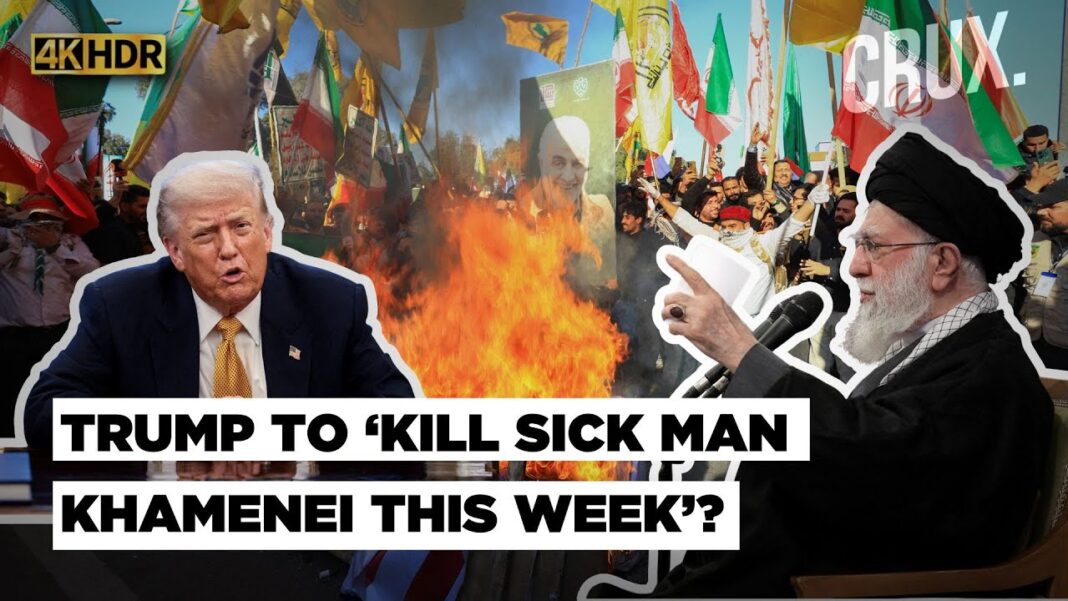
Late on Wednesday morning, as diplomats whispered and military planners sharpened contingency maps, the Middle East hovered at the precipice of another major war. According to a detailed reconstruction published by The Washington Post on Saturday, much of the region—and a significant portion of official Washington—believed that President Trump was preparing to order punishing U.S. airstrikes against Iran. Senior national security advisers braced for imminent authorization, while military officials prepared for what they expected would be a long and volatile night.
Yet by the end of the week, the feared bombardment had not come. Instead, Trump reversed course in a moment that, as The Washington Post reported, stunned advisers, rattled Iranian dissidents, and left global allies struggling to understand the volatile decision-making process inside the Oval Office.
The story of how Washington pulled back from the brink is one of geopolitical calculation, domestic politics, fragile diplomacy, and the sobering realities of military risk. It is also a window into the instinctive unpredictability of a president who prides himself on keeping adversaries guessing.
The immediate backdrop to the crisis was Iran’s brutal crackdown on nationwide protests—demonstrations that had erupted in response to spiraling economic hardship and deep public anger at the ruling clerical regime. Reports of mass arrests and planned executions of demonstrators triggered outrage across Western capitals.
Trump’s own rhetoric escalated rapidly. In a Tuesday morning social media post directed at Iranian protesters, he declared: “HELP IS ON ITS WAY,” and urged demonstrators to “take over” regime institutions. As The Washington Post report observed, many U.S. and foreign officials interpreted that message as a virtual signal flare for imminent military intervention.
Inside the administration, preparations accelerated. Although Trump had not formally issued a strike order, senior advisers expected authorization to come at any moment. Military planners began reviewing target lists, while intelligence officials updated assessments of how Iran might retaliate.
At the Pentagon, however, unease was mounting. According to the information provided in The Washington Post report, officials worried that American forces in the region were not ideally positioned to respond to an Iranian counterattack. The administration had recently redeployed an aircraft carrier strike group to the Caribbean on unrelated orders, leaving U.S. firepower in the Middle East comparatively thin.
For Israel, the situation was equally precarious. Israeli defense planners warned Washington that the Jewish state had expended significant stocks of interceptor missiles during a punishing 12-day conflict with Iran the previous summer. Israeli leaders feared that any American strike could unleash a new barrage of Iranian rockets and drones—an onslaught Israel might struggle to contain without massive U.S. assistance.
The moment that ultimately changed the trajectory of events arrived on Wednesday. According to the information contained in The Washington Post report, Trump received word through his Middle East envoy, Steve Witkoff, that Tehran had canceled the planned executions of roughly 800 prisoners.
The message carried significant weight. “We’re going to watch and see,” Trump told reporters in the Oval Office, hinting for the first time that military action might be averted.
By Thursday, U.S. intelligence confirmed that the executions had indeed not taken place. For Trump, who had publicly warned Iran against killing protesters, the development appeared to offer a diplomatic offramp.
The Washington Post report described the shift as abrupt and disorienting. Advisers who had been preparing for imminent conflict suddenly found themselves navigating a rapidly cooling crisis. Iranian opposition figures, who had hoped for decisive American intervention, were left disappointed and confused.
Still, Trump’s decision did not emerge in a vacuum. It was shaped by a complex web of pressures and concerns—strategic, economic, and political.
Interviews conducted by The Washington Post with more than a dozen current and former U.S. and Middle Eastern officials paint a vivid picture of the competing forces at play.
One central concern was the unpredictability of escalation. Unlike previous limited military actions Trump had ordered—such as targeted strikes in Syria or the assassination of Iranian general Qassem Soleimani—an attack on Iran in this context risked triggering a sprawling regional war.
“This was not going to be a one-and-done operation,” one former U.S. official briefed on the deliberations told The Washington Post. “This was going to be messier.”
Pentagon leaders warned that Iran possessed significant capabilities to strike back—against American troops stationed across the Middle East, against shipping in the Persian Gulf, and against U.S. allies such as Israel and Saudi Arabia. Roughly 30,000 American service members remain deployed throughout the region, a fact that weighed heavily on Trump’s calculus.
Economic risks also loomed large. Analysts cautioned that an all-out confrontation with Iran could disrupt global energy markets, send oil prices soaring, and destabilize fragile economies already reeling from inflation and supply chain shocks.
Key regional allies added their voices to the chorus of restraint. According to The Washington Post report, Saudi Arabia, Qatar, Egypt, and other Arab states quietly urged Washington to pursue diplomacy rather than military action. Although these Sunni-majority nations view Shiite Iran as a strategic adversary, they feared that another major conflict would ignite the entire region.
Inside the White House, the debate was intense.
Vice President JD Vance reportedly favored military action, arguing that Trump needed to enforce his warnings to Tehran and demonstrate that threats against protesters would carry real consequences.
CIA Director John Ratcliffe presented the president with graphic videos of regime violence against demonstrators, underscoring the brutality of Iran’s crackdown. It was not clear, The Washington Post report noted, whether Ratcliffe actively advocated for strikes or simply laid out the intelligence picture.
Others counseled caution. Witkoff, the envoy who had helped broker communication with Tehran, pushed for a diplomatic solution. Chief of Staff Susie Wiles warned against rushing into an open-ended conflict. Treasury Secretary Scott Bessent argued that economic sanctions and financial pressure should be given more time to bite.
Gen. Dan Caine, chairman of the Joint Chiefs of Staff, remained at the White House throughout the day, prepared to implement whatever decision the president made.
After hours of deliberation, Trump ultimately concluded that the potential benefits of a strike did not outweigh the enormous risks.
“Would a strike have resulted in regime change? The answer is clearly ‘no,’” an individual close to the administration told The Washington Post. “The negative impact of any attack outweighed any benefit.”
While American officials weighed their options, back-channel diplomacy continued at a frantic pace.
Iran, aware of U.S. military movements and public threats, sought to defuse the crisis. Foreign Minister Abbas Araghchi reportedly reached out to Witkoff, delivering assurances that helped calm tensions.
That communication, The Washington Post reported, “kind of also defused the situation.”
Trump later acknowledged the impact of Iran’s decision to halt executions, telling reporters he “greatly respect[ed] the fact that they canceled.”
Arab governments also played a crucial role. Saudi Arabia, the United Arab Emirates, Qatar, Oman, and Egypt all urged restraint, fearing that a regional conflagration would destabilize their own security and economies.
Even Israeli Prime Minister Benjamin Netanyahu, often seen as a hawk on Iran, reportedly pressed Trump to hold off. According to The Washington Post report, Netanyahu warned that Israel was not fully prepared to defend itself without substantial U.S. naval support. The two leaders spoke twice as the crisis unfolded.
Although the immediate threat of strikes has receded, The Washington Post report emphasized that the situation remains fluid.
The USS Abraham Lincoln aircraft carrier strike group is currently steaming toward the Middle East, though it remains more than a week away. U.S. Central Command has been instructed to plan for high-level readiness for at least the next month.
Officials told The Washington Post that Trump could revisit the option of military action within two to three weeks, once additional assets are in place and the regional balance shifts.
For now, however, the administration appears to be leaning on economic pressure and diplomatic maneuvering rather than bombs and missiles.
The episode underscores the complexity of modern crisis management, where social media rhetoric, real-time intelligence, and fragile alliances collide in unpredictable ways.
It also reveals the mercurial nature of Trump’s leadership style—a blend of bluster and calculation that can veer from imminent war to cautious restraint in a matter of hours.
As The Washington Post report noted, the drama of those tense days left a lasting imprint on Washington and the Middle East alike. Advisers learned once again that Trump’s instincts often defy expectations. Allies were reminded that American policy can shift on a dime. And Iranian protesters were forced to reckon with the limits of outside intervention.
Whether the reprieve proves temporary or enduring remains an open question. But for one week at least, a region accustomed to living on the edge stepped back from the abyss—and the world exhaled.
