



|
Getting your Trinity Audio player ready...
|
By: Fern Sidman
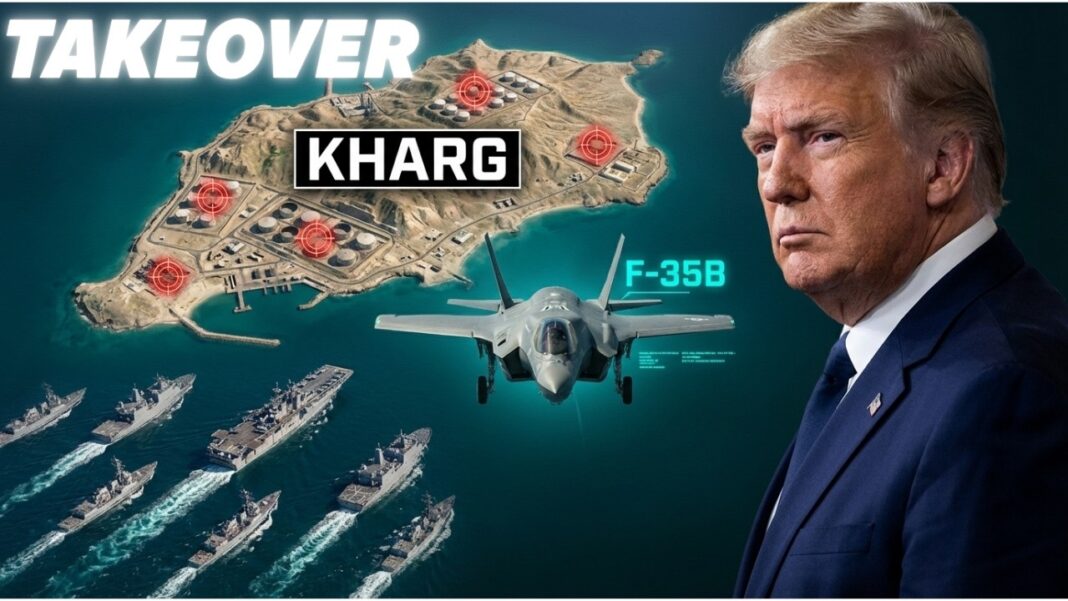
As the conflict between the United States, Israel, and Iran enters a critical and increasingly volatile phase, senior officials indicate that President Donald Trump is actively considering a dramatic escalation: a potential ground operation targeting Iran’s vital energy infrastructure, including the strategically indispensable Kharg Island. According to multiple diplomatic sources cited in a report on Thursday at World Israel News, the deliberations reflect a growing conviction within Washington that intensified military pressure may be the only viable path to compel Tehran toward meaningful concessions.
The prospect of a ground incursion—long viewed as a threshold the United States would hesitate to cross—marks a profound shift in the trajectory of the war. It underscores not only the persistence of Iranian resistance but also the mounting impatience within the American leadership as diplomatic overtures fail to yield tangible results.
At the center of these deliberations lies Kharg Island, a modest yet immensely consequential landmass in the Persian Gulf that serves as the linchpin of Iran’s oil export apparatus. For decades, Kharg Island has functioned as the primary conduit through which Iranian crude reaches global markets, accounting for a substantial proportion of the nation’s energy revenue.
The strategic logic of targeting Kharg Island is both straightforward and profound. By seizing or neutralizing this critical node, U.S. forces could effectively cripple Iran’s economic lifeline, depriving the regime of the financial resources necessary to sustain its military operations and support its network of regional proxies.
The World Israel News report emphasized that such a move would represent a calculated attempt to transform economic pressure into immediate leverage, accelerating the timeline for potential negotiations. Yet, the same reports caution that the operational challenges associated with capturing and holding the island are considerable.
In preparation for a possible ground operation, the United States has already undertaken a significant military buildup in the region. Thousands of troops have been deployed, with additional forces—including U.S. Marines—scheduled to arrive in the coming days. This mobilization reflects a level of readiness that suggests the option of a ground assault is being treated with increasing seriousness.
According to the World Israel News report, the deployment has been carried out under direct presidential orders, signaling the administration’s willingness to escalate if necessary. The presence of these forces not only enhances operational capabilities but also serves as a powerful signal to Tehran that Washington is prepared to act decisively.
However, the scale of the buildup also raises questions about the sustainability of such an operation. Military analysts and diplomatic officials alike have noted that while U.S. forces may possess the capability to seize Kharg Island, maintaining control would likely require a far more substantial and prolonged commitment.
The distinction between capturing territory and holding it is a critical one. As one official from a mediating country observed, the initial seizure of Kharg Island could be achieved with relative speed, leveraging the United States’ overwhelming technological and logistical advantages. Yet, the subsequent phase—establishing and maintaining control—would present a far more complex and resource-intensive challenge.
Iran’s capacity for asymmetric warfare, combined with its proximity to the island and its familiarity with the surrounding terrain, would likely complicate any occupation. The potential for sustained resistance, including attacks on supply lines and infrastructure, could transform what might begin as a swift operation into a protracted engagement.
The World Israel News report highlighted concerns that such an escalation could extend well beyond the four-to-six-week timeframe that U.S. officials have publicly cited for the duration of the war. This discrepancy between stated timelines and operational realities underscores the inherent uncertainties associated with military planning in a dynamic and contested environment.
The consideration of a ground operation must also be understood in the context of a broader diplomatic impasse. Despite the presentation of a comprehensive 15-point proposal aimed at ending the conflict, Iran has shown little inclination to accept terms that it has previously rejected.
Officials involved in mediation efforts have indicated that Washington privately acknowledges the low likelihood of Iranian capitulation under current conditions. This assessment has contributed to a growing sense of frustration within the administration, as diplomatic avenues appear increasingly constrained.
The decision to delay a previously announced deadline for Iranian acceptance of the proposal—extending it to Friday—reflects an attempt to balance the pursuit of diplomacy with the maintenance of military pressure. The arrival of additional U.S. forces around the revised deadline further underscores this dual-track approach.
World Israel News reported that while negotiations continue through intermediaries, the simultaneous advancement of military preparations suggests that Washington is seeking to create a sense of urgency, compelling Tehran to reconsider its position.
From Tehran’s perspective, the situation presents a complex set of incentives and constraints. On one hand, the increasing intensity of military pressure poses a tangible threat to the regime’s survival and its ability to project power. On the other, capitulating to U.S. demands could be perceived as a sign of weakness, undermining the regime’s domestic legitimacy and emboldening its adversaries.
Officials from mediating countries have indicated that Iran is unlikely to yield, even in the face of a potential ground operation. This assessment reflects a broader understanding of the regime’s strategic culture, which prioritizes resilience and resistance over short-term concessions.
The World Israel News report noted that this dynamic creates a paradox: the very measures designed to compel Iranian compliance may instead reinforce its determination to resist, prolonging the conflict and increasing the risk of escalation.
The potential seizure of Kharg Island carries implications that extend far beyond the immediate theater of operations. As a critical hub for global energy supply, any disruption to the island’s functionality would reverberate through international markets, potentially driving up oil prices and exacerbating economic instability.
Moreover, a ground operation would likely draw in additional regional actors, either directly or indirectly, further complicating the strategic landscape. The possibility of retaliatory actions against U.S. allies or interests cannot be discounted, raising the specter of a broader and more protracted conflict.
The World Israel News report underscored the interconnected nature of these dynamics, highlighting the delicate balance that must be maintained between achieving strategic objectives and avoiding unintended consequences.
As the war approaches its fourth week, the deliberations surrounding a potential ground operation represent a defining moment for the United States and its allies. The choice to escalate carries both significant risks and potential rewards, reflecting the high stakes of the current conflict.
On one hand, a successful operation could deliver a decisive blow to Iran’s economic and military capabilities, potentially accelerating the path to a negotiated settlement. On the other, the challenges associated with occupation and the risk of broader escalation could entangle the United States in a prolonged and costly engagement.
President Trump’s decision-making process, as reported by World Israel News, appears to be guided by a desire to balance these competing considerations, leveraging military pressure while preserving the possibility of a diplomatic resolution.
The unfolding developments in the Persian Gulf underscore the precariousness of the current moment. As Washington weighs the option of a ground assault on Kharg Island, the stakes are nothing short of historic.
The decision will not only shape the trajectory of the war but also influence the broader geopolitical landscape for years to come. In this context, the insights provided by World Israel News offer a critical lens through which to understand the complexities and consequences of the choices that lie ahead.
For now, the world watches with bated breath as the United States stands on the threshold of a potential escalation, one that could redefine the contours of conflict in the Middle East and beyond.

Israel must do more that hit military targets. Israel must hit and destroy areas of Iran where the hotshots live. There are 13 neighborhoods in Iran known for overwhelming housing the regime loyalists. They must be completely obliterated. These 13 neighborhoods are as follows: City Center, Jamkaran and Pardisan District in Qoms; Boroujerdi, Mahallati, Tehranpars, Darband, Zafaraniyeh, Tajrish and Narmark in Teheran; Eidgah, Paein Khiaban and Noghan in Mashhad (This information came from Jfeed David Crythal 3-16-2026) . Israel must get serious if it wants to win.