



|
Getting your Trinity Audio player ready...
|
By: Fern Sidman
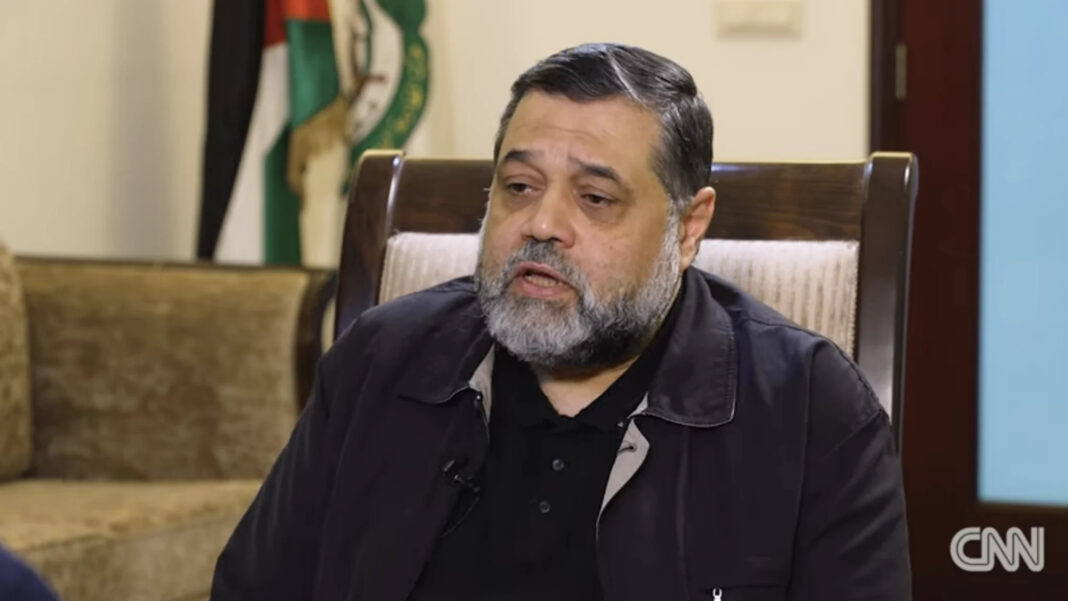
The recent interview granted by senior Hamas official Osama Hamdan to Norway’s state broadcaster NRK has ignited a storm of controversy across Europe and the Middle East, not merely for what Hamdan said, but for what many critics argue he was permitted to say without sufficient scrutiny. As The Jerusalem Post has reported on Tuesday, the exchange—conducted in a secret location in Istanbul—offered a rare but troubling window into the ideological rigidity of Hamas at a moment when diplomatic efforts are attempting, however tenuously, to chart a postwar future for Gaza.
According to the information provided in The Jerusalem Post report, Hamdan made it unequivocally clear that Hamas has no intention of relinquishing its weapons unless Israel were to retreat to pre-1967 borders, including Jerusalem, and accede to demands that amount to the dissolution of Israel as a sovereign Jewish state. In articulating these maximalist conditions, Hamdan effectively rejected the premise underpinning phase two of the Trump administration’s proposed framework for Gaza, which envisions a technocratic transitional body overseeing the Strip while Hamas disarms voluntarily or is compelled to do so by international force.
The Jerusalem Post report emphasized that this was not an offhand rhetorical flourish but a deliberate statement of strategic posture. Hamdan declared that Hamas was prepared to cede political governance to a technocratic committee, but not to surrender the instruments of violence that have defined its existence. “Hamas did not create the resistance to the occupation; the occupation did,” he asserted, invoking a narrative that recasts a designated terrorist organization as a natural byproduct of geopolitical grievance rather than as an actor that has repeatedly targeted civilians.
What startled observers, as The Jerusalem Post report noted, was not merely the content of Hamdan’s remarks but the unyielding pride with which he spoke of October 7, 2023, the Hamas-led massacre that resulted in the murder of some 1,200 people and the abduction of hundreds more. Even after nearly two years of devastating warfare that has reduced vast swaths of Gaza to rubble and inflicted immense suffering on its civilian population, Hamdan described the attack as an “achievement.” He framed Israel’s ensuing international isolation as a strategic objective long contemplated by Hamas, suggesting that the organization’s leaders had anticipated that the atrocities would catalyze global condemnation of the Jewish state.
The Jerusalem Post reported that Hamdan went further still, denying that Hamas fighters had killed civilians on October 7, despite extensive video documentation released by Hamas itself, testimony from survivors, and forensic evidence gathered by Israeli and international investigators. In one of the interview’s most jarring moments, Hamdan claimed that Israeli forces were responsible for the massacre at the Supernova music festival, asserting that Israel had fabricated or manipulated evidence to justify its subsequent military campaign. When pressed by NRK journalist Yama Wolasmal, Hamdan remained unmoved, reiterating claims that have been widely debunked.
For many observers, as The Jerusalem Post report documented, this was not simply an exercise in misinformation but a deliberate attempt to invert reality. The danger, critics argue, lies not only in the falsehoods themselves but in their dissemination through a respected public broadcaster. The Israeli Embassy in Norway condemned NRK for what it described as granting a platform for Hamas propaganda, pointing out the moral incoherence of allowing a representative of an organization that openly celebrates mass murder to deny its own crimes before a national audience.
Within Norway’s Jewish community, the reaction was one of profound alarm. Ester Nafstad, a community leader, told The Jerusalem Post that the interview was “shocking,” not because NRK spoke to a Hamas figure per se, but because Hamdan was allowed to repeat demonstrably false claims with what she described as minimal substantive challenge. She warned that such narratives are already circulating in Norwegian public discourse, often among pro-Palestinian activists, and that their uncritical amplification risks normalizing the denial of documented atrocities. The Jerusalem Post report underscored her concern that this is not merely about hearing “the other side” but about ensuring that public understanding is grounded in verifiable fact rather than ideological distortion.
The broader implications of Hamdan’s statements extend beyond media ethics. By conditioning disarmament on Israel’s retreat to pre-1967 lines, including Jerusalem, Hamas effectively rejects the foundational parameters of any two-state framework that preserves Israel’s security and legitimacy. The Jerusalem Post has long chronicled how Hamas’s charter and subsequent declarations position the organization not as a negotiable political actor but as an entity committed to Israel’s eradication. Hamdan’s insistence on a so-called “right of return” for millions of Palestinians, coupled with territorial demands that would render Israel strategically indefensible, reinforces the conclusion that Hamas’s vision of “self-determination” is inextricable from the negation of Israeli sovereignty.
Equally troubling, as The Jerusalem Post report observed, is Hamdan’s assertion that Hamas continues to enjoy broad popular legitimacy among Palestinians. When confronted with the fact that Gaza has not held elections since 2006, Hamdan dismissed the need for renewed democratic processes, arguing that Hamas’s electoral victory nearly two decades ago suffices as a permanent mandate. Such claims sit uneasily alongside reports of repression within Gaza, including extrajudicial killings of individuals accused of collaborating with Israel.
Hamdan defended these executions as lawful under Palestinian jurisprudence, describing them as a justified response to “betrayal.” The Jerusalem Post has repeatedly reported on the climate of fear that such practices engender, casting doubt on the credibility of claims that Gazans are free to criticize Hamas without consequence.
The interview also illuminated a disquieting asymmetry in journalistic posture. As The Jerusalem Post report noted, Wolasmal’s approach to Hamdan contrasted sharply with his often confrontational tone when interviewing Israeli officials, including government spokespersons and Knesset members. While Wolasmal did challenge some of Hamdan’s assertions, he allowed others—particularly the denial of civilian casualties on October 7—to pass with limited rebuttal. For critics, this disparity reinforces perceptions of a double standard that subjects Israeli representatives to rigorous scrutiny while affording Hamas figures a more permissive platform.
This episode raises profound questions about the responsibilities of public broadcasters in an age of information warfare. The Jerusalem Post has long warned that modern conflicts are waged not only with rockets and drones but with narratives designed to shape international opinion. In this context, the decision to air an interview with a senior Hamas leader without robust, sustained fact-checking risks transforming journalism into an unwitting conduit for extremist messaging.
The stakes are not abstract. Misinformation about the October 7 massacre and the ensuing war has already fueled polarization, antisemitism, and the erosion of trust in democratic institutions across Europe. When claims that deny or relativize mass violence circulate under the imprimatur of respected media outlets, they acquire a veneer of legitimacy that can distort public discourse and policy debates.
At the same time, the interview underscores the intransigence of Hamas at a moment when international actors are searching for pathways toward de-escalation and reconstruction in Gaza. Hamdan’s rejection of disarmament, his valorization of violence, and his maximalist territorial demands suggest that any postwar arrangement predicated on Hamas’s cooperation faces formidable obstacles. Israel’s security establishment views Hamas’s continued militarization as incompatible with any durable ceasefire or reconstruction framework.
In the end, the NRK interview serves as a stark reminder of the chasm between the rhetoric of “resistance” and the realities of terror. As The Jerusalem Post report documented, Hamas’s leaders continue to articulate a worldview in which civilian suffering—both Palestinian and Israeli—is subsumed under an absolutist narrative of struggle. The danger for international audiences lies in mistaking such rhetoric for legitimate political discourse rather than recognizing it as a calculated effort to obscure responsibility and perpetuate conflict.
For journalists, policymakers, and citizens alike, the episode poses an urgent challenge: how to engage with voices from all sides of a conflict without becoming instruments of their propaganda. The Jerusalem Post’s coverage of the Hamdan interview suggests that the answer lies not in silencing controversial figures, but in confronting their claims with rigorous evidence, historical context, and moral clarity. Without such safeguards, the line between critical journalism and inadvertent amplification of extremism becomes perilously thin.