



|
Getting your Trinity Audio player ready...
|
Oldest Jewish Mikvah Outside Israel Unearthed in Ancient Roman Port City of Ostia Antica
By: Fern Sidman
In a landmark archaeological discovery, researchers in the ancient Roman port city of Ostia Antica have uncovered what may be the oldest Jewish ritual bath, or mikvah, ever found outside of Israel. The finding, reported by VIN News on Tuesday, offers a profound new chapter in the understanding of Jewish life in the Roman Empire and sheds fresh light on the deep historical roots of the Jewish community in Italy.
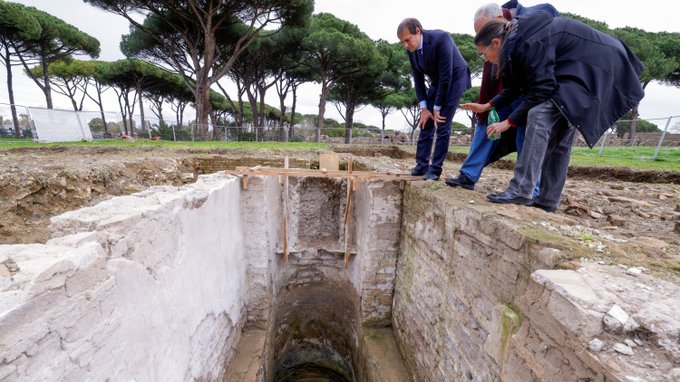
The excavation, led by Professor Luigi Maria Caliò of the University of Catania, marks a breakthrough in the study of Jewish heritage in Europe. The site, previously untouched by modern archaeological tools, revealed a meticulously constructed structure that experts believe dates back to the late fourth or early fifth century. At the heart of this discovery lies a pool deep enough for ritual immersion, meeting the requirements of a mikvah—an integral institution in Jewish religious life.
What makes the identification particularly compelling, as highlighted in the VIN News report, is the presence of a menorah-shaped oil lamp discovered at the bottom of the immersion pool. This symbol, a hallmark of Jewish ritual and identity, strongly supports the interpretation of the structure as a mikvah. It serves as a tangible spiritual marker linking the site to its Jewish roots.
The implications of this discovery are immense. As detailed in the VIN News report, the mikvah bolsters longstanding evidence of a vibrant Jewish presence in Ostia, a city that once bustled with trade and commerce as Rome’s principal seaport. Historical records already placed Jews in Ostia as early as the second century B.C., and this latest find adds new depth to the narrative.
Riccardo Di Segni, the Chief Rabbi of Rome, called the discovery “relevant” and emphasized its importance in reconstructing the life and traditions of Jewish communities in the region. Speaking to the significance of the mikvah, Di Segni remarked, “Such an antique mikvah has never been found outside Israel,” a statement cited by VIN News that calls attention to the rarity and historical magnitude of the site.
The mikvah was not an isolated structure. As VIN News reported, it was discovered within a “large and rich domus”—a well-appointed Roman house that had been inhabited until the sixth century, after which it was abandoned. The house itself provides an extraordinary glimpse into life in late antiquity, featuring a kitchen, latrines, ovens, a portico, and remnants of frescoed walls, all unearthed alongside the mikvah. The integration of a mikvah within such an opulent residence suggests that the structure likely served a well-established and possibly affluent Jewish family or community.
The domestic setting of the mikvah offers a rare window into the daily rhythms of Jewish religious practice in the Roman world—one that typically remains hidden behind the grandeur of temples and synagogues in the archaeological record. As the VIN News report pointed out, such a find humanizes history, illustrating how Jewish traditions were maintained quietly and privately, even within the heart of a non-Jewish empire.
Ostia Antica has repeatedly proven itself to be a treasure trove of Jewish heritage. According to VIN News, in 1961, archaeologists discovered one of the oldest known synagogues in the Western world in Ostia, dating to the mid-fourth century and likely in use until the sixth century. This earlier discovery already established Ostia as a critical hub of Jewish spiritual life during the Roman era.
Further strengthening this historical tapestry, the VIN News report recalled a 2009 discovery of a first-century inscription referencing Jewish residents, which remains the oldest such inscription ever found in Italy. These archaeological milestones—now crowned by the newly discovered mikvah—paint a compelling portrait of a flourishing Jewish community intricately woven into the life of the Roman Empire.
The significance of this discovery goes beyond the local context. As emphasized in the report at VIN News, it contributes vital evidence to the global understanding of Jewish diaspora life in antiquity. It reaffirms that Jewish communities were not only present but were socially and culturally embedded in various corners of the Roman world, preserving their traditions while coexisting within broader imperial frameworks.
Moreover, this find opens new avenues for scholarly inquiry into the architecture, religious practices, and domestic lives of Jews in ancient Europe. The mikvah’s integration within a Roman domus challenges previously held assumptions that Jewish ritual sites in the diaspora were confined to communal religious structures such as synagogues.
Despite the initial enthusiasm, VIN News reported that certain scholars are adopting a more reserved stance regarding the mikvah’s classification. L. Michael White, a noted authority on ancient synagogues, has urged prudence. He emphasized that not every pool in the Roman world should automatically be interpreted as a Jewish ritual bath, cautioning that immersion pools were also common in other contexts, including Roman bathhouses and early Christian baptisteries.
White’s remarks, as cited by VIN News, reflect a broader methodological challenge in archaeology: distinguishing religious function from structural form. He warned against overinterpretation, noting that without unequivocal corroborating evidence, the identification of the pool as a mikvah remains tentative, albeit promising.
Nevertheless, Professor Caliò and his team remain optimistic. As indicated in the VIN News report, they believe that continued excavation and careful analysis will provide stronger confirmation of the mikvah’s identity. The presence of a Jewish artifact—specifically the menorah lamp—alongside the architectural features of the pool has given researchers confidence in their initial assessment. Further excavation is expected to yield additional clues.
The archaeological team is set to resume work in June, with renewed hopes of uncovering further evidence of Jewish life in Ostia, including the potential discovery of a synagogue near the current site, according to the information provided in the VIN News report. Such a finding would significantly bolster the interpretation of the mikvah and help establish the surrounding area as a definable Jewish quarter within Ostia Antica.
This phase of excavation, scholars and archaeologists suggest, could prove pivotal. Ostia Antica has long been recognized as a rich archaeological repository of Jewish heritage, including the discovery of one of the oldest known synagogues in the Roman world in 1961 and a first-century inscription referencing Jewish inhabitants found in 2009, the VIN News report said. The possibility that this latest mikvah is part of a larger complex tied to Jewish worship and community life is therefore not outside the realm of possibility.
As archaeologists continue to peel back layers of the past, the VIN News reported pointed out that the mikvah will likely become a focal point in broader discussions about Jewish life in the Mediterranean during the Roman period. Its implications reach far beyond Ostia, offering vital context for how Jewish customs were preserved, adapted, and practiced far from the land of Israel.