



|
Getting your Trinity Audio player ready...
|
By: Abe Wertenheim
The Mandarin Hotel ballroom in New York City, normally the setting for business conferences and gala receptions, became the stage for an extraordinary and unprecedented encounter on Sunday night. Hundreds of U.S.-based Syrians, including eleven members of the Syrian Jewish community, gathered to meet Ahmed al-Sharaa — Syria’s new transitional president, the man who rose to power after ousting Bashar al-Assad last December.
As The Times of Israel reported on Monday, this gathering marked the first time in decades that Syrian Jews had been invited to meet officially with the head of state of their ancestral homeland. The symbolism of the moment — Jews and Syrians of other backgrounds sitting side by side, applauding a leader who has promised to pursue stability, reconciliation, and even a potential security arrangement with Israel — was not lost on the participants.
“It was very emotional and inspiring,” said Joe Jajati, a Syrian-born Jewish businessman who attended the event. Speaking to The Times of Israel, Jajati noted that President Sharaa “welcomed everybody, including the Jews, very nicely,” leaving a strong impression on those present.
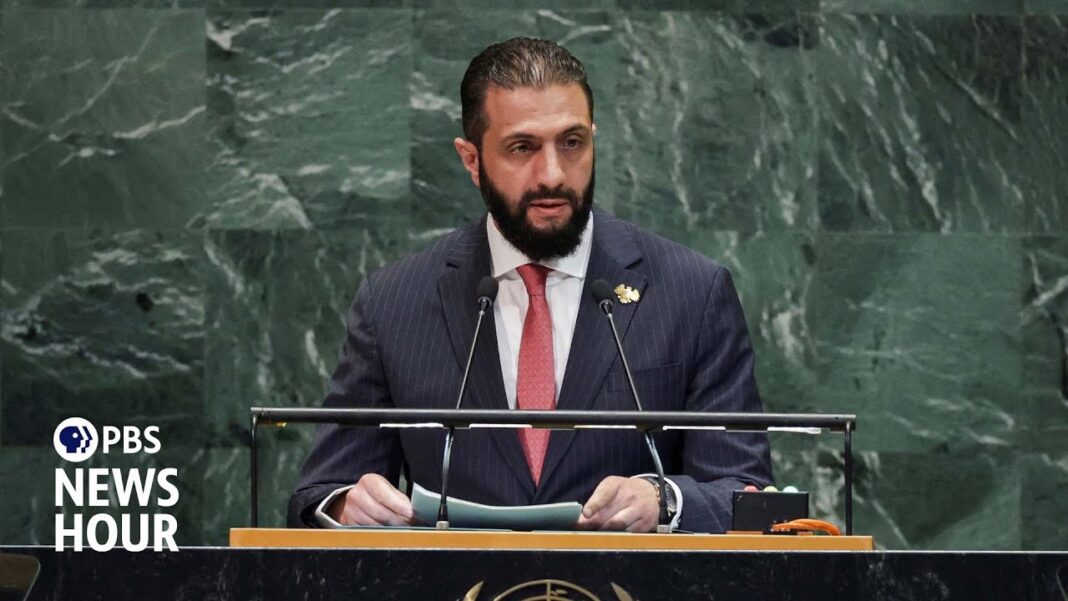
Sharaa’s presence in New York is itself momentous. On Wednesday, he addressed the United Nations General Assembly — the first Syrian leader to speak before the body in nearly sixty years. His speech emphasized national reconciliation, sovereignty, and the pursuit of stability after fifteen years of civil war.
According to the information provided in The Times of Israel report, Sharaa highlighted ongoing negotiations with Israel, aimed at reaching a narrowly defined security agreement that could reduce tensions on the border and prevent external actors — notably Iran and Hezbollah — from reasserting themselves in Syrian territory. U.S. officials told the outlet that a deal is “99 percent done,” with the prospect of finalizing it within the next two weeks.
For the Syrian Jewish community, both in Israel and abroad, this is a striking development. Many still carry the scars of persecution under previous regimes and had long abandoned hopes of open dialogue with Damascus. Yet the meeting on Sunday suggested a tentative shift, even if fraught with uncertainty.
The Times of Israel report confirmed that eleven Jews of Syrian origin were among the attendees, though the precise method of their selection was not disclosed. Jajati said the invitations had come directly from Syria’s Foreign Ministry. Two of the Jewish attendees wore kippot and stood to speak during the event, proudly identifying themselves as Jews.
One participant, David Shelly, even pledged a $100,000 donation toward rebuilding Syria. Sharaa responded with humor, saying it “wasn’t enough,” but his expression betrayed genuine appreciation. “You could see how moved he was,” Jajati recounted to The Times of Israel.
Asaad al-Shaibani, Syria’s new foreign minister, reportedly smiled broadly at the gesture, remarking afterward that the financial contribution was less important than the symbolism of Jewish support for Syria’s recovery.
Interestingly, despite the fevered speculation surrounding Syria’s negotiations with Israel, the subject was not raised during the gathering. “Israel was not discussed at all,” Jajati told The Times of Israel, noting that no one had personal conversations with Sharaa outside the formal event. The evening, he said, was more about “community, symbolism, and being seen.”
Nevertheless, the backdrop of talks with Israel lent the meeting added weight. Both Prime Minister Benjamin Netanyahu and Sharaa have recently acknowledged “progress” in reaching a security deal. Netanyahu said on Sunday that “certain progress” had been achieved, while Sharaa himself suggested that results could emerge “in the coming days.”
Sunday’s gathering followed another groundbreaking development: a visit to Syria last week by a nine-member Jewish delegation, organized in part by Jajati. As The Times of Israel’s own editor, David Horovitz, reported, the delegation met with Syrian ministers and government officials, toured historic Jewish sites, and received rare access to the Dura-Europos wall paintings — the world’s earliest known series of Jewish figurative art, preserved at the Damascus National Museum.
For many participants, this was the first time returning to Syria in decades, offering a poignant reminder of the community’s deep historical ties to the country.
Despite the conciliatory tone of Sunday’s meeting, tensions linger in the background. During the Jewish group’s visit to Syria, Qutaiba Idlbi, the Foreign Ministry’s director of American Affairs, sharply criticized Prime Minister Netanyahu’s approach. Idlbi accused Netanyahu of exploiting the recent fighting in Sweida to undermine Syrian control in the south, near the Israeli border.
According to the information contained in The Times of Israel report, Idlbi warned that destabilizing Syria would only invite the return of Iran and Hezbollah — actors that Sharaa’s forces claim to have expelled on December 8, 2024. “Anyone realistic enough can see that a stable Syria is actually in the interest, first and foremost, of Israel,” Idlbi argued.
This framing reflects the new Syrian leadership’s attempt to reposition itself as a bulwark against Iranian expansionism, appealing both to Israel and to Western audiences skeptical of Sharaa’s past as a jihadist commander.
Indeed, Sharaa’s transformation is one of the most striking aspects of this unfolding story. Until last December, the U.S. had a $10 million bounty on his head for terrorism. His rebel forces were once listed as extremists. Yet after toppling Assad’s regime and consolidating power, Sharaa has sought to recast himself as a pragmatist.
In an interview with CBS’s 60 Minutes ahead of his U.S. trip, Sharaa praised President Donald Trump for lifting sanctions following their meeting in Saudi Arabia in May. He portrayed himself as a liberator who had saved Syrians from Assad’s chemical weapons, confronted ISIS, and expelled foreign militias.
“All of these noble acts should have been the role of the international community,” he told CBS, insisting that Syria’s new government should be commended rather than condemned. Anyone opposing the lifting of sanctions, he added, was “complicit in killing the Syrian people once again.”
The Times of Israel has reported extensively on the delicate negotiations between Israel and Syria, now in their final phase. According to U.S. envoy Tom Barrack, the prospective deal would involve Israel halting air incursions into Syrian territory, while Damascus pledges not to deploy heavy weaponry near the border. Such a “de-escalation” agreement could serve as a first step toward a broader framework, though recognition of Israel by Syria remains off the table.
For Netanyahu, the challenge is acute. While securing a stable northern border is in Israel’s interest, there is deep skepticism among Israeli officials and the public about trusting Sharaa. His violent past, his ties to jihadist groups bent on terrorism such as Al-Qaeda and the fragile nature of his transitional government all raise serious questions.
For the Syrian Jewish community, both in New York and in Israel, the developments provoke a mixture of hope and anxiety. Many feel a deep attachment to their Syrian roots and see the symbolic gestures — invitations, visits, and gestures of goodwill — as potential openings for reconciliation.
Yet memories of persecution, forced emigration, and the Assad regime’s hostility toward Jews linger strongly. As The Times of Israel report noted, the community is cautious, recognizing that today’s optimism could easily dissolve if political winds shift.
Still, Jajati expressed guarded confidence: “We are feeling more optimistic, especially with what’s going to happen in the next few days,” he told The Times of Israel.
Sunday night’s gathering at the Mandarin Hotel was historic for its symbolism if nothing else: Syrian Jews, once marginalized and exiled, sitting in the same room with Syria’s new president, applauding his words, and even pledging financial support for rebuilding the country.
Whether this moment will lead to lasting change — a genuine reconciliation between Syria and its Jewish diaspora, or even a concrete security arrangement with Israel — remains uncertain. But as The Times of Israel report highlighted, the mere fact that such meetings are taking place at all, against the backdrop of decades of hostility, marks a profound and perhaps unexpected shift.