



|
Getting your Trinity Audio player ready...
|
By: Fern Sidman
In British politics, few figures have displayed the instinct for disruption and resilience quite like Nigel Farage. From his days as the insurgent leader of UKIP to his successful campaign to wrench Britain out of the European Union, Farage has repeatedly proven himself adept at channeling the undercurrents of public sentiment into seismic political change. Now, as The New York Times has observed in a report that appeared on Tuesday, Farage is turning his attention once again to the subject that has become central to Britain’s political discourse: immigration—specifically, the question of how to address the hundreds of thousands of migrants who have entered the country illegally.
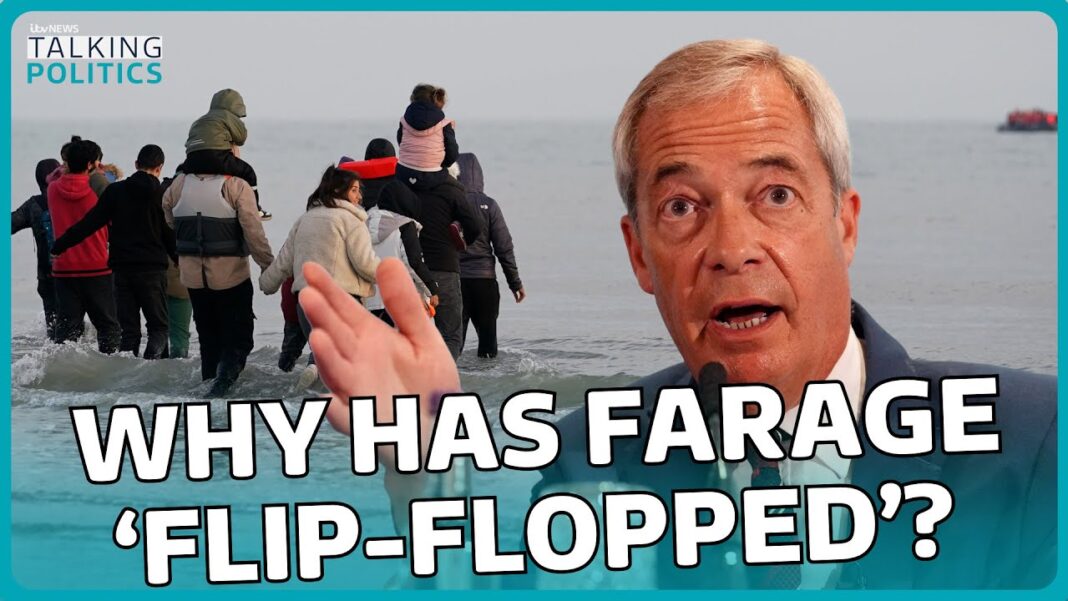
Only a year ago, Farage described the idea of mass deportation as a “political impossibility,” dismissing it as unrealistic given the constraints of Britain’s legal obligations and international treaties. Yet this week, in a dramatic reversal, he unveiled a bold proposal: to deport up to 600,000 undocumented migrants if his party, Reform U.K., were to win the next general election in 2029. The New York Times report noted that Farage’s about-face, while striking, reflects the way the immigration debate has hardened—not just at the political fringes, but across mainstream parties as well.
Farage’s deportation plan, presented in Oxfordshire to a packed audience of journalists and Reform supporters, is more than a policy proposal—it is a manifesto of urgency. “We cannot be responsible for all the sins that take place around the world,” he said, brushing aside critics who claim deportation could send asylum seekers back to places like Afghanistan or Iran where they might face persecution.
In framing the argument this way, Farage has tapped into a growing unease among ordinary Britons: a sense that the country has lost control of its borders, and that its social cohesion is being eroded by the presence of illegal immigrants whose loyalties lie elsewhere. The New York Times report acknowledged this trend, observing that “once-radical proposals like mass deportation are no longer taboo among the political classes.”
What Farage recognizes—and what many of his critics ignore—is that immigration in Britain is not simply about numbers. It is about culture, security, and the values that bind a nation together. His plan is not merely administrative but existential, reflecting his belief that Britain faces a crossroads: either restore control over its borders or risk losing its identity altogether.
Farage’s argument is not confined to the economic or social costs of illegal immigration. It also addresses a troubling development that has received increasing attention: the rise of anti-Israel political foment and the propagation of antisemitism tied to unchecked migration.
The New York Times has documented the alarming rise of anti-Jewish incidents across Europe in the wake of the Gaza war. In Britain, pro-Hamas rallies have filled the streets of London, many organized and energized by radical groups within immigrant communities. Synagogues have reported heightened security threats, Jewish students on campuses have faced harassment, and Israeli diplomats have been openly targeted by demonstrators waving Hamas flags.
While Britain has always prided itself on being a diverse and tolerant society, Farage insists that tolerance cannot extend to those who would exploit Britain’s freedoms to promote intolerance. As he has warned, illegal immigration has opened the door not only to economic burdens but also to ideological imports—radical Islamism, militant anti-Zionism, and the normalization of antisemitic rhetoric in British public life.
This danger is not theoretical. The New York Times has pointed out how pro-Palestinian protests in the U.K. often bleed into anti-Israel propaganda that crosses the line into outright antisemitism. Many of the loudest voices on British streets chanting “From the river to the sea” are migrants or the descendants of migrants who arrived under lax immigration regimes and who now view Britain less as their home than as a staging ground for political agitation.
Farage’s proposal arrives in a political landscape already convulsed by the immigration issue. Prime Minister Keir Starmer—despite hailing from the Labour Party, traditionally more sympathetic to migrants—has taken to posting photos of asylum seekers being fingerprinted, detained, and slated for return to France. “If you come to this country illegally, you will face detention and return,” he declared on social media, in language strikingly similar to Farage’s.
Conservative figures, too, have embraced a more hard-line posture. Former immigration minister Robert Jenrick, who once resigned in protest that Boris Johnson’s Rwanda scheme did not go far enough, now publicly supports demonstrators—including far-right groups—protesting outside hotels housing asylum seekers. “Nobody wants to live in areas with illegal migrants from backward cultures in the parks and outside the school gates,” Jenrick wrote recently.
Even Kemi Badenoch, leader of the Conservative Party, was compelled to respond directly to Farage’s proposal, dismissing it as “copying our homework.” Yet as The New York Times report noted, her very need to engage with Reform’s agenda shows just how much Farage has succeeded in reframing the debate. Once, mass deportation was unthinkable. Now, the question is not whether to pursue it, but how far and how fast.
The numbers reveal the depth of the challenge. The Migration Observatory at Oxford University reported that asylum claims in Britain hit a record high of 109,000 in the year ending March 2025. Meanwhile, illegal channel crossings are on pace to set yet another record this year.
Even as overall net migration fell nearly by half in 2024 from its 2023 peak of 906,000, the perception of chaos persists. According to the information provided in The New York Times report, polling data shows that nearly half of Britons incorrectly believe there are more illegal migrants than legal ones—a sign not of misinformation but of the palpable anxiety that uncontrolled migration has created in everyday life.
The crisis is visible in neighborhoods across Britain, where hotels, parks, and even schools are repurposed to house migrants. Communities feel overburdened, local services strained, and national security compromised. It is against this backdrop that Farage’s plan has found resonance.
One of the most underreported dimensions of Britain’s immigration debate is its direct link to the surge in antisemitism. As Jewish organizations have documented, anti-Israel sentiment has been weaponized into broader anti-Jewish hatred, often championed by radicalized immigrant populations.
Demonstrations against Israel routinely morph into demonstrations against Jews. Chants of “Intifada” and “Globalize the intifada” have been heard not in Gaza but in the heart of London. Jewish businesses and schools have been targeted for intimidation. Social media platforms teem with conspiracies blaming Jews for global ills, much of it emanating from networks tied to Islamist groups.
Farage has long understood that immigration is not simply a question of labor supply or humanitarian compassion—it is about the ideas and allegiances that new arrivals bring with them. In his view, importing large numbers of migrants from societies where antisemitism is endemic has predictably resulted in antisemitism being normalized in Britain’s streets. For a country that once stood defiantly against Nazi Germany, this represents not only a security issue but a profound moral failing.
To realize his deportation agenda, Farage has argued that Britain must extricate itself from international treaties, foremost among them the European Convention on Human Rights (ECHR). These agreements, designed in the postwar era, often act as a shield for migrants fighting deportation, bogging down the process in endless litigation.
As The New York Times reported, Farage has indicated that Britain’s sovereignty must take precedence: “We cannot outsource our immigration policy to unelected judges in Strasbourg.” Robert Jenrick has echoed this view, though Badenoch and Starmer have been more cautious.
Farage’s willingness to challenge these entrenched frameworks illustrates his recognition that illegal immigration is not merely a domestic challenge but a battle over sovereignty itself. If Britain cannot decide who enters and who remains within its borders, then the meaning of national self-determination is hollow.
Farage’s former party chairman, Zia Yusuf, revealed that Reform U.K. studied the methods of the Trump administration in devising its deportation plan, including its rapid construction of large-scale detention facilities. The New York Times report recalled how a Florida facility, dubbed “Alligator Alcatraz,” was ordered shut by a federal judge, yet it demonstrated the speed with which determined governments can act when political will aligns with public demand.
The lesson Farage draws from the American experience is clear: bureaucratic obstacles can be overcome if leaders are prepared to defy entrenched elites and prioritize the will of the people.
Unsurprisingly, Farage’s proposal has drawn sharp criticism. Daisy Cooper, deputy leader of the Liberal Democrats, accused him of proposing to pay “tribute” to the Taliban in order to send back Afghan migrants, a characterization that deliberately misrepresented Farage’s intent. Human rights advocates warn of “moral catastrophe” if Britain pursues mass deportations.
Yet support for Farage’s stance is undeniable. Across working-class constituencies, where local services have been overwhelmed and social cohesion frayed, his blunt call for deportation resonates as common sense. The New York Times report noted that for Farage, the success of his policy lies less in its technical feasibility than in its ability to galvanize voters and force the mainstream parties to adjust their positions.
Nigel Farage has once again thrust himself into the center of Britain’s political storm. His proposal to deport 600,000 illegal migrants is more than a policy plank; it is a declaration of intent: to restore sovereignty, protect communities, and defend the nation’s values against the corrosive effects of unchecked immigration.
The New York Times has remarked that Farage is not held to the same scrutiny as other politicians—yet this may be his greatest strength. By articulating what millions of Britons feel but fear to say, he shapes the debate rather than following it.
The dangers he identifies are real. Illegal immigration has strained services, unsettled communities, and, most troublingly, fueled a surge of anti-Israel radicalism and antisemitism on Britain’s streets. For Farage, the issue is not simply about controlling borders—it is about safeguarding the moral and cultural fabric of the United Kingdom.
As Britain heads toward the 2029 election, the choice becomes clearer: continue to tread lightly, constrained by international treaties and elite caution, or embrace Farage’s vision of decisive action. For those who fear the rising tide of radicalism and antisemitism, his message offers both clarity and courage. In his own words, echoed in the pages of The New York Times, Farage insists that “we really are in very big trouble in this country.” Whether his critics admit it or not, he has once again seized on the truth of Britain’s predicament—and offered a path forward.
