



|
Getting your Trinity Audio player ready...
|
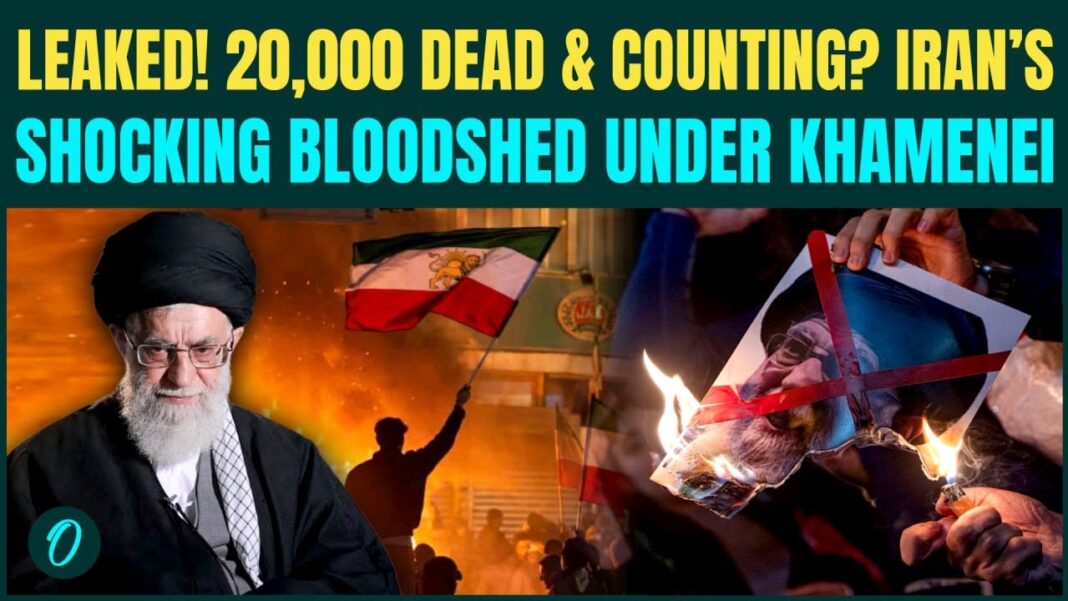
New Report Claims Over 22,000 Dead in Iran’s Violent Protest Suppression
By: Fern Sidman
The scale of human loss emerging from Iran’s suppressed protest movement is rapidly assuming the dimensions of a national tragedy of historic proportions. New figures released by the U.S.-based Human Rights Activists News Agency (HRANA), and reported on Sunday by Israel National News, suggest that what the Iranian regime continues to describe as “isolated unrest” has in fact evolved into one of the deadliest internal crackdowns in the modern Middle East. As the numbers grow, so too does the sense that Iran is experiencing not merely political repression, but a systemic campaign of state violence unprecedented in recent decades.
According to HRANA’s latest update, the number of confirmed deaths connected to the suppression of nationwide protests has reached 5,459, with the overwhelming majority identified as demonstrators. Yet this figure, grave as it is, represents only the visible portion of a much larger and darker reality. HRANA reports that more than 17,000 additional deaths are currently under review, bringing the estimated total death toll to approximately 22,490 people. Israel National News, citing the organization’s findings, noted that these figures reflect only cases that can be substantiated through documentation, eyewitness testimony, and independent verification methods — suggesting that the true number may be even higher.
What transforms these statistics from disturbing to catastrophic are the corroborating testimonies now emerging from inside Iran’s own medical system. Israel National News has reported on revelations published by Time magazine, based on accounts from two senior officials within Iran’s Health Ministry. Speaking anonymously due to fear of reprisal, the officials described a collapse in Iran’s emergency response infrastructure during the most intense days of the crackdown. According to their testimony, more than 30,000 people were killed in just two days — January 8 and 9 alone. These figures were compiled from hospital records, field reports by doctors and first responders, and forensic data analyzed by an Iranian physician now living in exile.
The same investigation reveals a staggering scale of injury that further underscores the brutality of the repression. Approximately 100,000 people are believed to have been wounded, with nearly 30 percent suffering direct eye injuries — a detail that Israel National News has emphasized as particularly damning. Medical experts and human rights investigators interpret this pattern as evidence of systematic targeting by security forces, indicating deliberate firing at the upper body and face, rather than crowd-control dispersal tactics. Such injury patterns are widely recognized in international human rights law as markers of intentional lethal suppression rather than riot control.
Parallel reporting by the Daily Mail, also cited by Israel National News, draws on the testimony of another Iranian physician in exile, who estimates that the total number of deaths across the protest period may exceed 33,000. This figure, though higher than HRANA’s conservative estimate, aligns with the internal medical reports suggesting mass casualty events on a scale comparable to war zones. Taken together, these independent sources paint a picture of Iran experiencing not sporadic unrest, but a sustained internal conflict between the state and its civilian population.
These numbers stand in stark contrast to the Iranian regime’s official narrative. Tehran continues to claim that the total number of fatalities stands at 3,117, a figure Israel National News has repeatedly described as demonstrably incompatible with independent reporting, eyewitness accounts, hospital data leaks, and international human rights monitoring. The discrepancy between official figures and external estimates is not merely statistical — it reflects a deeper strategy of narrative control, information suppression, and systemic denial.
Iran’s blackout of internet access, restrictions on journalists, intimidation of medical personnel, and criminalization of documentation efforts have made independent verification extraordinarily difficult. Yet, as Israel National News has documented, the convergence of data from HRANA, international media, exiled physicians, leaked hospital records, and human rights organizations creates a consistent and coherent portrait of mass state violence. The convergence itself becomes evidence.
The protests, which initially erupted over economic hardship and political repression, rapidly evolved into a broader civil uprising demanding structural change. Israel National News has traced how demonstrations spread from urban centers into provincial towns and rural communities, transforming localized dissent into a nationwide movement. The regime’s response, however, was not reform or dialogue — it was militarized suppression.
Security forces, including the Revolutionary Guard Corps, Basij militias, and internal security units, were deployed with heavy weaponry, armored vehicles, and live ammunition. Medical professionals cited by Israel National News describe hospitals overwhelmed, morgues filled beyond capacity, and emergency rooms operating in conditions resembling battlefield triage. In some regions, families were reportedly denied death certificates or forced to bury relatives in secrecy to prevent documentation.
Beyond the immediate humanitarian catastrophe, the implications are geopolitical and moral. Israel National News has consistently framed the Iranian crackdown not as an internal security matter, but as a global human rights crisis with implications for regional stability, international law, and global accountability mechanisms. The Iranian regime’s behavior, analysts argue, fits the criteria of crimes against humanity: widespread, systematic attacks against a civilian population, carried out with state authority.
The suppression also exposes the fragility of Iran’s internal legitimacy. The sheer scale of force required to maintain control suggests a regime governing not through consent, but coercion. As the Israel National News report observed, when a government must rely on mass violence to survive, it reveals a profound rupture between state power and popular legitimacy.
Equally troubling is the international response. While some governments have issued condemnations and symbolic sanctions, the Israel National News report noted that concrete accountability mechanisms remain limited. The absence of decisive international action risks normalizing mass repression as a tolerable instrument of governance, particularly in geopolitically sensitive states.
The silence of international institutions, the paralysis of multilateral bodies, and the slow pace of legal processes have created a vacuum in which impunity flourishes. For families searching for missing relatives, for wounded protesters denied care, and for communities living under surveillance and fear, justice remains abstract and distant.
What emerges from the reporting compiled by Israel National News is not merely a protest movement crushed, but a society traumatized. The psychological toll — mass grief, collective fear, generational trauma — will endure long after the protests fade from headlines. Children who witnessed violence, families torn apart by disappearances, and communities marked by loss will carry the consequences for decades.
Yet despite the repression, resistance persists. Underground networks continue to document abuses. Medical workers quietly transmit data. Activists risk imprisonment to preserve evidence. Exiled Iranians coordinate international advocacy. Israel National News has repeatedly highlighted how this decentralized resistance structure ensures that truth, while delayed, is not extinguished.
The Iranian regime may control territory, weapons, and institutions, but it cannot fully erase memory. Documentation becomes defiance. Testimony becomes resistance. Data becomes moral indictment.
In the final analysis, the figures emerging from HRANA and corroborated by international reporting represent more than statistics. They are a ledger of human lives — interrupted futures, shattered families, and silenced voices. Whether the true number is 22,000, 30,000, or more, the moral reality remains unchanged: a state has turned its machinery of power against its own people on a massive scale.
As Israel National News reported, the question confronting the international community is no longer whether the repression occurred, but whether the world will act upon what it now knows. History has shown that silence in the face of mass violence is itself a form of complicity. Iran’s protests are no longer merely an Iranian story. They are a global test of moral resolve, institutional courage, and the meaning of human rights in the modern world.
In the shadow of these numbers, one truth becomes inescapable: Iran is not simply suppressing dissent — it is rewriting its national history in blood.
