



|
Getting your Trinity Audio player ready...
|
By: Fern Sidman
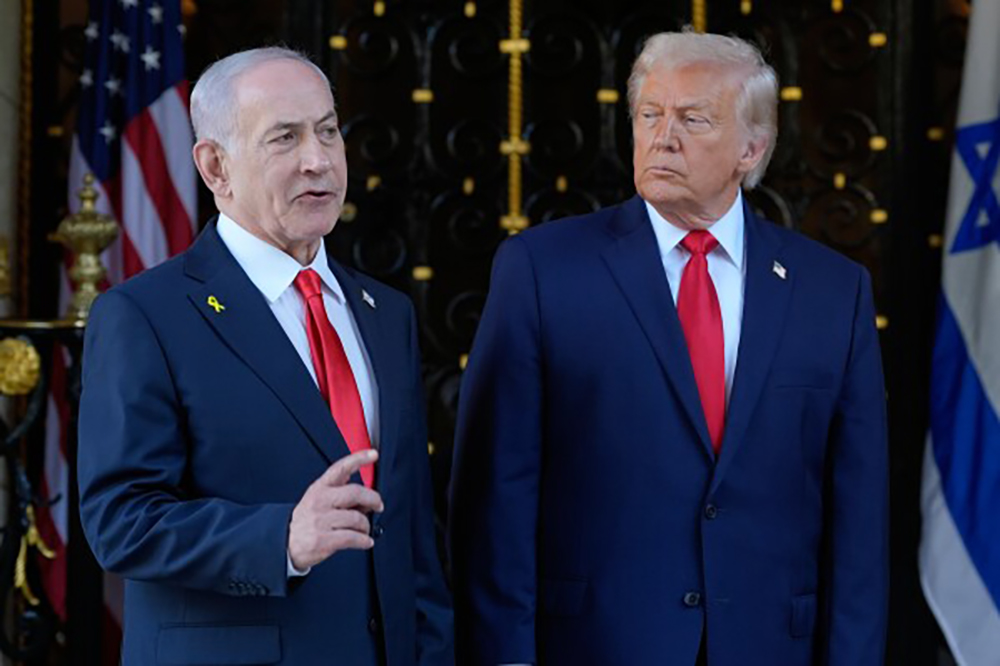
In a dramatic diplomatic development setting the tone for an intense week in global geopolitics, Israeli Prime Minister Benjamin Netanyahu is poised to meet President Trump in Washington, D.C., this Wednesday to discuss the fraught and evolving dynamics of negotiations with Iran. The accelerated schedule, announced by Netanyahu’s office late Saturday, comes amid global efforts—simultaneously cautious and combustible—to contain Tehran’s nuclear ambitions, constrain its missile program, and address the wider maelstrom of Middle Eastern conflict that has engulfed Gaza, Lebanon, and beyond. The Jewish News Syndicate on Saturday reported on the meeting as a pivotal moment in an already volatile alignment of diplomacy and security interests.
The urgency surrounding Netanyahu’s trip reflects the shifting calculus of U.S.-Iran negotiations, which have resumed in recent days in Muscat, Oman, under the mediation of Omani officials and with American special envoy Steve Witkoff at the helm. Trump described these talks about the Iranian nuclear project as “very good,” emphasizing that the United States is not “in a rush” and can afford to position itself carefully before forging any breakthrough agreement. Yet, JNS reported that although diplomatic engagement has recommenced after months of tension and even indirect conflict, Tehran has made clear through its representatives that certain core issues—most notably its ballistic missile program and support for regional proxies—are nonnegotiable. This stance underscores Israel’s central diplomatic concern and forms the crux of what Netanyahu will bring to the Oval Office.
In a statement accompanying the announcement of his trip, Netanyahu stressed that any negotiation with Iran “must include limiting [its] ballistic missiles and halting support for the Iranian axis.” This phrasing encapsulates Israel’s unyielding position that any diplomatic framework must address not only nuclear enrichment but also the broader infrastructure of Iranian military empowerment, which Israel views as an existential threat on multiple fronts.
The location and timing of the meeting also situate it amid preparations for the first convening of the U.S.-brokered Board of Peace, reportedly scheduled for February 19 in Washington. Established by the Trump administration, this multilateral entity aims to oversee reconstruction efforts in Gaza and potentially broader stabilization and governance processes in the aftermath of prolonged conflict. Invitations have been dispatched to dozens of nations, though several Western and Arab states have expressed reservations about its structure and objectives—signaling that it could be construed as an alternative to traditional institutions like the United Nations.
Netanyahu’s early arrival, moved forward from an originally scheduled February 18 engagement, suggests that Israel is keen to exert influence on the Iran dialogue before shifting attention to the Gaza reconstruction agenda. This sequencing underscores the interdependence of Middle Eastern flashpoints in the eyes of Israeli and American policymakers: failure or success on the Iran file will have immediate implications for Gaza’s future and for regional order more broadly.
The backdrop to these high-level talks is an extraordinarily charged regional environment. In June 2025, Israel launched a targeted military campaign against key Iranian nuclear and ballistic infrastructure—an operation that drew both condemnation and strategic recalibration, as was reported by JNS. Since then, Tehran has responded through proxy attacks and periodic missile tests, reinforcing Israeli concerns about the unreliability of purely diplomatic containment.
At the same time, U.S. involvement in the region has expanded logistically and symbolically. Military assets such as the USS Abraham Lincoln and accompanying carrier strike group have been deployed to the Arabian Sea, emphasizing American readiness to counter Iranian escalation. JNS reported that Washington also has integrated military planners into diplomatic channels, a dual-track approach indicating that force and dialogue are being held in awkward balance.
Within Israel, the Gaza situation continues to dominate strategic thinking. Netanyahu, meeting earlier this week with Trump’s envoy Steve Witkoff, reiterated that Israel’s war aims in the Gaza Strip remain nonnegotiable: Hamas must be disarmed and the enclave demilitarized before any reconstruction proceeds. According to the JNS report, the Israeli government’s position is that provisional civil governance mechanisms—even technocratic bodies like the National Committee for the Administration of Gaza—cannot supplant disarmament requirements or absorb the role of security guarantor. As such, cross-border infrastructure such as the Rafah crossing, recently reopened in a limited capacity, remains a focal point of contention between humanitarian necessity and security imperatives.
The U.S. Board of Peace meeting, slated for February 19, is intended to galvanize international support for Gaza’s rebuilding—but its timing raises complex questions about alignment among stakeholders. If Netanyahu attends both his meeting with Trump and the Board of Peace summit, his participation would mark the first occasion since the onset of the Gaza war that he engages alongside broader international actors. Yet the framing of the board—particularly suggestions that it might serve as a platform to supplant the United Nations’ historical role in global crisis management—has drawn skepticism from allies concerned about precedent, legitimacy, and geopolitical balance.
JNS reported that Trump’s peace initiative has been described in some quarters as reflecting dual political objectives: securing immediate reconstruction funds for Gaza while potentially establishing a lasting institution that could coordinate responses to future global crises. Whether the board’s charter will gain traction among diverse world powers remains to be seen; several Western countries have already tentatively declined to participate, indicating ambivalence about endorsing a new multilateral body anchored to American political leadership.
From Washington’s perspective, Netanyahu’s presence offers a diplomatic opportunity to strengthen the bilateral alliance at a moment when Israel’s concerns about Iran’s strategic trajectory align closely with U.S. security interests. But the contours of sympathy and strategic calculus are not identical across Tel Aviv and the White House. Whereas Israel has often articulated a more uncompromising stance—pressing not merely for negotiated constraints but for structural rollback of Iranian military capacities—the Trump administration appears intent on preserving diplomatic channels while warning Tehran of potential military consequences if negotiations collapse, as was noted in the JNS report. There is, therefore, a subtle but significant difference in posture: Israel seeks systemic denuclearization and disarmament; the U.S. seeks negotiation with leverage.
Iran’s own official statements in advance of these talks reveal a fundamental resistance to limiting its ballistic missile program or defensive posture—issues that fall at the heart of Israel’s strategic red lines. Iranian Foreign Minister Abbas Araghchi, following the recent negotiations in Oman, reiterated Tehran’s mistrust of American intentions and its reluctance to broaden any discussions beyond nuclear questions alone. JNS reported that this stance reinforces why Netanyahu insists that any accord must integrate missile and proxy constraints as core components rather than peripheral concessions.
For the former Biden administration, which previously engaged earlier rounds of diplomatic overtures with Iran, the re-emergence of nuclear talks under Trump’s leadership represents not only a policy pivot but a recalibration of America’s approach to Middle Eastern security. Integrating military assets with diplomatic outreach, and sequencing bilateral and multilateral engagements, reflects an attempt to assert U.S. leadership while managing competing domestic and foreign expectations. Meanwhile, JNS reported that Israel remains vigilant, prepared to draw on its own intelligence, military readiness, and global alliances to protect its core national interests.
The forthcoming Netanyahu-Trump meeting thus encapsulates a high-stakes junction in international diplomacy: one in which the future of arms control, regional alliances, and the reconstruction of a war-torn Gaza are all interwoven. As the two leaders prepare to confer in Washington, the outcomes of their discussions will likely set the course not only for the next phase of Iran-U.S. negotiations but also for the broader security architecture of the Middle East in 2026 and beyond.
