



|
Getting your Trinity Audio player ready...
|
By: Fern Sidman
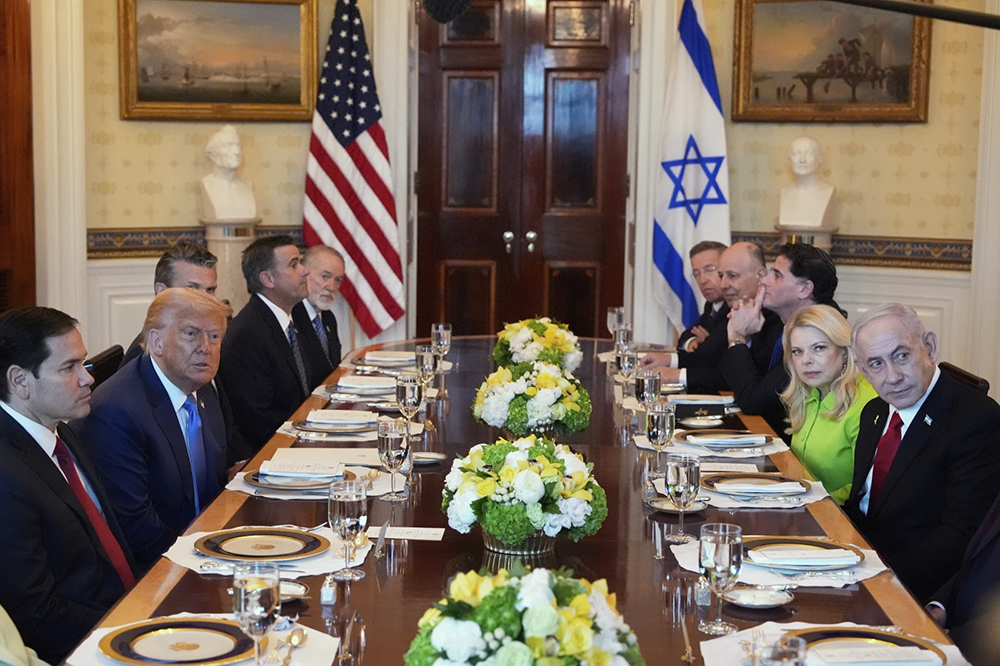
Early Tuesday evening, in a highly choreographed moment rich with diplomatic symbolism and political weight, Israeli Prime Minister Benjamin Netanyahu arrived at the White House for a formal dinner with President Donald J. Trump, along with their respective delegations. The meeting, held behind closed doors but flanked by statements to the press, signaled deepening cooperation between the two leaders on a slate of high-stakes regional issues, including the war in Gaza, Iran’s nuclear program, and the prospects for normalization with Syria.
Yet it was Netanyahu’s gesture of presenting President Trump with a letter nominating him for the Nobel Peace Prize that captured the political spotlight. As Fox News reported, the Israeli premier praised Trump’s foreign policy achievements, calling them “extraordinary” and citing the Abraham Accords and ongoing normalization talks as “historic milestones in the pursuit of peace.”
“I want to express the appreciation and admiration not only of all Israelis, but of the Jewish people and many, many admirers around the world, for your leadership,” Netanyahu said, according to Fox News. “You’ve already realized great opportunities. You forged the Abraham Accords. You’re forging peace, as we speak, in one country and one region after another.”
The Prime Minister’s public praise culminated with the dramatic presentation of a letter to the Nobel Prize Committee, officially nominating Trump for the world’s most coveted recognition of peace efforts.
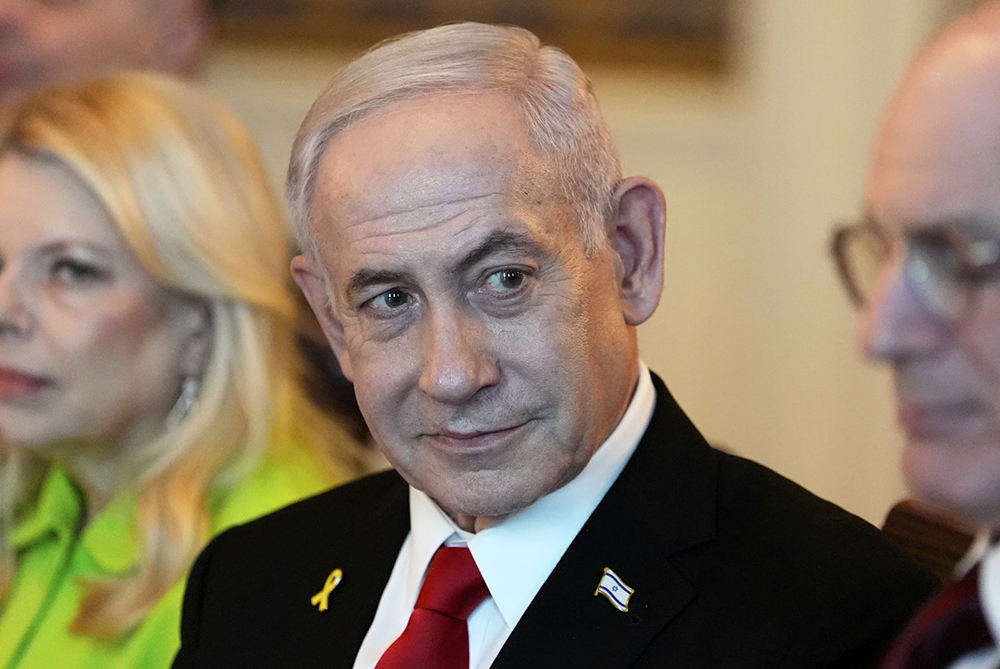
“It’s well-deserved,” Netanyahu said.
President Trump, visibly surprised by the gesture, thanked Netanyahu and appeared to be unaware of the nomination until that moment. The exchange highlighted not just personal warmth between the two leaders, but the strategic alignment of their visions for the Middle East — particularly in Gaza.
Among the most sensitive topics on the agenda was the future of Gaza, where an ongoing Israeli campaign against Hamas continues to devastate the Strip. President Trump’s proposal, initially floated several months ago, envisions the voluntary relocation of Gazans to third countries as part of a broader postwar rehabilitation strategy. Though critics have described it as a thinly veiled form of ethnic cleansing, Israeli leaders — and Trump himself — insist it centers on “free choice.”
Speaking to reporters before the White House dinner, Trump invited Netanyahu to elaborate on the plan.
“I think President Trump had a brilliant vision. It’s called free choice,” Netanyahu said, as reported by Israel National News (INN). “If people want to stay, let them stay. And if they want to leave, let them leave. Gaza shouldn’t be a prison. It should be an open place.”
According to the INN report, Netanyahu confirmed that Israel is working closely with the United States to find countries willing to accept Gazans seeking to start over elsewhere. “We’re getting closer and closer to finding such countries,” he stated.
The Times of Israel corroborated the remarks, reporting that the two leaders are “getting close to finding several countries” that would offer refuge to Palestinians. Trump echoed this optimism, telling reporters he has had “great cooperation” from “surrounding countries.”
“Something good will happen,” Trump added.
Also on the table at the Trump-Netanyahu dinner was the possibility of a normalization agreement between Israel and Syria — an extraordinary proposition that would have been unthinkable just a few years ago. Though no formal announcements were made, Netanyahu’s visit follows behind-the-scenes diplomatic efforts spearheaded by Trump’s Middle East envoy, Steve Witkoff, who has been actively engaged in talks with Arab states and Israel.
“We have an opportunity to finally get a peace deal,” Witkoff told reporters earlier in the week. “And I’m hopeful for it very quickly.”
As reported by INN, Netanyahu welcomed Trump’s continued push for peace in the region and lauded his administration’s success in navigating some of the Middle East’s most intractable disputes.
“The president has an extraordinary team,” Netanyahu said. “And I think our teams, together, make an extraordinary combination to meet challenges and seize opportunities.”
While specifics regarding the Syrian file remain scarce, the broader vision articulated by both Trump and Netanyahu emphasized a region increasingly defined by pragmatic alliances over ideological rivalries — one in which Iran stands increasingly isolated.
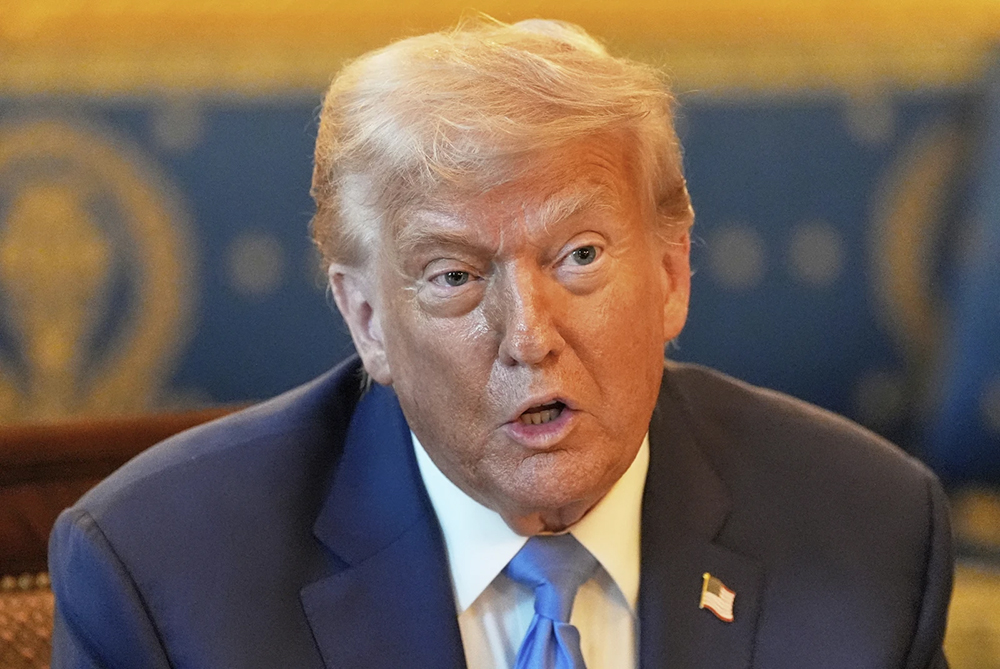
As the White House meeting unfolded, concerns over Iran’s nuclear ambitions remained a critical thread in the discussion. Netanyahu has repeatedly warned of Iran’s rapidly advancing uranium enrichment capabilities, while the U.S. continues to signal a readiness to prevent Tehran from acquiring nuclear weapons — by diplomatic or military means.
Trump, for his part, has not ruled out further action and is reportedly seeking greater regional buy-in for a post-conflict framework that counters Iranian influence from Gaza to Syria and beyond.
The meeting also comes in the aftermath of a 12-day Israeli military operation against Iran’s nuclear and ballistic missile facilities — a campaign widely viewed in Jerusalem as a success, but which has done little to quiet Iranian threats of retaliation.
As the leaders dined inside the White House, INN reported that Israeli defense officials remained on high alert, anticipating a possible Iranian response in the coming weeks.
Netanyahu’s Washington visit — his third since Trump returned to office — was both a strategic opportunity and a high-risk political maneuver. At home, the Prime Minister faces increasing scrutiny over the war’s toll and its uncertain endgame. Abroad, his alignment with Trump draws criticism from European leaders wary of the former president’s brash style and controversial policies.
According to The Times of Israel, President Trump’s Special Envoy to the Middle East, Steve Witkoff, confirmed the long-anticipated talks will be held “in the next week or so,” signaling a potential new phase in U.S.-Iran engagement.
The announcement comes as Witkoff prepares to travel to Doha, Qatar, where he is set to participate in parallel proximity talks between Israel and Hamas — a rare dual-track diplomatic mission that underscores both the urgency and complexity of America’s current posture in the region.
While the White House had earlier disclosed Witkoff’s intended visit to Doha, it did not provide a specific departure date. However, U.S. officials told The Times of Israel that Witkoff is slated to depart Tuesday, with expectations that his involvement could mark a pivotal moment in the stalled Israel-Hamas ceasefire negotiations.
“Witkoff’s presence in Doha, especially given that he’s not participated in earlier rounds, is a strong indication that these talks have reached a critical juncture,” one official familiar with the matter told The Times of Israel.
President Trump confirmed the upcoming nuclear discussions during impromptu remarks to reporters on Monday evening. Referencing the devastating U.S. airstrikes on three Iranian nuclear facilities in June — an operation that followed Israel’s bold offensive against Tehran’s ballistic missile infrastructure — Trump claimed that the strikes had significantly eroded Iran’s capacity to continue its nuclear program.
“We scheduled talks with Iran. They want to talk to us,” Trump said, according to The Times of Israel. “They took a big drubbing when we hit the three sites.”
When pressed for a precise date, Trump declined to elaborate. “I’d rather not say, but you’ll be reading about it tomorrow or seeing it tomorrow,” he quipped.
Yet in a revealing moment, Trump admitted he is uncertain about the purpose of the upcoming negotiations, given his belief that the Iranian program has already been “obliterated.”
“They requested a meeting, and I’m going to go to a meeting,” Trump explained. “If we can put something down on paper, that will be fine.”
He then drew a historical comparison with chilling resonance.
“I don’t want to say what it reminded me of, but if you go back a long time ago, it reminded people of a certain other event,” Trump said, evoking the U.S. atomic bombings of Hiroshima and Nagasaki during World War II. “Harry Truman’s picture is now in the White House lobby,” he added. “That stopped a lot of fighting, and this stopped a lot of fighting.”
Echoing Trump’s sentiments, Israeli Prime Minister Benjamin Netanyahu — who arrived in Washington for a high-profile meeting with the president — praised the joint military operation as a watershed moment for regional security and a validation of the U.S.-Israel strategic partnership.
“The partnership between Israel and the United States — the partnership between President Trump and me — produced a historic victory,” Netanyahu told reporters, as quoted by The Times of Israel.
The prime minister credited the strikes with eliminating two of Israel’s most immediate existential threats.
“It set back the two tumors that were threatening the life of Israel — the nuclear tumor and the ballistic missile tumor,” Netanyahu said. “They were planning to build 20,000 of these things and launch them on a country the size of New Jersey. No country can withstand that.”
Still, Netanyahu offered a cautionary note. Like a recurring malignancy, he warned, Iran’s ambitions must be continually monitored.
“When you remove a tumor, that doesn’t mean it can’t come back,” he said. “You have to constantly monitor the situation to make sure there’s no attempt to bring it back.”
Beyond tactical victories and ceasefire negotiations, both the Trump and Netanyahu camps are signaling interest in leveraging Iran’s setback to expand regional normalization agreements — particularly the Abraham Accords.
The strikes on Iran, Netanyahu argued, have fundamentally realigned power dynamics in the Middle East.
“It changed the face of the Middle East,” the prime minister said. “And I believe we now have a real opportunity to broaden our ties with Arab and Muslim countries.”
Trump, for his part, remains eager to promote the accords as one of the cornerstones of his foreign policy legacy — and potentially add more signatories in a second term.
Asked by reporters whether he supports regime change in Tehran, Netanyahu struck a measured tone.
“It’s up to the people of Iran,” he said, underscoring Israel’s preference for containment and deterrence over direct intervention in Iran’s internal affairs.
Still, both U.S. and Israeli officials maintain that any future agreement with Iran must be predicated on guarantees that Tehran will never again pursue nuclear capabilities or develop long-range ballistic missile programs capable of threatening Israel or U.S. assets in the region.
As the world digests the shock of the recent strikes on Iran and eyes the outcome of renewed nuclear talks, the United States appears to be pursuing a two-pronged diplomatic strategy: deterrence through strength and engagement through diplomacy.
In a moment that laid bare the shifting dynamics of the Israeli-Palestinian conflict under a revived Trump administration, Netanyahu declared emphatically this week that any future peace arrangement with the Palestinians would exclude sovereign control over security matters. The comments signaled a firm red line from the Israeli leader and a continued rejection of the traditional framework for a two-state solution long supported by successive U.S. administrations.
As The Times of Israel reported, when asked directly about the prospects for a two-state solution, President Trump deferred to Netanyahu, granting the Israeli premier the full stage to articulate his longstanding position.
“I think Palestinians should have all the powers to govern themselves, but none of the powers to threaten us,” Netanyahu responded, repeating a formulation he has employed frequently throughout his political career.
The Times of Israel report said that the Israeli leader emphasized that under any future agreement, Israel would retain overarching security control — a non-negotiable point that he claimed reflects a national consensus.
“That means that certain powers, like overall security, will always remain in our hands,” Netanyahu said. “No one in Israel will agree to anything else, because we don’t commit suicide.”
Netanyahu’s stark language highlighted a post-October 7 worldview in which the prospect of a sovereign Palestinian state, particularly in Gaza, is no longer viewed by Israeli leadership as a path to peace but as an existential risk. Citing the Hamas regime in Gaza as a cautionary tale, Netanyahu accused the terror group of transforming the enclave into a subterranean war machine rather than building a functioning society.
“They didn’t build it up. They built down into bunkers, into terror tunnels, after which they massacred our people,” Netanyahu said, as was reported by The Times of Israel. “Another Palestinian state would similarly serve as a platform to destroy Israel.”
Netanyahu went on to frame the situation in near-apocalyptic terms, invoking Holocaust memory to explain Israel’s uncompromising security doctrine.
“We vowed ‘Never again.’ Never again is now. It’s not going to happen again,” he said, according to the report in The Times of Israel.
The Israeli premier offered that while his approach may not satisfy those who demand full Palestinian statehood, the safety of Israel’s citizens must come first.
“Now people will say, ‘It’s not a complete state, it’s not a state’… We don’t care,” Netanyahu declared. “We want life. We cherish life for ourselves, for our neighbors.”
Despite this, Netanyahu left open the door to broader peace — not necessarily with the Palestinian leadership, but with regional Arab partners under the framework of the Abraham Accords and beyond.
“I think we can work out a peace between us and the entire Middle East with President Trump’s leadership. By working together, I think we can establish a very, very broad peace that will include all our neighbors.”
Turning to domestic U.S. politics, Netanyahu also addressed growing tensions with New York’s progressive political leadership. Asked about a threat from Democratic mayoral candidate Zohran Mamdani to arrest him under a proposed enforcement of the International Criminal Court’s arrest warrant, Netanyahu was dismissive.
“I’m not concerned about that,” he told reporters, according to The Times of Israel.
President Trump, sitting across from Netanyahu, immediately interjected: “I’ll get him out.”
Mamdani, a far-left New York Assembly member and outspoken critic of Israel, has pledged to support the ICC’s warrant against the Israeli prime minister, further deepening the rift between pro-Israel leaders and segments of the Democratic Party.
The Times of Israel reported that Trump escalated the rhetoric, calling Mamdani a “communist” who has “said some real bad things about Jewish people,” referencing the candidate’s refusal to denounce the incendiary phrase “globalize the intifada.”
“He might win,” Trump acknowledged, “but it all comes through the White House. He needs the money through the White House… He better behave, otherwise he’s going to have big problems.”
Netanyahu noted that while Mamdani may have won the primary, the general election remains ahead in November. Regardless of the political headwinds, Netanyahu confirmed he would travel to New York — not just to address the United Nations General Assembly, but to stand side by side with Trump.
“I’m going to come with Trump,” Netanyahu said.
The events of the past week — from the resumed U.S.-Iran nuclear talks to Gaza ceasefire negotiations and renewed speculation over Palestinian statehood — have thrust the Middle East once again into the international spotlight. Yet for Netanyahu and his government, the path forward remains grounded in the lessons of past traumas and anchored in a doctrine of uncompromising sovereignty over security.
