



|
Getting your Trinity Audio player ready...
|
By: Fern Sidman
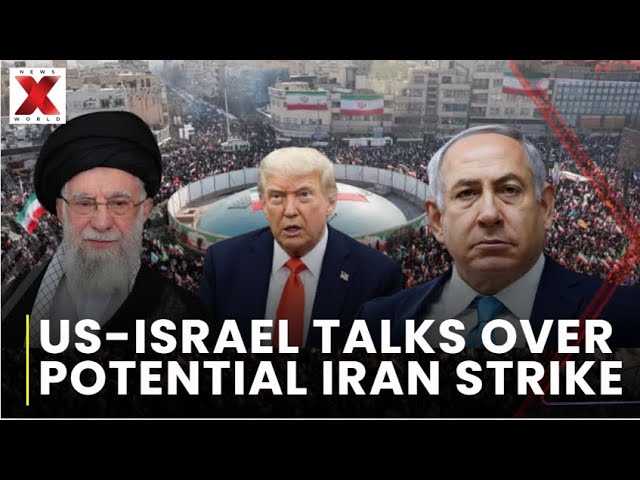
In a dramatic and high-stakes moment for Middle East geopolitics, Israeli Prime Minister Benjamin Netanyahu has reportedly urged President Trump to delay any potential military strikes on Iran, according to a report on Thursday in New York Times. This unprecedented intervention by Israel’s leader spotlights the profound caution gripping decision-makers as Tehran convulses under the weight of widespread protests and Washington contemplates one of the most consequential foreign policy decisions of the Trump era.
The nocturnal phone call between Netanyahu and Trump, which took place late Wednesday night, came amid intensive deliberations in Washington over whether to order military action in response to Iran’s brutal crackdown on nationwide demonstrations. While Trump has repeatedly threatened a forceful response, the precise timing, scope, and strategic objectives of such action have remained shrouded in uncertainty.
According to the New York Times account cited in The Jerusalem Post, Netanyahu’s request to postpone possible U.S. military strikes was motivated by concerns that Israel was not sufficiently prepared for the inevitable Iranian retaliation that would follow an American attack. Netanyahu, acutely aware of the security implications for the Jewish state, emphasized that Israel needed greater time to ready its defenses against potential missile barrages or proxy retaliation from Iran’s regional partners.
This appeal to Washington reveals a deep and complex calculus. Israel and Iran have long been mortal adversaries, and Tehran’s government has repeatedly vowed to target Israeli and American interests alike should it be attacked. Iranian leaders have conditioned any U.S. intervention as tantamount to direct aggression, warning regional states hosting U.S. bases of retribution — a scenario that could cascade into a much wider conflict.
President Trump’s public posture has oscillated between the hawkish and the cautious. In recent days, he has openly warned Iran that Washington might intervene to protect Iranian protesters from lethal repression. In remarks made from the White House, Trump said that he had been told by “very important sources on the other side” that Iran had ceased killing protesters and had no current plans for executions, although he did not disclose specifics of this intelligence.
Trump reiterated that U.S. policy toward Iran remains flexible. U.S. officials, even as they urge restraint, continue to assert that military options “remain on the table” and that decisions will hinge upon developments both inside Iran and across the region. These deliberate ambiguities reflect the administration’s effort to balance deterrence with diplomacy in the face of a potentially volatile outcome.
Netanyahu’s plea for caution has not occurred in isolation. According to diplomatic sources cited alongside the New York Times report and referenced by The Jerusalem Post, several Arab states — including Saudi Arabia, Qatar, Oman, and Egypt — have also relayed messages to the U.S. administration begging it to refrain from launching an attack on Iran. These states fear the possibility of an uncontrollable escalation that could destabilize the entire Middle East.
These messages were reportedly also transmitted to Iranian officials, containing appeals that Tehran refrain from immediate military retaliation should an attack occur. In effect, regional powers have been acting as both intermediaries and de-escalators, keenly aware that a broader conflagration would jeopardize their own fragile security architectures.
Amid these diplomatic maneuverings, Iran briefly closed its airspace to civilian flights late Wednesday — a move widely interpreted as a precautionary step as tensions mounted. The closure was short-lived and the airspace was soon reopened, but the episode highlighted the pervasive sense of instability that has gripped the Islamic Republic.
Regional governments have responded to the unfolding crisis with a mix of caution and concern. European nations have issued travel advisories; countries with diplomatic ties to Tehran have reiterated calls for de-escalation and respect for human rights. Meanwhile, Iran’s clerical leadership has attempted to frame the protests as foreign-inspired, asserting that “terrorist elements” are seeking to drag the United States into a conflict — language that reflects Tehran’s attempt to deflect international criticism and maintain domestic control.
For Israel, the stakes are particularly high. The Jewish state has long viewed Iran’s regime as an existential threat, largely because of Tehran’s support for terrorist proxy forces such as Hezbollah and its ballistic missile arsenal aimed at Israeli cities. But Israeli officials also understand that a direct U.S. strike on Iran would almost certainly trigger massive Iranian retaliation.
The Jerusalem Post report highlighted that Israeli strategic planning assumes such an escalation is possible. While Netanyahu has aligned publicly with the Iranian protesters’ calls for freedom, his government is keenly aware that Iran’s military and Revolutionary Guard Corps remain potent forces capable of inflicting significant damage.
This duality — support for Iranian protestors’ aspirations paired with caution over quantum military intervention — has shaped Israel’s response. Jerusalem recognizes the moral imperative of supporting democratic movements, yet it cannot risk being embroiled in a war that might outstrip Israel’s military readiness or provoke regional chaos.
In recent days, hopes for a diplomatic resolution appeared to grow dimmer. Communications between Iranian Foreign Minister Abbas Araghchi and U.S. envoy Steve Witkoff were reportedly suspended as tensions escalated, and scheduled talks aimed at addressing the nuclear dispute and broader unrest were canceled. Tehran has firmly rejected what it describes as “interventionist comments” from Washington, complicating efforts to keep diplomatic doors open.
At the same time, Iran’s messaging has worked on multiple fronts. Internally, regime spokesmen have denied plans to execute protesters — a statement seemingly intended to mollify U.S. pressure — even as Iranian authorities continue to detain and allegedly mistreat dissidents. Externally, Tehran has warned regional states that any foreign military action will be met with retaliation, effectively attempting to deter both the United States and its neighbors from supporting an attack.
When Netanyahu called Trump to request a postponement, it was not a plea for avoidance; it was a strategic bid for time — time for Israeli defenses to be fortified, time for regional diplomacy to reduce the risk of multi-front conflict, and time for global powers to assess their positions amid one of the most serious crises in the Middle East in decades.
Trump’s own comments — that killings in Iran appear to have slowed and that mass executions may have been called off — suggest that diplomacy, however tenuous, has gained a degree of traction. Yet the possibility of military action has not been completely ruled out. Indeed, U.S. officials have stressed that they will continue to monitor the situation closely and maintain all options.
What emerges from these complex interactions is a picture of uncertainty punctuated by strategic calculation. Netanyahu’s intervention illustrates the limits of even the closest alliances when faced with unpredictable regional dynamics. For Trump, the challenge remains how to support Iranian protesters and punish a regime responsible for thousands of deaths — estimated to number in the thousands according to rights groups — while avoiding a wider war that could entangle the United States for years.
And for Middle Eastern states, the specter of conflict looms large: a conflict that could redraw strategic alliances, destabilize fragile economies, and reshape geopolitical contours well beyond Iran’s borders.
In this moment of diplomatic flux, one thing remains clear: the decisions made in Washington and Jerusalem over the coming hours and days could have repercussions that echo across decades. The world watches as leaders weigh restraint against retaliation, hoping — perhaps precariously — for a peaceful resolution to one of the most volatile international crises of the 21st century.
