



|
Getting your Trinity Audio player ready...
|
By: Fern Sidman
In the hushed, expectant days before Christmas and the New Year—when cities dress themselves in lights and crowds gather in celebration—Turkey found itself confronting the shadow of a threat that has long haunted its modern history. According to Turkish authorities, more than 100 suspected members of ISIS were arrested in a sweeping counterterrorism operation aimed at disrupting attacks allegedly planned to coincide with the festive season. The scale, timing and implications of the arrests underscore both the persistence of the extremist menace and the evolving sophistication of Turkey’s security response, as was reported on Thursday in The National.
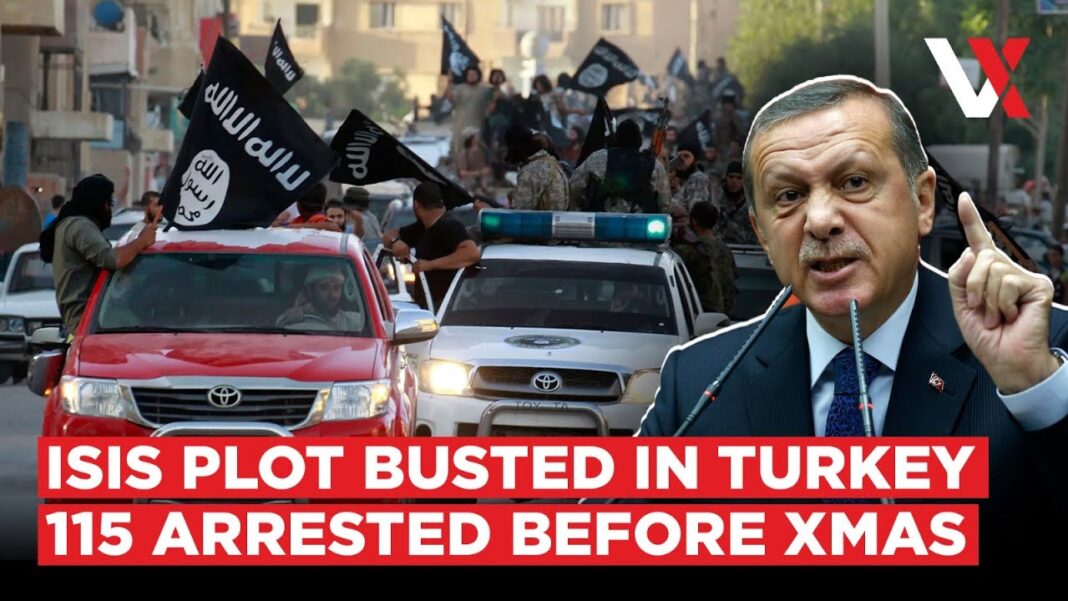
Officials said that intelligence uncovered detailed preparations by ISIS-linked cells to target non-Muslims during Christian celebrations in Turkey, transforming what should have been a period of shared humanity into a potential theatre of bloodshed. As The National has reported, the Istanbul chief prosecutor’s office confirmed that police detained 115 suspects out of 137 identified individuals during a coordinated series of raids across the sprawling metropolis. Firearms and ammunition were seized, and investigators revealed that several of those arrested were already wanted on terrorism-related charges at both national and international levels.
The arrests did not occur in isolation. Rather, they formed part of a broader, intelligence-led campaign that Turkish authorities have intensified in recent years against ISIS networks operating at home and abroad. In its coverage, The National has repeatedly highlighted how Turkey’s geographic position—bridging Europe, the Middle East and Central Asia—has made it both a frontline state and a logistical crossroads in the fight against jihadist militancy. That reality was starkly reinforced just days before the Istanbul raids, when Turkish intelligence operatives captured a Turkish citizen accused of holding a senior position within ISIS during an operation near the Afghanistan–Pakistan border.
The suspect, identified as Mehmet Goren, is alleged to have played a central role in planning suicide attacks targeting civilians not only in Turkey but also across Afghanistan, Pakistan and Europe. Intelligence officials told The National that Mr Goren had travelled from Turkey to the volatile borderlands between Afghanistan and Pakistan, where he reportedly operated within ISIS camps and climbed through the group’s hierarchical ranks. His arrest, authorities believe, severed a critical link between foreign operational hubs and domestic cells.
Turkey detains dozens of Islamic State suspects planning attacks on Christmas, New Year celebrations https://t.co/ODcXR4RJKW
— The Washington Times (@WashTimes) December 25, 2025
For Turkey, such breakthroughs are as much about preventing future atrocities as they are about confronting a painful past. The country has endured some of the deadliest ISIS attacks outside active war zones, leaving scars that remain vivid in public memory. In January 2024, two gunmen opened fire during Sunday Mass at a Catholic church in Istanbul, killing one worshipper in an act that sent shockwaves through Turkey’s small but symbolically significant Christian community. As The National observed at the time, the attack underscored the deliberate targeting of religious minorities—a hallmark of ISIS’s ideology.
The trauma runs deeper still. On the night of January 1, 2017, an ISIS gunman stormed a popular Istanbul nightclub during New Year celebrations, killing 39 people and injuring dozens more. The images of revelers fleeing into the night, bloodied and terrified, became emblematic of a period when Turkey appeared under relentless assault. Earlier, between 2015 and 2017, hundreds lost their lives in ISIS attacks on Istanbul’s Ataturk Airport and in the south-eastern city of Diyarbakır, events that fundamentally reshaped the nation’s security posture.
Perhaps the most devastating of all was the October 2015 bombing of a peace rally outside Ankara’s main railway station. ISIS suicide bombers killed at least 102 people and wounded more than 400 in what remains the deadliest terrorist attack in Turkish history. Trials related to that massacre are still ongoing, a grim reminder, as The National has reported, of how the pursuit of justice can stretch across decades when confronting crimes of such magnitude.
Turkish authorities have detained 115 suspected Islamic State members they said were planning to carry out attacks on Christmas and New Year celebrations in the country.
Contributed by @AZ_Intel_. pic.twitter.com/dSgGjCPDQG
— Open Source Intel (@Osint613) December 25, 2025
Against this backdrop, the latest arrests carry both immediate and symbolic weight. Authorities say the suspects had been actively planning attacks during the Christmas and New Year period—a time when public gatherings, religious services and tourist activity peak. That the alleged targets included non-Muslims reflects a strategy of sectarian provocation designed to inflame social tensions and project ISIS’s ideological rigidity onto Turkey’s pluralistic society.
Security analysts quoted by The National note that the operation demonstrates the growing effectiveness of intelligence coordination within Turkey. Police reportedly acted on precise information, allowing them to dismantle cells before plans could be executed. The seizure of weapons suggests the plots had moved beyond abstract intent into operational readiness, lending urgency to the intervention.
Yet the arrests also expose the scale of the challenge. Turkey is widely acknowledged to host the largest number of ISIS-linked individuals among Middle Eastern countries, a consequence of its proximity to former conflict zones in Syria and Iraq, as well as its extensive transport links to Europe and Asia. Thousands of foreign fighters passed through Turkish territory during the height of ISIS’s territorial control, leaving behind networks that have proven difficult to eradicate entirely.
In response, Turkish authorities have expanded surveillance, tightened border controls and deepened intelligence-sharing with international partners. Operations such as the recent raids in Istanbul and the capture of Goren near the Afghanistan–Pakistan border illustrate a strategy that now extends far beyond Turkey’s immediate neighborhood. Officials argue that disrupting leadership figures abroad is essential to neutralizing domestic threats, a view echoed by counterterrorism experts cited by The National.
The human dimension of these operations, however, should not be overlooked. Each arrest, each raid at dawn, reverberates through families and communities, sometimes straining social trust. Civil liberties groups have urged transparency and judicial oversight to ensure that counterterrorism measures do not erode fundamental rights. Turkish officials insist that all actions are conducted within the framework of the law, with prosecutors overseeing investigations and courts determining guilt or innocence.
As winter deepens and the festive season draws to a close, the foiled plots serve as a stark reminder that vigilance remains essential. For many Turks, the absence of an attack this year will be felt as a quiet relief rather than a cause for celebration. The real victory lies in the prevention of violence that never makes headlines precisely because it never occurs.
Looking ahead, the question is not whether ISIS has been defeated—it has not—but whether sustained, intelligence-driven pressure can continue to blunt its capacity for harm. The arrests of more than 100 suspects in Istanbul, coupled with the capture of a senior operative abroad, suggest that Turkey’s security apparatus has learned hard lessons from past tragedies. Yet the persistence of extremist ideology, capable of regenerating across borders and years, means the struggle is far from over.
In the end, the story of this thwarted winter of terror is one of contrasts: of celebration shadowed by menace, of violence anticipated but averted, and of a nation determined to protect its citizens and guests alike. As The National reported, Turkey stands at a critical intersection in the global fight against extremism—where history, geography and resilience converge. The silence that followed the arrests, unmarred by explosions or gunfire, may be the most eloquent testament to the operation’s success.