



|
Getting your Trinity Audio player ready...
|
Midnight Diplomacy in the Kremlin: Inside the High-Stakes Meeting With Putin as Witkoff and Kushner Push for Peace in Ukraine
By: Tzirel Rosenblatt
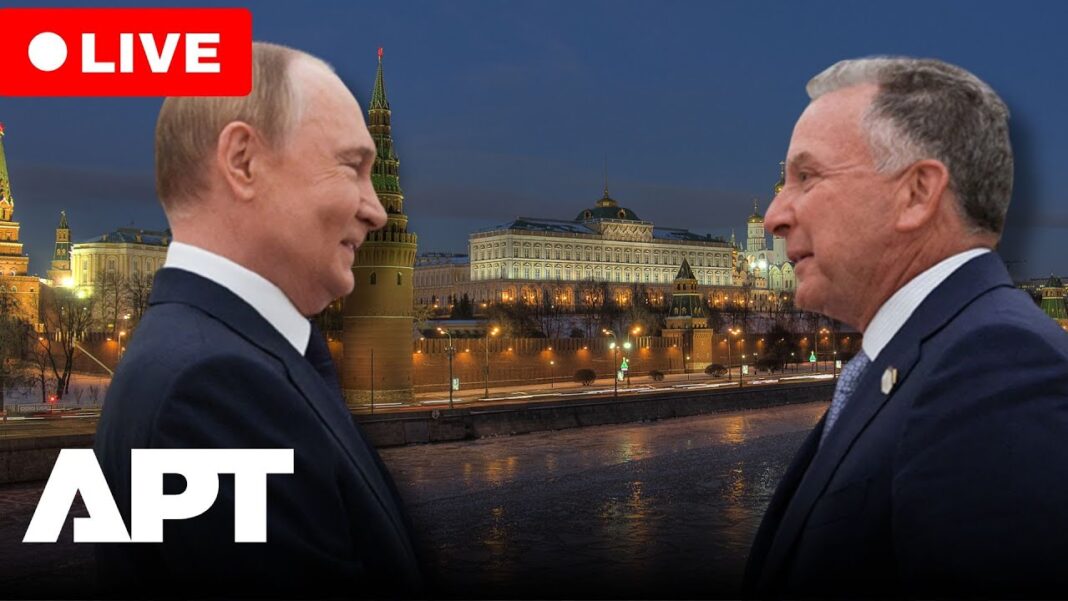
In a moment heavy with geopolitical symbolism and strategic consequence, a senior U.S. delegation led by Special Envoy Steve Witkoff and joined by Jared Kushner, President Donald Trump’s son-in-law and longtime confidant, met directly with Russian President Vladimir Putin in Moscow on Thursday evening, in what may prove to be one of the most consequential diplomatic encounters since the outbreak of Russia’s full-scale invasion of Ukraine.
According to a report that appeared on Thursday in The Kyiv Independent, the late-night Kremlin meeting — which stretched for more than three hours — was not a ceremonial courtesy call, but a serious and substantive negotiation session, situated at what American officials now describe as the “final stage” of a year-long effort by the Trump administration to broker an end to the war.
The presence of Josh Gruenbaum, a White House staffer previously involved in negotiations with Ukrainian representatives, underscored the gravity of the mission. The Americans were formally received by Putin alongside two of his most influential aides: Yuri Ushakov, a veteran foreign policy advisor, and Kirill Dmitriev, the Kremlin’s key economic envoy and an increasingly central figure in Russia’s diplomatic backchannel operations.
As The Kyiv Independent has repeatedly emphasized, the Moscow visit represents a decisive escalation in Washington’s direct engagement strategy — shifting from indirect mediation and multilateral pressure toward direct leader-level diplomacy.
The talks come as Russia’s invasion of Ukraine approaches its fourth anniversary, a grim milestone in a conflict that has redrawn Europe’s security architecture, destabilized global energy markets, reshaped NATO strategy, and entrenched a new era of geopolitical polarization.
For nearly a year, President Trump has pursued what his administration calls a “peace-first doctrine”, centered on high-level engagement, economic leverage, and unconventional diplomatic frameworks. Yet, as The Kyiv Independent has reported, those efforts have repeatedly stalled amid irreconcilable demands, battlefield realities, and entrenched mistrust between Moscow and Kyiv.
Now, U.S. officials are signaling that negotiations have reached a critical inflection point.
Speaking earlier this week at the World Economic Forum in Davos, Witkoff declared: “We are at the end now, and I actually am optimistic.”
While he declined to specify the final unresolved issue, The Kyiv Independent report noted that Ukrainian officials have long identified Russia’s demand that Ukraine cede the entire Donbas region as the most intractable obstacle to any settlement.
At the center of the Kremlin talks is a 20-point peace framework drafted over recent weeks through intensive consultations between U.S., Ukrainian, and Western officials. As reported by The Kyiv Independent and corroborated by Bloomberg, the current document evolved from an earlier 28-point proposal that was initially co-drafted by Russian negotiators — a version widely viewed as heavily skewed in Moscow’s favor.
The revised plan, however, reflects significant recalibration.
According to The Kyiv Independent, the updated framework seeks to balance Ukrainian sovereignty, territorial integrity, security guarantees, demilitarization mechanisms, economic reconstruction structures, international oversight mechanisms and phased de-escalation benchmarks.
A draft of the revised plan was transmitted to the Kremlin earlier in January via Kirill Dmitriev, following his meeting with Witkoff in Davos on January 20 — a detail The Kyiv Independent report described as evidence of an increasingly structured diplomatic channel between Washington and Moscow.
Kremlin spokesperson Dmitry Peskov, while declining to comment on Witkoff’s optimism, made a pointed public statement underscoring the symbolic alignment emerging between Trump’s White House and the Russian presidency: “It’s clear that the Russian president highly values the peacemaking efforts of President Trump personally and his team, including Special Envoy Witkoff.”
As The Kyiv Independent report observed, this language reflects Moscow’s strategic interest in legitimizing Trump’s diplomatic architecture — particularly as it diverges from traditional multilateral frameworks like the United Nations, which Trump has openly criticized.
In parallel with the Moscow negotiations, Ukrainian President Volodymyr Zelensky confirmed that a two-day trilateral meeting involving Ukraine, the United States, and Russia is scheduled to begin on January 23 in the United Arab Emirates — a neutral diplomatic venue increasingly used for high-level international mediation.
According to the information provided in The Kyiv Independent report, this meeting will mark the first structured trilateral forum since the early phases of the war and may represent the first serious multilateral attempt at settlement since hostilities escalated into full-scale invasion.
Zelensky has described the emerging peace framework as “90% ready”, while cautioning that the remaining 10% involves the most politically and emotionally charged issues — territorial sovereignty, war accountability, and long-term security guarantees.
While negotiations advance, Kyiv remains deeply cautious.
Zelensky’s meeting with Trump in Davos on Thursday was described by the U.S. president as “very good,” yet The Kyiv Independent reported that the Ukrainian leader used the meeting to stress urgent concerns about air defense vulnerabilities, particularly amid continued Russian attacks on Ukraine’s energy infrastructure.
Ukraine’s strategic position remains precarious. Energy grids remain vulnerable, civilian infrastructure continues to suffer damage, military supply chains face strain, air defense systems remain overstretched and civil morale remains fragile.
For Kyiv, peace without security guarantees risks becoming merely a pause before renewed aggression — a lesson deeply ingrained from earlier ceasefire failures.
One of the most unusual elements surrounding the Moscow talks is Trump’s invitation for Putin to join his newly formed “Board of Peace”, a global body intended to oversee postwar Gaza and potentially other conflict zones.
As The Kyiv Independent reported, dozens of countries — including Ukraine and Belarus — have been invited to participate in the board, which analysts increasingly describe as Trump’s alternative diplomatic architecture to the United Nations.
Putin, according to Trump, has already accepted the invitation and reportedly floated an extraordinary proposal: to fund the $1 billion cost of a permanent seat using Russian frozen assets held by the United States.
If confirmed, this proposal would represent a remarkable fusion of diplomacy, sanctions policy, and institutional reinvention — turning frozen assets from punitive tools into bargaining instruments for geopolitical integration.
As The Kyiv Independent report observed, the Trump administration’s strategy reflects a broader transformation in global diplomacy. Less reliance on legacy institutions, more emphasis on leader-to-leader engagement, flexible, ad hoc negotiation platforms, economic leverage over ideological alignment and transactional diplomacy replacing alliance orthodoxy.
This model unsettles traditional diplomatic actors but appeals to states seeking alternatives to the post–Cold War global order.
The symbolism of the Kremlin meeting itself cannot be overstated. Late-night negotiations, closed doors, minimal press access, and tightly controlled messaging evoke Cold War–era diplomacy, yet the players, context, and stakes are distinctly modern.
As The Kyiv Independent report noted, this was not merely a diplomatic courtesy — it was crisis diplomacy, conducted under the shadow of an active war, nuclear deterrence, economic sanctions, and global strategic realignment.
Despite Witkoff’s optimism, skepticism remains widespread among analysts, diplomats, and military experts.
Key unresolved questions include: Will Ukraine accept any territorial concessions? Will Russia agree to binding security guarantees? How will war crimes accountability be addressed? What mechanisms will enforce compliance? Who will underwrite reconstruction? How will displaced populations be protected? What role will NATO play post-settlement?
As The Kyiv Independent report emphasized, peace agreements without enforcement structures risk becoming symbolic documents rather than durable settlements.
The Moscow meeting between Witkoff, Kushner, and Putin may mark one of two futures. Either it becomes the first decisive step toward ending Europe’s bloodiest war since World War II, or it becomes another chapter in a long history of near-peace that collapses under the weight of irreconcilable realities.
For now, diplomacy has re-entered the foreground. Midnight meetings replace missile strikes. Frameworks replace frontline maps. Documents replace drone footage. But the war is not over.
As The Kyiv Independent reported, from diplomatic corridors, and from Kyiv’s embattled streets, the reality remains stark: Peace is being negotiated in marble halls, while war is still being fought in mud, fire, and frozen fields.
And between those two worlds — diplomacy and destruction — the fate of Ukraine, Russia, and Europe now hangs in fragile balance.
