



|
Getting your Trinity Audio player ready...
|
Memory, Mourning, and Unity: Putin Meets Jewish Leaders on Holocaust Remembrance Day
By: Fern Sidman
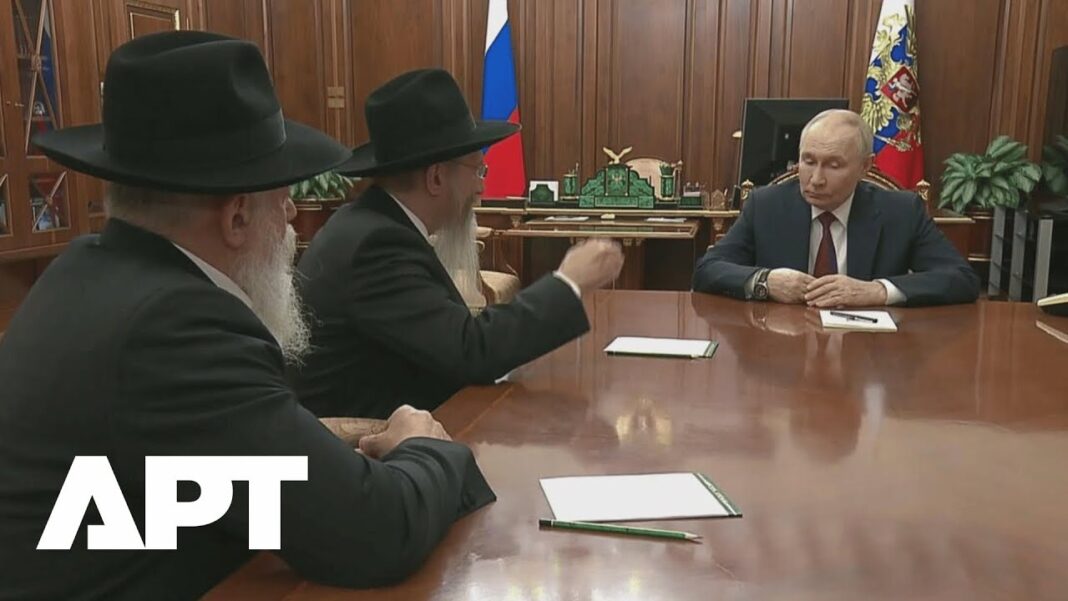
On a solemn winter day marked by historical gravity and moral reflection, Russian President Vladimir Putin convened a rare and symbolically charged meeting at the Kremlin with two of the most prominent figures in Russian Jewish life: Chief Rabbi Berel Lazar and Alexander Boroda, president of the Federation of Jewish Communities of Russia. As Russia observed Holocaust Remembrance Day, the encounter became more than a ceremonial gesture. It evolved into a layered dialogue about memory, identity, suffering, faith, and the place of religious communities in the modern Russian state — a conversation that VIN News reported has resonated deeply within Jewish communities both inside Russia and beyond.
According to a report at VIN News, the meeting took place on Wednesday, as Russia joined the international community in commemorating the victims of the Holocaust — the systematic annihilation of European Jewry by Nazi Germany and its collaborators. Yet Putin framed the date not merely as a global memorial observance, but as a profoundly Russian tragedy, rooted in the specific historical experience of the Soviet Union during World War II. He reminded his guests that more than one million Soviet and Russian Jews were murdered during the Holocaust, embedding Jewish suffering within the broader narrative of wartime devastation that scarred the Soviet lands.
VIN News reported that Putin explicitly connected International Holocaust Remembrance Day to another defining moment in Russian history: the anniversary of the complete liberation of Leningrad from the Nazi siege. The Siege of Leningrad, one of the most catastrophic civilian tragedies of the war, resulted in the deaths of over a million civilians through starvation, bombardment, and disease. By linking these two events, Putin framed both as crimes against humanity that targeted civilians not for military reasons, but for who they were — their identity, their location, their existence.
In this framing, remembrance becomes not simply Jewish memory or Russian memory, but a universal moral reckoning — one that transcends ethnicity and religion while still honoring the specific suffering of distinct communities. The VIN News report noted that Putin’s language emphasized this duality: the Holocaust as a uniquely Jewish catastrophe, and as part of a wider pattern of mass civilian destruction that defined the Nazi war machine.
The meeting itself, described by VIN News as both solemn and symbolically rich, reflected Russia’s contemporary approach to religious pluralism and state-recognized faith communities. Putin asked Rabbi Lazar directly about the commemorative events being held by Russia’s Jewish community, signaling not only awareness but engagement with communal religious life. Lazar responded that Holocaust remembrance events had already begun and would continue throughout the week, including conferences, cultural programs, and concerts attended by representatives of different faiths and nationalities.
Lazar framed these events not merely as acts of memory, but as moral education. The purpose, he explained, was not only to preserve historical truth but to transmit its lessons — especially the consequences of dehumanization, ideological hatred, and the targeting of civilians based solely on religion or nationality. In his remarks, Lazar underscored that Holocaust remembrance is not backward-looking nostalgia but forward-looking responsibility.
This moral dimension is particularly significant in contemporary global context. Antisemitism is rising in many parts of the world, often under new ideological guises but animated by ancient prejudices. Lazar contrasted the situation in Russia with developments in other countries, stating that Jewish communities in Russia currently feel secure and experience cooperation and mutual respect with other religious groups.
He recalled, however, that this sense of security was not always the case. The early 1990s, following the collapse of the Soviet Union, were a period of instability and uncertainty for Jewish institutions in Russia. Community infrastructure was fragile, resources were scarce, and religious life was still emerging from decades of suppression. According to the information provided in the VIN News report, Lazar emphasized that conditions have changed dramatically since then, particularly among younger generations, where Jewish identity, religious life, and communal participation have become increasingly normalized.
This generational dimension carries deep significance. Holocaust remembrance is not only about honoring the dead but about educating the living — particularly those who did not witness war, genocide, or ideological totalitarianism firsthand. The VIN News report noted that Lazar’s remarks reflected an awareness that memory must be transmitted intentionally, or it will fade into abstraction.
During the meeting, Lazar also referenced the anniversary of the leadership of the Lubavitcher Rebbe, Rabbi Menachem Mendel Schneerson, a towering figure in post-Holocaust Jewish history. The Rebbe’s philosophy emphasized love of one’s fellow, dignity of the individual, and moral responsibility toward all humanity — principles that Lazar described as central values shaping contemporary Jewish communal life.
This reference carried deep symbolic weight. The Lubavitcher Rebbe’s leadership emerged from the ashes of European Jewry and helped guide the reconstruction of Jewish life worldwide after the Holocaust. By invoking his legacy on Holocaust Remembrance Day in the Kremlin, Lazar was situating Russian Jewish life within a global post-Holocaust Jewish renaissance — one built not on fear, but on faith, resilience, and ethical responsibility.
Putin, in turn, responded by situating interfaith harmony within Russia’s broader civilizational narrative. He stated that peace among Russia’s religious communities is rooted in the country’s shared religious culture, emphasizing that cooperation among faiths contributes directly to national stability and development. Every ethnic and religious group, he said, plays a role in strengthening the country’s social fabric.
This rhetoric reflects a core feature of contemporary Russian state ideology: the framing of traditional religious communities — Orthodox Christian, Muslim, Jewish, and others — as pillars of national identity rather than threats to it. VIN News has repeatedly documented how the Russian government presents interfaith cooperation as a stabilizing force, not merely a matter of tolerance but a strategic foundation for national cohesion.
Alexander Boroda, president of the Federation of Jewish Communities of Russia, expanded this theme by speaking about patriotism and love of country as values shared across religious traditions. Boroda described these principles as forming the moral infrastructure of national unity — values that transcend theological differences while allowing distinct religious identities to flourish.
Boroda’s remarks emphasized that religious identity and civic identity are not mutually exclusive. In his framing, loyalty to faith and loyalty to country reinforce one another, producing social cohesion rather than fragmentation. He credited the state’s emphasis on traditional values with creating a supportive environment for religious communities and strengthening social solidarity.
Putin concluded the exchange by affirming that these principles — cooperation, mutual respect, and shared responsibility — have been developed through joint efforts between the state and religious communities and would continue in the future. According to the information contained in the VIN News report, his remarks framed interfaith collaboration not as symbolic performance, but as a long-term strategic partnership.
The symbolism of the meeting is multilayered. International Holocaust Remembrance Day, by its very nature, confronts humanity with the consequences of ideological extremism, racial hatred, and moral collapse. To mark it in the Kremlin — the seat of Russian political power — through dialogue with Jewish leadership transforms remembrance into policy language: memory becomes part of national discourse, not merely communal ritual.
The VIN News report emphasized that this moment reflects a broader pattern in Russian public life, where historical memory is tightly interwoven with state identity. In Russia, World War II — known as the Great Patriotic War — is not simply history; it is foundational mythology, moral reference point, and national narrative. By embedding Jewish Holocaust memory within this larger framework, Russian leadership integrates Jewish suffering into the core moral story of the nation.
For Russian Jews, this integration carries both symbolic and practical meaning. Symbolically, it affirms belonging — not as outsiders tolerated by the state, but as integral participants in national history. Practically, it reinforces institutional security, communal legitimacy, and interfaith cooperation.
VIN News reported that Jewish communities across Russia have interpreted the meeting as a sign of continued state recognition and protection, especially in a global climate where Jewish communities elsewhere face rising hostility, vandalism, and violence. In contrast, Russian Jewish leaders emphasize stability, safety, and institutional partnership.
Yet the deeper significance of the meeting lies not only in politics but in philosophy. Holocaust remembrance, when reduced to ritual, risks becoming hollow. But when embedded in dialogue about values, responsibility, and communal coexistence, it becomes a living moral framework. Lazar’s emphasis on civilian suffering, moral lessons, and interfaith respect transforms memory into ethical obligation.
The presence of multiple faith traditions at Holocaust commemorations, as Lazar described, reflects this broader moral architecture. These events are not exclusively Jewish spaces, but interreligious gatherings that communicate a universal message: that dehumanization of any group ultimately corrodes the moral structure of society itself.
In this sense, the Kremlin meeting becomes emblematic of a larger narrative: the transformation of Holocaust memory from historical tragedy into civilizational warning. It is not only about what happened, but about what must never happen again — and what social structures are necessary to prevent it.
International Holocaust Remembrance Day in Russia is increasingly framed not only as Jewish remembrance, but as a national moral event — a day that affirms human dignity, condemns ideological hatred, and reinforces the values of coexistence.
The image of Russia’s president sitting with Jewish religious leadership on this day, discussing memory, unity, faith, and shared responsibility, carries powerful symbolic resonance. It suggests that remembrance is not confined to synagogues and memorial halls, but belongs in the highest chambers of political power.
In an era marked by polarization, cultural fragmentation, and rising extremism across the globe, the Kremlin encounter offers a counter-narrative — one in which memory becomes the foundation of unity, faith becomes a bridge rather than a barrier, and history becomes a guide rather than a weapon.
As the VIN News report emphasized, the significance of such moments lies not only in what is said, but in what they represent: the deliberate weaving of moral memory into national identity, and the insistence that the horrors of the past must shape the ethics of the future.
