



|
Getting your Trinity Audio player ready...
|
By: Fern Sidman
President Emmanuel Macron’s bold plan to push France into formally recognizing a Palestinian state at the United Nations General Assembly next week has ignited a storm of political, diplomatic, and public backlash. While the French leader insists the move is essential to isolating Hamas and reviving prospects for a two-state solution, new data suggests the French public sees things very differently. According to a survey by IFOP for the Representative Council of Jewish Institutions of France (CRIF), more than 70 percent of French citizens oppose Macron’s initiative.
The results of the poll, published and analyzed in The Algemeiner, underscore how disconnected Macron’s foreign policy gamble may be from public sentiment, especially in a nation already shaken by a surge of antisemitic incidents and polarizing debates about national identity.
The IFOP survey revealed a striking divide: only 29 percent of French citizens support Macron’s plan to unilaterally recognize a Palestinian state. A clear majority — 71 percent — insist that any recognition must be conditioned on two fundamental prerequisites: the release of all remaining Israeli hostages still held in Gaza, and the unconditional surrender of Hamas, the terrorist organization that has dominated the enclave for nearly two decades.
As The Algemeiner reported on Friday, this finding reflects broader anxieties in French society. Nearly 70 percent of respondents said that antisemitism poses a “serious threat,” not only to Jewish communities but to the fabric of French society itself. Equally alarming, the survey found that 19 percent of French citizens — and an even more troubling 31 percent among those aged 18 to 24 — consider it “acceptable” to target Jews due to the conflict in Gaza.
These statistics confirm what CRIF and Jewish leaders in France have warned for months: that political gestures seen as legitimizing Palestinian militant narratives risk pouring fuel on the fire of an already volatile climate.
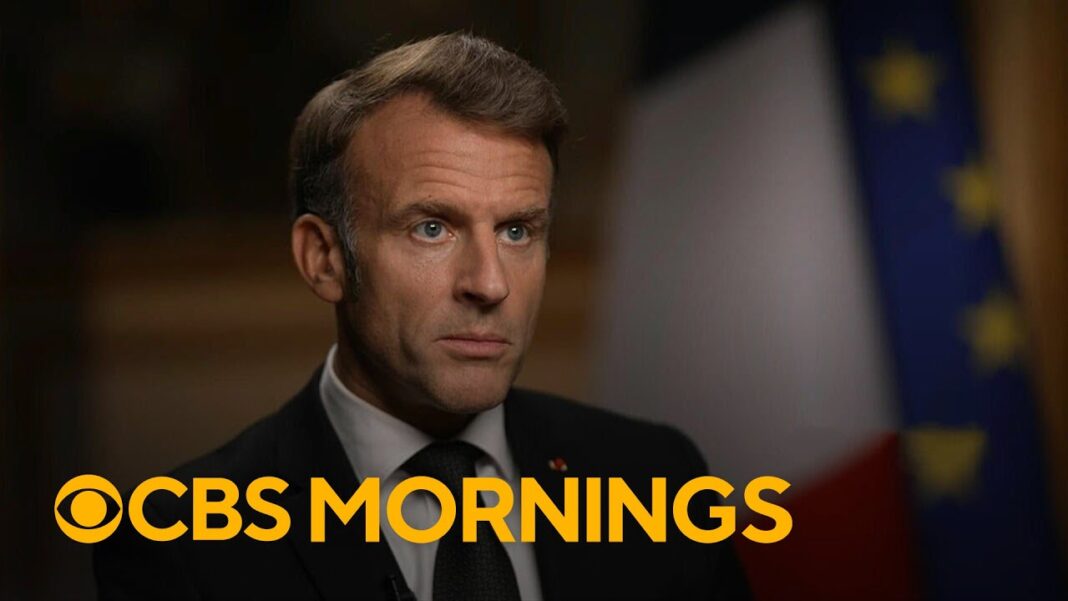
Despite the backlash, Macron has doubled down on his argument that recognition of a Palestinian state would serve as a strategic counterweight to Hamas. In interviews with both Israeli broadcaster Channel 12 and CBS News, the French president sought to frame his initiative as a way to delegitimize Hamas by offering Palestinians an alternative political horizon.
“The objective of Hamas has never been to make two states, and especially two states as we propose,” Macron told Channel 12. “They want to destroy Israel. The recognition of a Palestinian state is the best way to isolate Hamas.”
He repeated the theme in remarks to CBS: “Hamas is just obsessed with destroying Israel. But I recognize the legitimacy of so many Palestinian people who want a state … and we shouldn’t push them toward Hamas.”
According to the information provided in The Algemeiner report, Macron has argued that the move is necessary not only to stabilize the region but also to reassert France’s role as a global diplomatic player capable of shaping outcomes rather than merely reacting to crises.
Yet Hamas itself has hailed the wave of Western discussions about Palestinian statehood as proof that its Oct. 7 atrocities achieved their intended effect. The group has described European talk of recognition as “the fruits of Oct. 7,” openly linking international concessions to the massacre in southern Israel that left 1,200 dead and 251 kidnapped.
The Algemeiner report pointed out that this cynical celebration reveals the inherent contradiction in Macron’s strategy: while he hopes recognition will undercut Hamas, the group itself is publicly treating it as validation. By presenting international recognition as a direct reward for violence, Hamas strengthens its claim that armed struggle is the only effective path forward.
Israeli leaders have responded with alarm and anger to Macron’s plan, warning that recognition under current circumstances would embolden terrorists, weaken efforts to free the remaining hostages, and undercut Israel’s security.
According to the information contained in The Algemeiner report, officials in Jerusalem are weighing a series of retaliatory measures, including accelerating annexation plans in Judea and Samaria, closing the French consulate in Jerusalem, and seizing French-owned religious sites such as the Sanctuary of the Eleona — a prominent Christian pilgrimage destination.
Foreign Minister Gideon Sa’ar bluntly declared that “rewarding terrorism with statehood recognition will not bring peace. It will bring more bloodshed.”
Within France, reactions have been equally polarized. CRIF issued a scathing denunciation, calling Macron’s initiative “a moral failing, a diplomatic error, and a political danger.” The Jewish body warned that recognition would exacerbate antisemitism, which has already spiked since October 2023.
Far-right leader Marine Le Pen seized on the moment to accuse Macron of cynically pursuing the recognition “purely for electoral reasons,” aiming to curry favor with left-wing voters and immigrant communities.
On the other side of the spectrum, France’s Socialist Party applauded the president’s plan. Olivier Faure, the party’s leader, went so far as to call on mayors across France to raise the Palestinian flag over municipal buildings on the day of recognition.
That gesture quickly ran into resistance. Interior Minister Bruno Retailleau instructed prefects not to permit Palestinian flags on public buildings, citing the principle of neutrality in government institutions. He warned that violations would be referred to administrative courts. As The Algemeiner report noted, French judges have already ordered the removal of Palestinian flags in several towns, underscoring the legal and cultural tensions surrounding the issue.
France is not acting in isolation. Macron’s initiative coincides with similar signals from the United Kingdom, Canada, and Australia, which are also considering recognition at the UN General Assembly. Yet opposition is strong from both Washington and Jerusalem.
Israeli and U.S. officials have warned that premature recognition undermines peace negotiations and rewards violent actors. In Washington, lawmakers from both parties have expressed unease, noting that U.S. policy has always been to support a two-state solution through direct negotiations rather than unilateral declarations.
The Algemeiner reported that U.S. officials fear Macron’s move could complicate hostage negotiations and embolden Hamas at the precise moment when Israel is pressing its military offensive in Gaza.
The IFOP survey suggests that Macron faces not only diplomatic headwinds but also serious political risks at home. At a time when antisemitic incidents are rising, public disapproval of his recognition plan could damage his standing among moderates and fuel further polarization.
As The Algemeiner report emphasized, nearly 70 percent of French respondents view antisemitism as a grave societal threat. Linking that perception to the fact that 71 percent oppose recognition without hostage releases and Hamas’s defeat, the survey highlights how the French public sees Israel’s security as intimately tied to their own social cohesion.
This puts Macron in a precarious position: his foreign policy gamble may isolate him domestically at a time when public trust in political institutions is already fragile.
Beyond the diplomatic chessboard, the recognition debate is playing out against the backdrop of a frightening surge in antisemitism across France. Since Hamas’s October 2023 attack, anti-Jewish hate crimes have spiked, ranging from vandalism of synagogues to assaults on Jewish individuals.
The Algemeiner report documented the growing unease among French Jews, many of whom now see Macron’s Palestinian initiative as a signal that their government is not prioritizing their security.
The survey’s finding that nearly one in five French citizens finds it “acceptable” to target Jews because of the Gaza conflict underscores the dangers. Particularly alarming is the generational divide: nearly one-third of young French adults hold such views, suggesting that antisemitic narratives are gaining traction among the next generation.
President Macron’s plan to recognize a Palestinian state at the UN General Assembly represents one of the boldest — and most controversial — moves of his presidency. While he frames it as a way to counter Hamas and advance peace, critics argue that it risks rewarding terror, inflaming antisemitism, and deepening France’s internal divisions.
As The Algemeiner report highlighted, the overwhelming majority of French citizens reject the initiative in its current form, demanding conditions such as the release of Israeli hostages and Hamas’s defeat before recognition. At the same time, Jewish leaders, international allies, and domestic political opponents are warning of dire consequences.
Macron insists that his plan is a necessary act of leadership in the face of global instability. But with opposition mounting at home and abroad, his recognition gamble could ultimately leave France more isolated diplomatically and more divided internally — a high-stakes test of whether moral intent and political calculation can withstand the harsh realities of war, terrorism, and public opinion.
