



|
Getting your Trinity Audio player ready...
|
Louvre Looted: Thieves Pull Off Daring Daylight Heist of Napoleon’s Crown Jewels in Paris
By: Russ Spencer
In a theft worthy of a Hollywood screenplay, professional criminals stormed the Louvre Museum in Paris early Sunday morning, making off with a cache of priceless jewels once belonging to Emperor Napoleon Bonaparte and his wife, Empress Eugénie, in what The New York Post called “a brazen daylight robbery that stunned France and humiliated the world’s most visited museum.”
According to multiple French media outlets cited in a report on Sunday in The New York Post, the gang of thieves—armed with an aerial lift, small chainsaws, and an angle grinder—executed the heist in just ten minutes. Between 9:30 and 9:40 a.m., they broke into the museum’s Apollon Gallery, a second-floor chamber overlooking the River Seine that houses the French Crown Jewels. By the time security arrived, the robbers had vanished, leaving behind shattered glass, panic-stricken visitors, and a missing trove of national treasures.
Officials confirmed that nine artifacts were stolen, including a diamond-studded necklace, a brooch, and a tiara, items believed to date back to the Napoleonic era. “Beyond their market value, the items have inestimable heritage and historical value,” France’s Interior Ministry said in a statement quoted in The New York Post report.
One artifact—reportedly a crown belonging to Empress Eugénie, Napoleon III’s wife—was later discovered damaged and abandoned outside the museum’s walls, according to Le Parisien. The French government has launched an intensive forensic effort to determine exactly what was taken and to assess the scope of the loss.
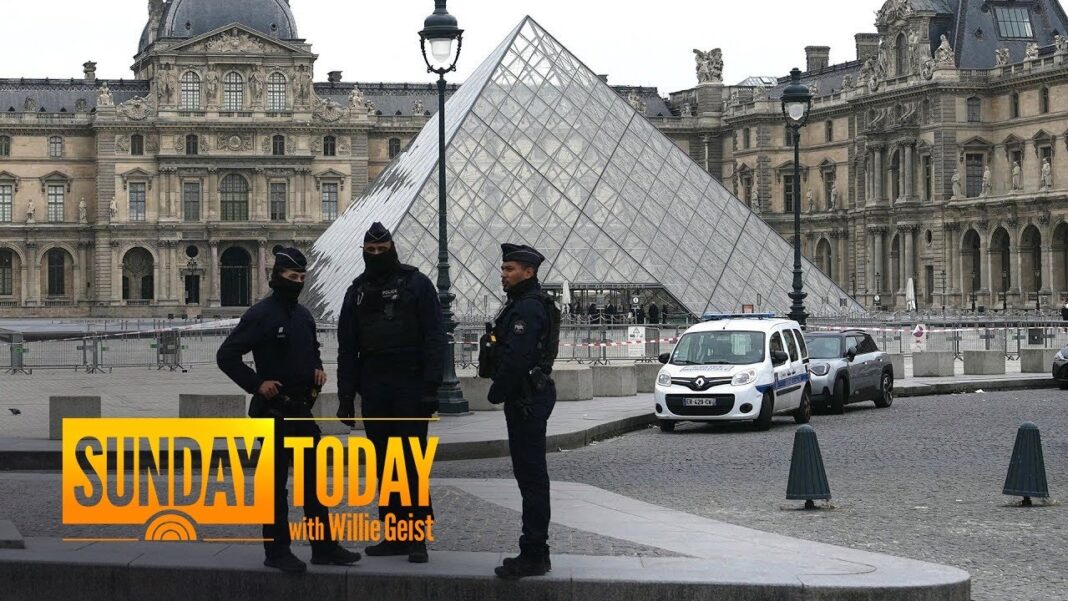
As The New York Post reported, panic erupted inside the Louvre shortly after the break-in. Security guards ordered a full evacuation, while police swarmed the premises. “The police were running near the pyramid and trying to enter the Louvre through the side glass doors, but they were locked and impossible to open,” one American tourist named Kacie told Le Parisien. “We didn’t know what was happening—everyone was rushing toward the exits.”
Video shared by BFMTV and later cited in The New York Post report shows one of the suspects using a miniature chainsaw to cut through a glass display case, sparks flying as alarms blared in the background. The suspects, masked and hooded, were described as working with chilling efficiency—one kept lookout while two others dismantled the display, grabbed the jewels, and fled through the same window they had breached minutes earlier.
Surveillance footage reportedly shows the robbers escaping on two scooters, speeding toward the A6 highway, a route that leads southeast out of Paris. A third scooter, believed to have served as a backup vehicle, was later found abandoned in a nearby arrondissement, police sources told AFP and confirmed by The New York Post.
No injuries were reported during the robbery, though French Culture Minister Rachida Dati—who visited the scene—acknowledged that the event exposed severe vulnerabilities in museum security. “Organized crime today is targeting art objects,” she said. “Museums have become targets.”
The Apollon Gallery, where the theft took place, is one of the most celebrated rooms in the Louvre. As The New York Post report highlighted, it not only houses the French Crown Jewels, but also the hardstone vessel collection of King Louis XIV and the legendary Regent Diamond, a 140-carat gem once set in Napoleon’s sword.
The stolen pieces, officials said, are part of a collection of royal jewelry that survived revolutions, wars, and centuries of French history—making their loss particularly devastating. “This isn’t just theft—it’s the erasure of a piece of France’s soul,” one curator told The New York Post.
Early estimates suggest the market value of the stolen jewels could exceed tens of millions of dollars, though experts emphasize that their historic and cultural worth is incalculable.
Forensic teams are analyzing video footage, tool marks, and fingerprints, while Interpol has been notified to watch for attempts to fence or smuggle the pieces abroad.
Still, investigators fear the worst. “The risk is that some of the diamonds could be sold at retail, which would make reconstituting the jewels very difficult,” a source close to the investigation told Le Parisien, a sentiment echoed in The New York Post’s report. Others warned that the thieves might melt down the gold settings, obliterating any chance of recovery.
“All means are already being implemented to recover the loot,” Paris police headquarters told Le Monde, according to the report in The New York Post.
Reaction across France was swift and furious. Right-wing opposition leader Jordan Bardella of the National Rally Party blasted the government for what he called “a monumental failure of state security.”
“The Louvre is a global symbol of our culture,” Bardella posted on X (formerly Twitter), as quoted in The New York Post report. “This heist, which allowed thieves to steal the Crown Jewels of France, is an intolerable humiliation for our country. How far will the decay of the state go?”
Other lawmakers demanded an immediate overhaul of museum security nationwide, citing the Louvre’s chronic understaffing and the pressures of mass tourism. The museum, which draws nearly 9 million visitors annually, was temporarily closed in June after a staff walkout protesting unsafe working conditions, overcrowding, and inadequate protection of exhibits.
Union representatives have since warned that lax security and relentless visitor traffic have made the museum increasingly vulnerable. As one worker told The New York Post, “We’ve been saying for years that it was only a matter of time before something like this happened.”
The Louvre heist marks the latest in a disturbing string of high-profile art thefts and museum robberies in France. Just weeks ago, thieves stole $700,000 worth of gold nuggets from Paris’ Natural History Museum, according to the report in The New York Post. In September, robbers raided a leading porcelain museum in Limoges, causing damage estimated at over $7 million.
Experts fear that organized criminal networks have turned their sights on Europe’s cultural institutions, exploiting weak security and high black-market demand. “This is not the work of amateurs,” one law enforcement official told The New York Post. “It’s a highly coordinated team that knew exactly where to strike, what to take, and how to get out.”
While art theft has long plagued museums, the use of industrial tools and scooters points to a new generation of thieves—blending speed, precision, and audacity. French investigators are reportedly exploring links to Eastern European syndicates known for trafficking in antiquities and jewels.
As headlines from The New York Post cheekily framed it—“Lou-dunnit?”—the question now gripping Paris and the art world alike is who masterminded one of the boldest museum robberies in modern history.
Authorities believe at least three suspects were directly involved, but more may have played supporting roles, including scouts, getaway drivers, and fences ready to move the goods. Police are combing through surveillance footage across central Paris, hoping to trace the scooters’ path south toward the A6, a known smuggling corridor leading toward Spain and Italy.
Interpol’s Art Crime division has joined the investigation, and border agencies throughout Europe have been placed on alert. “These items are instantly recognizable. They cannot be sold legally,” an official told The New York Post. “But with the right buyer and the right connections, they could disappear forever.”
For the Louvre itself, Sunday’s theft represents not just a security lapse but an existential crisis. The museum, already under fire for overcrowding and declining staff morale, now faces a reckoning over how it protects the nation’s most sacred relics.
As The New York Post report observed, “The world’s most famous museum—home to the Mona Lisa, the Venus de Milo, and centuries of French glory—now finds itself the victim of a crime that reads like a symbol of France’s fragility.”
By late afternoon, police tape cordoned off the Apollon Gallery as investigators examined shards of glass and scuff marks on the parquet floors. The museum issued a terse statement, announcing that the gallery would remain closed for “exceptional reasons” until further notice.
French President Emmanuel Macron has not yet commented publicly, but sources told The New York Post that he is receiving hourly updates on the investigation and has ordered “maximum coordination” between the Ministry of Culture and the National Police.
The stolen jewels once adorned Napoleon’s court, glittering symbols of imperial power and French artistry. Now, they have vanished—snatched from behind glass by thieves who exploited modern vulnerabilities to erase centuries of legacy in mere minutes.
As one historian told The New York Post, “Napoleon lost his empire on the battlefield. France lost its crown in broad daylight.”
Whether the jewels are ever recovered—or whether they meet the fate of being melted down and scattered to the winds—remains to be seen. But for now, the Louvre stands not as the guardian of French grandeur, but as the stage for its most audacious humiliation.
And as the world looks on in disbelief, one haunting question lingers above the Seine: how could the Louvre, fortress of art and history, be conquered so easily?
