



|
Getting your Trinity Audio player ready...
|
By: Fern Sidman
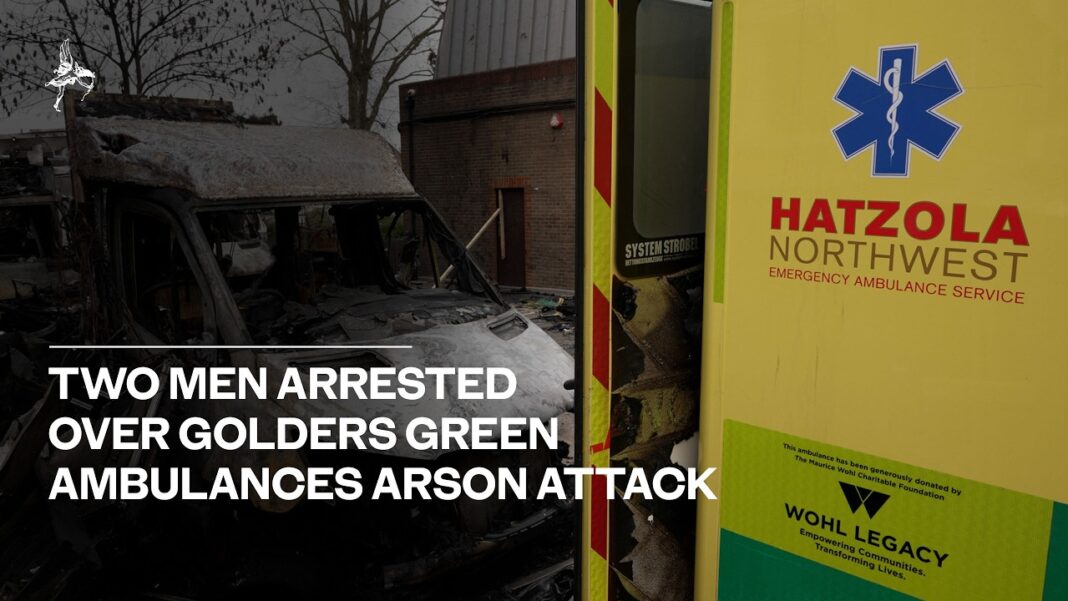
In the pre-dawn stillness of a North London neighborhood long associated with communal resilience and cultural continuity, an act of calculated destruction has reverberated far beyond the charred remains of four ambulances. The arrest of two men in connection with the firebombing of vehicles belonging to Hatzola Northwest marks a critical development in what authorities have described as a deeply troubling antisemitic hate crime—one that has intensified scrutiny of rising hostility toward Jewish communities across the United Kingdom.
According to a report on Wednesday by VIN News, the Metropolitan Police confirmed that two suspects, aged 47 and 45, were apprehended on Wednesday at separate locations in northwest and central London. Both individuals were detained on suspicion of arson with intent to endanger life, a charge that underscores the severity of the alleged offense. As officers continue to conduct searches and gather evidence, the arrests represent the first tangible step toward accountability in a case that has captured national attention.
The attack unfolded shortly after 1:35 a.m. on Monday along Highfield Road in Golders Green, a neighborhood that serves as a vibrant hub of Jewish life in London. The targeted vehicles belonged to Hatzola Northwest, a volunteer emergency medical service that plays an indispensable role in providing rapid-response care within the community.
As the VIN News report documented, the blaze was not only destructive but also perilously close to becoming catastrophic. Gas cylinders housed within the ambulances ignited during the fire, triggering explosions that shattered windows in nearby homes and heightened the risk to residents. That no lives were lost is widely regarded as a matter of fortune rather than design.
Surveillance footage reviewed by investigators shows three individuals approaching the vehicles shortly before the fire erupted. The images, now central to the ongoing inquiry, have provided critical leads in identifying those responsible. Yet even as arrests have been made, authorities caution that the investigation remains active and complex.
The significance of the attack extends beyond the immediate destruction of property. Hatzola Northwest operates as a lifeline within the Jewish community, offering rapid medical assistance that often precedes the arrival of national emergency services. Its volunteers, trained and equipped to respond to a wide range of medical emergencies, are a cornerstone of community safety.
The deliberate targeting of such an organization, as emphasized in the VIN News report, represents a dual assault: one on physical infrastructure and another on the sense of security that such services provide. By attacking ambulances—vehicles universally associated with care and life-saving intervention—the perpetrators struck at a symbol of humanitarian service.
This dimension has not been lost on community leaders, who have described the incident as both shocking and deeply unsettling. The destruction of emergency vehicles raises immediate concerns about response capacity, particularly in a neighborhood where demand for such services is high.
The Metropolitan Police have approached the case with a level of seriousness commensurate with its implications. Counterterrorism detectives have been assigned to lead the investigation, reflecting the potential for broader connections or motivations. However, at this stage, authorities have clarified that the incident is being treated as an antisemitic hate crime rather than a confirmed act of terrorism.
This distinction, while legally significant, does little to diminish the gravity of the offense. The charge of arson with intent to endanger life carries substantial penalties and signals the authorities’ recognition of the potential for harm inherent in the act.
VIN News reported that investigators are also examining a purported claim of responsibility by a previously unknown Islamist group. While the authenticity and relevance of this claim remain under scrutiny, its existence adds a further layer of complexity to the case. Determining whether the attack was part of a coordinated effort or an isolated act will be central to the investigation’s next phase.
The identities of the arrested individuals have not been disclosed, and police have refrained from providing details about their backgrounds. This caution reflects both the sensitivity of the case and the need to preserve the integrity of ongoing inquiries.
The incident has elicited swift and unequivocal condemnation from across the political spectrum. Prime Minister Keir Starmer described the attack as a “horrific act of antisemitism,” reaffirming the government’s commitment to protecting Jewish communities.
Such statements underscore the broader recognition that antisemitism poses a persistent and evolving threat within British society. The Golders Green attack is not an isolated event but part of a pattern that has prompted increasing concern among policymakers and community leaders alike.
Public officials have emphasized the importance of vigilance and solidarity, calling for a collective response to what they describe as an affront to the values of tolerance and coexistence. Yet the recurrence of such incidents suggests that rhetorical condemnation, while necessary, may be insufficient on its own.
For residents of Golders Green, the attack has had a profound psychological impact. The sight of emergency vehicles reduced to charred wreckage, combined with the knowledge that the perpetrators remain only partially identified, has heightened a sense of vulnerability.
VIN News has reported that community members have expressed both fear and determination in the aftermath. While there is widespread concern about safety, there is also a palpable resolve to maintain normalcy and resist intimidation. This dual response—anxiety coupled with resilience—is characteristic of communities that have faced repeated challenges.
The reopening of affected institutions and the continuation of daily activities are seen as acts of defiance, affirming the community’s commitment to its way of life. At the same time, there is a growing call for enhanced security measures, including increased police presence and improved surveillance.
The Golders Green attack must be understood within the broader context of rising antisemitism in the United Kingdom and beyond. VIN News has consistently highlighted a series of incidents ranging from verbal harassment to physical violence, suggesting a trend that transcends individual cases.
This trend raises fundamental questions about the factors driving such hostility and the effectiveness of existing measures to counter it. While law enforcement plays a critical role in responding to specific incidents, addressing the underlying causes requires a more comprehensive approach involving education, community engagement, and policy reform.
The involvement of counterterrorism units in the investigation reflects an awareness that the boundaries between hate crimes and extremist activity can be fluid. Even in cases where terrorism is not formally established, the ideological motivations may overlap with broader networks or narratives.
As the investigation continues, the focus will remain on identifying all individuals involved and establishing the full scope of the attack. The arrests made thus far represent a significant step, but they are unlikely to mark the conclusion of the case.
For the Jewish community in Golders Green and across the United Kingdom, the incident serves as both a warning and a call to action. It underscores the need for vigilance, solidarity, and sustained efforts to combat antisemitism in all its forms.
VIN News has emphasized that the response to such incidents must extend beyond immediate law enforcement measures. It must also involve a reaffirmation of the principles that underpin a diverse and inclusive society, ensuring that acts of hatred are met not only with justice but with a collective commitment to prevention.
The arrests in the Golders Green arson case mark a pivotal moment in a story that continues to unfold. They offer a measure of reassurance that those responsible may be held accountable, yet they also highlight the challenges that remain.
In the final analysis, the significance of this incident lies not only in its immediate impact but in what it reveals about the current state of social cohesion. It is a test of the ability of institutions, communities, and individuals to respond effectively to acts of hatred and to reaffirm the values that such acts seek to undermine.
As the VIN News report observed, the message is clear: the flames that consumed the ambulances in Golders Green have illuminated a broader struggle—one that demands vigilance, resilience, and an unwavering commitment to justice.
