



|
Getting your Trinity Audio player ready...
|
By: Carl Schwartzbaum
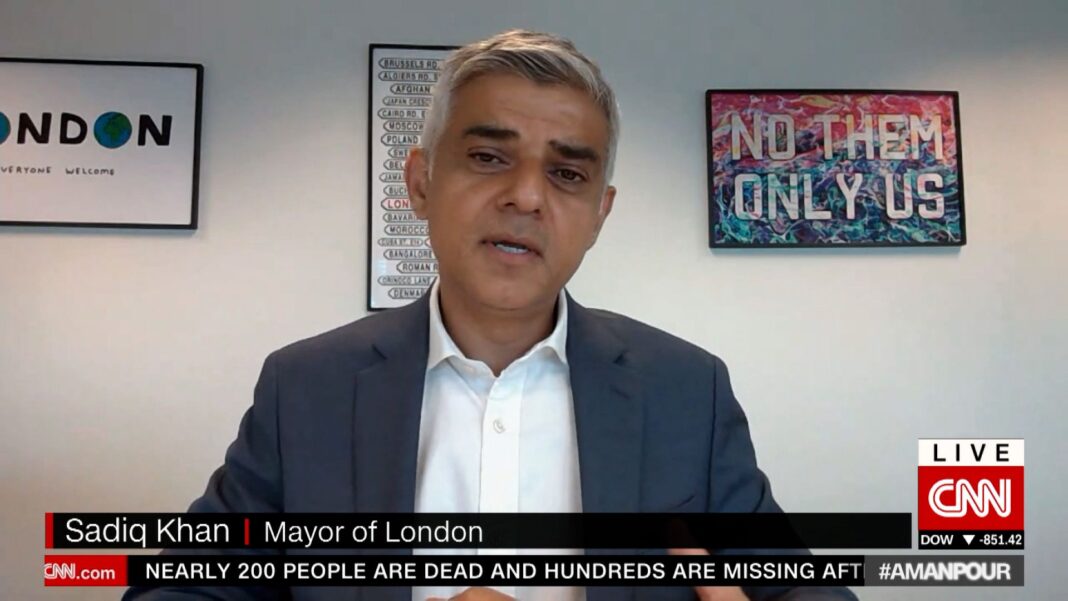
In a move that has drawn sharp rebuke from across the United Kingdom’s Jewish community and senior political figures, London Mayor Sadiq Khan on Thursday publicly called for the immediate recognition of Palestinian statehood by the British government. His statement, posted to social media platform X (formerly Twitter) — with replies disabled — notably omitted any reference to the ongoing hostage crisis in Gaza, a point of contention that has ignited widespread criticism and deepened tensions in a post-October 7 political landscape.
“The UK must immediately recognize Palestinian statehood,” Khan declared. “There can be no two-state solution if there is no viable state left to call Palestine.”
His comments, made amid continued rocket attacks on Israeli civilian centers by Hamas and persistent refusal by the terror group to release hostages taken during the October 7 massacre, have drawn accusations of moral imbalance and diplomatic irresponsibility. According to The Jewish Chronicle, over 1,200 Israelis were murdered during the October 7 attacks, and Hamas continues to hold women, children, and elderly civilians in captivity — facts not acknowledged in Khan’s statement.
Jewish organizations and community leaders swiftly responded to Khan’s announcement. The Jewish Leadership Council (JLC) issued a strong statement via The Jewish Chronicle, expressing deep disappointment over the mayor’s position and highlighting the exacerbation of communal tensions in London that such declarations can provoke.
“The community fabric in this country is under ever-increasing strain,” a JLC spokesperson told The Jewish Chronicle. “An international conflict has seen a rise in antisemitism across the UK including in London, where the impact has included lower attendances at synagogues whose worshippers must avoid regular protests which involve anti-Jewish chants and placards.”
The JLC emphasized that unilateral UK recognition of a Palestinian state would neither bring a Palestinian state into existence nor alleviate the humanitarian crisis in Gaza. Instead, they warned, Khan’s statement risks worsening inter-communal relations in the very city he leads.
“We are therefore deeply disappointed that the Mayor of London has chosen to intervene in support of a gesture to the detriment of community relations in the city he represents,” the JLC said.
Mayor Khan’s call also appears to have reignited internal fissures within the Labour Party, as party leadership continues to tread a cautious line on Middle East diplomacy. According to The Jewish Chronicle, Prime Minister Sir Keir Starmer reiterated earlier this week that any UK recognition of Palestinian statehood must be “a contribution to the peace process at a time most conducive to the prospects of peace.” Starmer’s comments were delivered during a session of Parliament’s liaison committee and echoed remarks made during French President Emmanuel Macron’s recent visit to London.
A senior Labour source, speaking anonymously to The Jewish Chronicle, criticized Khan for departing from the party’s measured stance. “We don’t elect mayors to freelance on national politics or international diplomacy,” the source said. “Keir and David [Lammy, the foreign secretary] have taken a mature, balanced approach.”
While acknowledging the consensus within Labour on the eventual need to recognize Palestine, the source added: “We need to recognize Palestine — nobody serious doubts that — but at a time when it will make a real difference to a lasting, two-state solution; not fritter it away because it makes us feel like we’re ‘doing something’.”
Describing Khan’s approach as “gesture politics,” the source expressed particular disappointment given the mayor’s prior engagement with the Jewish community. “Given his strong track record with the Jewish community, this gesture politics is deeply disappointing from Sadiq,” the source told The Jewish Chronicle.
Despite the backlash, Khan’s call is not without precedent. As The Jewish Chronicle reported, Labour officials have faced increasing pressure from within their own ranks to adopt a more assertive position on Palestinian statehood. Last month, Greater Manchester Mayor Andy Burnham, Welsh First Minister Eluned Morgan, and Labour MPs Andy Slaughter and Dame Emily Thornberry signed a letter published in The Guardian urging the UK to “recognize Palestine alongside Israel now, and without further delay or equivocation.”
The letter argued that recognition would not serve as punishment for Israel but rather as a “symbol of hope” for those working toward coexistence, mutual security, and equal rights.
Yet critics argue that such timing — while hostages remain underground in Gaza and while Hamas, a UK-designated terrorist organization, maintains its grip over the territory — sends a confusing message about British values, diplomacy, and the standards of state recognition.
“The mayor is calling for recognition of a Palestinian state while Hamas still rules Gaza, murders civilians, and holds innocent people in tunnels,” one British Jewish leader told The Jewish Chronicle. “That’s not diplomacy — it’s delusion.”
Particularly distressing to Jewish leaders and families of hostages has been Khan’s failure to acknowledge the hostages held by Hamas since the October 7 atrocities. The Jewish Chronicle noted that many hostages include women, children, and the elderly, and their plight has remained at the center of Israeli civil discourse and international appeals.
Pro-Israel advocates and relatives of the hostages have expressed profound frustration that a public official of Khan’s stature would issue a major foreign policy call while ignoring the humanitarian suffering that continues within Hamas-controlled Gaza.
“This omission is not simply a diplomatic oversight — it is a moral failing,” a rabbi affiliated with a central London synagogue told The Jewish Chronicle.
Downing Street has not officially responded to Khan’s statement. The UK government’s long-standing position remains that recognition of Palestinian statehood should be the outcome of bilateral negotiations and not a unilateral move.
Health Secretary Wes Streeting, responding to questions in Parliament earlier this week, took a different tack by criticizing Israel for attacks on health workers in Gaza — further revealing the complex and sometimes conflicting positions within Labour’s senior ranks.
Still, for now, Starmer’s leadership appears to maintain the view — echoed in multiple statements reported by The Jewish Chronicle — that recognition must be tethered to a sustainable diplomatic framework rather than a political gesture made during a live conflict.
Mayor Sadiq Khan’s unilateral call for the UK to recognize a Palestinian state has exposed fault lines within the Labour Party, deepened unease within Britain’s Jewish community, and revived debates about the appropriate timing and context for diplomatic recognition.
As The Jewish Chronicle has reported, Jewish leaders are especially alarmed by the messaging Khan’s statement sends amid ongoing trauma over the October 7 attacks and the unresolved hostage situation. For a city already grappling with elevated antisemitism and fragile community relations, critics warn, statements such as these may do more to polarize than to promote peace.
Whether Khan’s intervention influences broader government policy remains to be seen. But the reaction from within his own party and across the Jewish communal landscape, as documented by The Jewish Chronicle, suggests that the path to meaningful recognition — and enduring peace — will require greater nuance, balance, and moral consistency than what was offered in this latest declaration.

Has he declared London part of the Caliphate yet?