



|
Getting your Trinity Audio player ready...
|
By: Fern Sidman
The first night of Chanukah, a sacred moment traditionally devoted to kindling light against encroaching darkness, was transformed into a scene of terror and unspeakable loss on December 14, when gunmen attacked the annual “Chanukah by the Sea” celebration hosted by Chabad-Lubavitch of Bondi. According to extensive reporting and community testimony documented by Chabad.org, the assault claimed the lives of 16 people, including beloved Chabad rabbi Eli Schlanger, and left many others wounded—physically and spiritually—marking one of the darkest chapters in the history of Australian Jewry.
The event, which began at 5:30 p.m. local time, was intended to be a joyous, family-oriented celebration marking the onset of the Festival of Lights. For decades, “Chanukah by the Sea” has stood as a crown jewel of Sydney’s Jewish calendar, drawing thousands of attendees to Bondi Beach for music, menorah lighting, food, and communal pride. As Chabad.org has chronicled over the years, the event symbolizes not only religious observance but the unapologetic visibility of Jewish life in Australia’s most iconic public spaces.
That symbolism was violently assaulted shortly before 6:45 p.m., when the sound of gunfire shattered the evening air.
Eyewitnesses told Chabad.org that thousands of attendees scattered in all directions as two terrorists opened fire into the densely packed crowd. Parents grabbed children, elderly attendees sought cover, and what had moments earlier been laughter and song dissolved into screams and panic. The vast, open beachfront—usually synonymous with leisure and freedom—offered little shelter.
In the midst of the chaos, an extraordinary act of courage briefly altered the course of events. A middle-aged man, whose identity has not been publicly released, charged one of the gunmen and wrestled a long gun from his grasp. According to accounts shared with Chabad.org, the attacker was forced to flee, rejoining his accomplice on an elevated pedestrian bridge overlooking the beach. Both terrorists were later neutralized, but not before the carnage had already taken a devastating toll.
Emergency responders rushed to the scene as survivors attempted to administer aid to the wounded. The scale of the attack, unfolding in a matter of minutes, left even seasoned first responders visibly shaken.
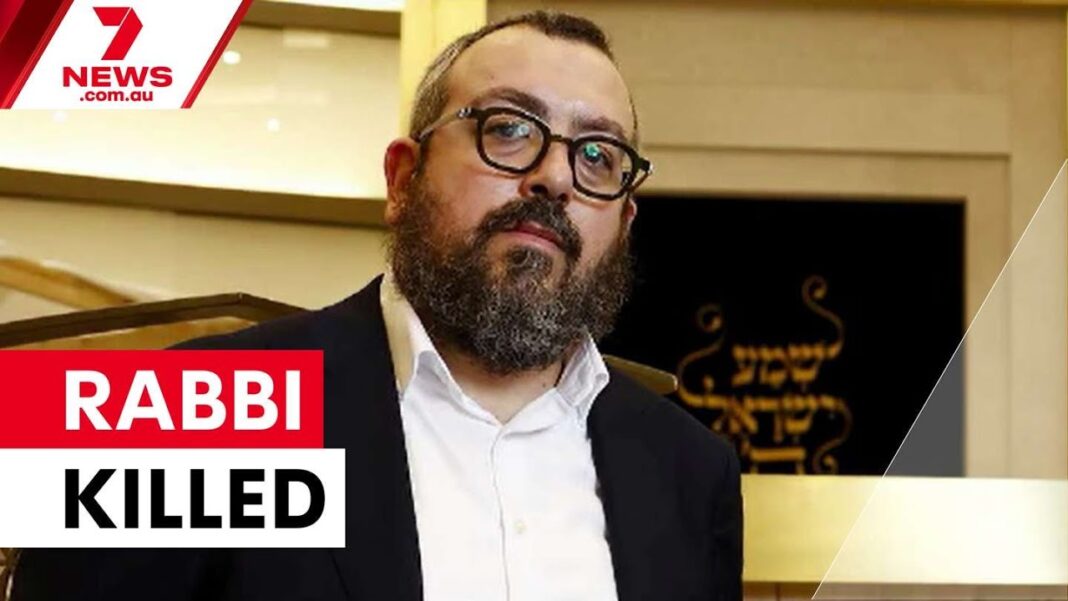
Among those murdered was Rabbi Eli Schlanger, 41, assistant rabbi of Chabad of Bondi and one of the principal organizers of the event. His death sent shockwaves through Jewish communities across Australia and around the world.
As Chabad.org detailed in its biographical tribute, Rabbi Schlanger was far more than an event organizer. He was a devoted emissary of the Lubavitcher Rebbe, Rabbi Menachem M. Schneerson, of righteous memory, who viewed his role not as a profession but as a sacred mission. Alongside his wife and family, Schlanger dedicated his life to strengthening Jewish identity in Bondi—through education, pastoral care, and a boundless sense of humor that made Judaism accessible and joyful.
Rabbi Schlanger also served as a chaplain, offering support to individuals facing illness, grief, or isolation. His in-laws Rabbi Yehoram and Shternie Ulman, founded Chabad of Bondi decades ago, establishing what would become a cornerstone of Jewish life in Sydney. Schlanger carried that legacy forward with passion and humility.
In interviews with Chabad.org earlier this year, Schlanger spoke candidly about the rising tide of antisemitism in Australia following the October 7, 2023 Hamas terror attacks in Israel. Synagogues had been vandalized or torched, Jewish homes and vehicles defaced with hateful graffiti, and mass protests in major cities featured open calls for violence against Jews and the destruction of Israel.
Yet Schlanger refused to retreat.
Rather than advocating fear or withdrawal, Rabbi Schlanger articulated a philosophy deeply rooted in Chabad thought. Speaking to Chabad.org, he observed with pride that attendance at the Bondi Chanukah celebration had doubled in response to antisemitic intimidation.
“The answer is never to hide,” he told Chabad.org at the time. “In the face of darkness, the way forward is always the same: be more Jewish, act more Jewish, and appear more Jewish.”
That conviction was not merely rhetorical. Last Chanukah, Schlanger posted a video on social media—later highlighted by Chabad.org—in which he danced from his home toward his car, hoisting a portable illuminated menorah onto its roof. Captioned, “Here’s the Best Response to Combat Antisemitism,” the video encapsulated his belief that joy, visibility, and faith were the most powerful rebuttals to hatred.
That message, now rendered painfully prophetic, has become a rallying cry in the aftermath of his death.
Among the survivors was Vlad, a State Emergency Services chaplain, who attended the event with his eight-year-old son. Speaking to Australian television in remarks later cited by Chabad.org, Vlad recounted the terrifying moments when gunfire erupted.
“I pushed my son to the ground and covered him,” he said. Nearby, a security guard was shot, and Vlad attempted to render aid amid the chaos. Despite the trauma, his response embodied the very ethos Rabbi Schlanger had championed.
Vlad had purchased Chanukah candles at the event before the attack. He vowed to light them at home that night. “We’re going to keep the show going,” he said. “We are not afraid.”
Another victim identified by Chabad.org was Reuven Morrison, a longtime supporter of Jewish causes who divided his time between Melbourne and Sydney. Morrison was known within communal circles for his quiet generosity and steadfast commitment to Jewish continuity.
The massacre did not occur in a vacuum. As Chabad.org has extensively reported, Australian Jewry has faced escalating hostility since October 2023. The attack on Bondi Beach crystallized fears long simmering beneath the surface—that Jewish visibility itself had become a target.
Security at Jewish events had been heightened in recent years, a fact Rabbi Schlanger himself acknowledged in his interview with Chabad.org. Yet the audacity of an attack on a major public religious celebration has prompted urgent questions about the safety of Jewish life in Australia and the adequacy of protections afforded to minority communities.
Leaders across the Jewish spectrum issued statements of mourning and defiance, many echoing the language Rabbi Schlanger himself had used: light over darkness, faith over fear.
Chanukah commemorates the rededication of the Holy Temple in Jerusalem after desecration and violence—a narrative of spiritual resistance that now feels hauntingly contemporary. The menorah’s flames, meant to burn publicly as a declaration of faith, took on a searing new resonance in Bondi.
In the days following the attack, Chabad centers across Australia and around the world announced plans to proceed with public menorah lightings in memory of the victims. Chabad.org reported that these events would be explicitly dedicated to Rabbi Schlanger’s legacy and to the principle he lived by: responding to hatred not with silence, but with light.
Rabbi Eli Schlanger’s life was cut short, but his teachings—captured in countless classes, conversations, and articles preserved by Chabad.org—continue to reverberate. He believed that Judaism was not merely something to be practiced behind closed doors, but a living, breathing presence meant to illuminate the public square.
As the Australian Jewish community mourns its dead and tends to its wounded, that belief has taken on renewed urgency. The attack on Bondi Beach was intended to extinguish light. Instead, it has exposed the depth of a community’s resolve.
In the words Rabbi Schlanger shared with Chabad.org, words that now read like a final testament: in the face of darkness, the response must always be more light.