



|
Getting your Trinity Audio player ready...
|
Lebanese President Cautiously Supports Peace With Israel, Resists Full Normalization as Hezbollah Tensions Mount
By: Ariella Haviv
In a carefully calibrated statement on Friday, Lebanese President Joseph Aoun reaffirmed his country’s aspirations for peace with Israel—while being clear that formal normalization remains off the table, according to a report in The Algemeiner. Aoun’s remarks reflect the delicate political balancing act facing Beirut amid increasing international pressure to disarm Hezbollah and chart a new diplomatic course with its southern neighbor.
Speaking from the presidential palace, Aoun drew a distinct line between the absence of armed conflict and the establishment of diplomatic ties. “Peace is the lack of a state of war, and this is what matters to us in Lebanon at the moment,” the Lebanese leader stated, according to a release from his office. “As for the issue of normalization, it is not currently part of Lebanese foreign policy.”
As The Algemeiner reported on Friday, Aoun’s comments follow a wave of diplomatic activity surrounding Hezbollah’s role in the region, including a recently proposed U.S.-backed framework aimed at dismantling the Iranian-backed terror group’s arsenal. The proposal, presented to Beirut during U.S. Special Envoy Thomas Barrack’s June 19 visit, reportedly calls for Hezbollah to fully disarm within four months. In return, Israel would halt its ongoing airstrikes and withdraw from five contested military outposts in southern Lebanon.
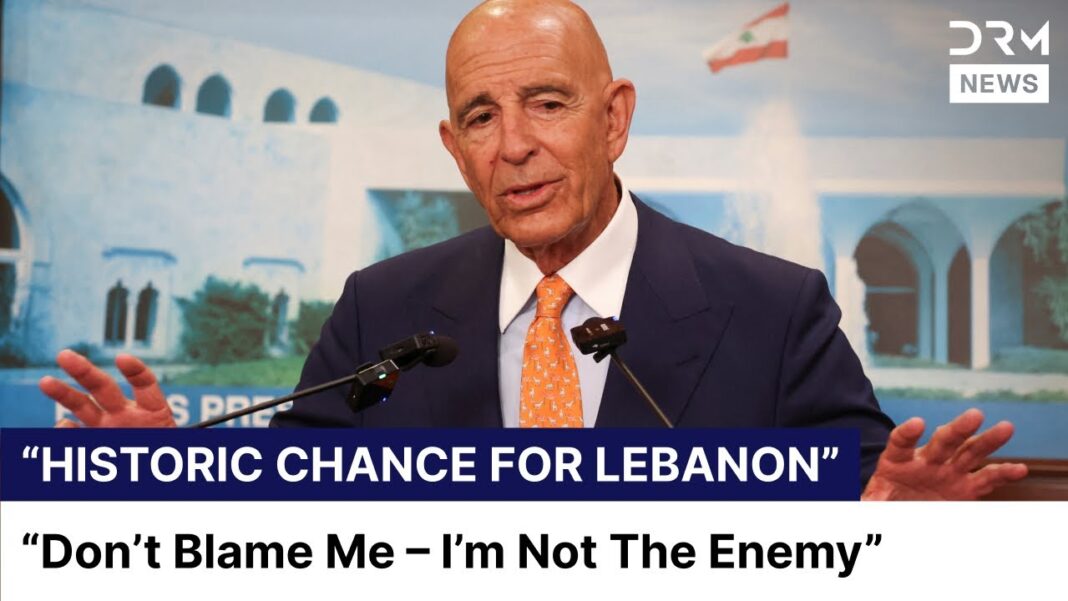
While the full details of Lebanon’s response to the American plan remain confidential, Barrack offered a cautiously optimistic assessment. “Unbelievably satisfied,” he told reporters, suggesting that Lebanon’s leadership, under Aoun, may be more receptive to a disarmament process than in years past.
However, as The Algemeiner report emphasized, any such diplomatic progress faces formidable resistance from Hezbollah itself. In a televised address, Sheikh Naim Qassem—who assumed leadership of Hezbollah following the assassination of Hassan Nasrallah in an Israeli strike last year—categorically rejected the disarmament proposal.
“How can you expect us not to stand firm while the Israeli enemy continues its aggression, continues to occupy the five points, and continues to enter our territories and kill?” Qassem thundered. “We will not be part of legitimizing the occupation in Lebanon and the region. We will not accept normalization [with Israel].”
The Algemeiner has closely tracked Hezbollah’s rhetorical and strategic posture in the wake of its battlefield losses. The group’s claims of resistance remain central to its identity, even as Israel has decimated its command structure through an aggressive air and ground campaign last fall. That campaign, launched in response to Hezbollah’s coordinated rocket barrage on Jerusalem in solidarity with Hamas during the war in Gaza, severely degraded the group’s operational capacity.
The ensuing ceasefire, brokered in November 2024 by U.S. diplomats, marked a turning point in the regional conflict. Under the terms of the agreement, Israel was to withdraw from southern Lebanon within 60 days, while the Lebanese Armed Forces (LAF) and UN peacekeepers assumed control of the border region. Hezbollah, in turn, was to begin disarming and vacating its combat positions along Israel’s northern frontier.
Yet as The Algemeiner has reported, that process has faltered. Despite the formal agreement, Israel has maintained a military presence at several posts in southern Lebanon—justified by the need to protect northern Israeli communities from possible Hezbollah resurgence. Israeli officials have pointed to intelligence indicating that Hezbollah retains rocket launchers and other military assets in violation of the ceasefire terms.
In response, the IDF has continued precision strikes targeting Hezbollah positions. Israel’s government has described these operations as necessary enforcement actions in the face of “blatant violations of understandings between Israel and Lebanon,” The Algemeiner report noted.
President Aoun, seeking to maintain both national sovereignty and domestic stability, has adopted a firm but measured tone. “The decision to restrict arms is final and there is no turning back on it,” he declared Friday, reaffirming Beirut’s commitment to curbing non-state military activity within its borders. For international observers, this remark signals that Aoun is preparing to assert greater state control over Hezbollah’s activities—a step long demanded by both Washington and Jerusalem.
Still, Aoun’s resistance to normalization should not be mistaken for rejection of diplomacy. As The Algemeiner report observed, Lebanese leaders must navigate a political minefield in which any overt rapprochement with Israel risks domestic upheaval, particularly from pro-Hezbollah factions within the government and among the public.
Indeed, the legacy of the 2006 Lebanon War and decades of intermittent conflict continue to weigh heavily on public sentiment. In this context, Aoun’s insistence on distinguishing between peace and normalization reflects an effort to shift policy without igniting backlash. “Normalization,” in Lebanese political discourse, is often synonymous with betrayal—a perception Hezbollah exploits to preserve its legitimacy.
Nevertheless, Israel has shown renewed interest in pursuing normalization not only with Lebanon but also with Syria. Last month, Israeli Foreign Minister Gideon Saar publicly stated that Jerusalem is open to peace agreements with its northern neighbors—provided that Hezbollah is fully disarmed and removed as a threat to Israeli civilians.
As The Algemeiner reported, this Israeli outreach marks a significant shift in tone, aligning with the broader Abraham Accords strategy that has reshaped regional alliances. But the Israeli government remains unequivocal: any diplomatic breakthrough with Lebanon is contingent on Hezbollah’s disarmament and withdrawal from the border.
The coming months will be critical. With the United States, Israel, and parts of the Lebanese establishment aligned on the need to dismantle Hezbollah’s military wing, a rare diplomatic opportunity has emerged. Yet it remains unclear whether Aoun’s government has the political strength—or international backing—to confront Hezbollah’s entrenched presence.
In its latest analysis, The Algemeiner report cautioned that failure to act decisively could leave Lebanon trapped in perpetual proxy conflict. As the report noted, “Without firm and verifiable steps toward disarmament, any peace with Israel will remain a paper promise—overshadowed by the continued threat of terror from within Lebanon’s own borders.”
The stakes are profound—not just for Lebanon and Israel, but for the future of regional stability. The coming negotiations, shaped by diplomacy, deterrence, and domestic calculus, will determine whether the eastern Mediterranean moves closer to peace—or slides back into confrontation.
