



|
Getting your Trinity Audio player ready...
|
Khamenei Blames the CIA & Mossad for Engineering “Sedition” in Iran
By: Fern Sidman
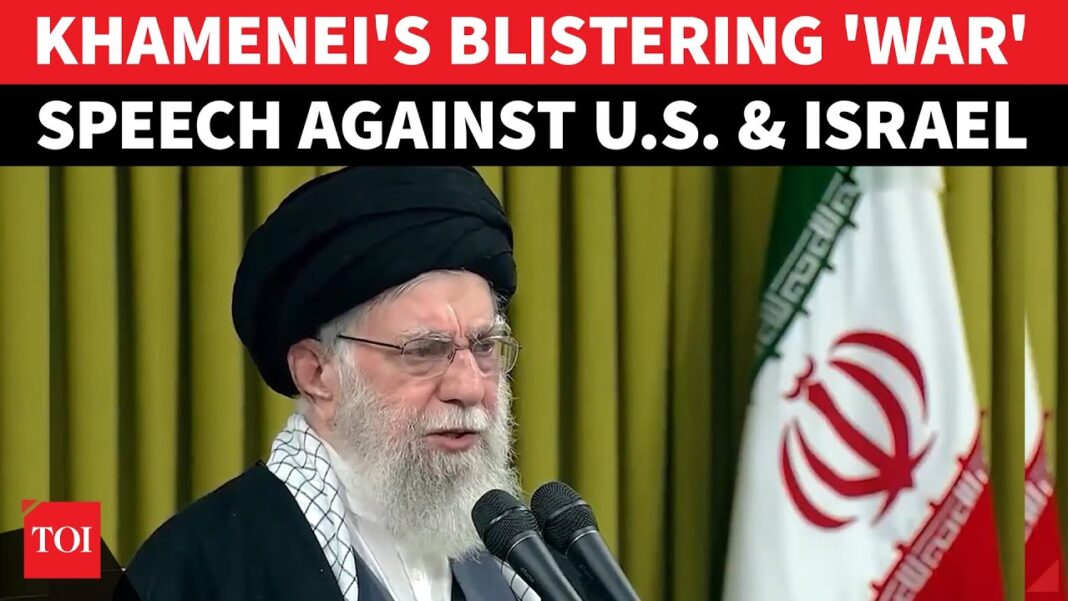
In a series of forceful statements that illuminate both the Iranian regime’s anxieties and its entrenched worldview, Iran’s Supreme Leader Ali Khamenei has accused foreign powers—specifically the United States and what he termed “Zionists”—of orchestrating the recent wave of unrest that shook the Islamic Republic. Casting the protests not as a domestic uprising rooted in social or economic grievances but as a meticulously engineered conspiracy, Khamenei insisted the turmoil was planned, directed, and managed from abroad. His remarks, reported on Monday by Israel National News, offer a revealing portrait of how Tehran’s leadership interprets dissent—and how it seeks to justify its response.
According to Khamenei, the unrest amounted to nothing less than a “sedition,” a term heavy with ideological significance in Iran’s political lexicon. He claimed that the plan behind the disturbances “was developed abroad, and it was managed from abroad,” asserting that Iran’s enemies had poured resources into destabilizing the country. In language that the Israel National News report described as unusually explicit, Khamenei alleged that he had been informed “through a certain channel” that the Central Intelligence Agency and Mossad had deployed “all of their resources into the field.” Despite this, he declared triumphantly, “they were defeated.”
These claims, which the Israel National News report noted were made without publicly presented evidence, fit squarely within a longstanding narrative employed by Iran’s leadership: that internal dissent is never organic, never spontaneous, and never legitimate. Instead, protests are framed as the work of external enemies exploiting discontent to weaken the state. By situating the unrest within a global conspiracy, Khamenei effectively absolves the regime of responsibility for the conditions that gave rise to the demonstrations in the first place.
Khamenei went further, arguing that U.S. involvement was evident not merely through intelligence assessments but through the words of the American president himself. Quoting remarks he attributed to the U.S. leader, Khamenei wrote that the president had explicitly encouraged the rioters, telling them, “Keep going, keep going. I’m coming [to help].” For Khamenei, this alleged statement served as proof that Washington was not a distant observer but an active instigator. Such accusations reflect Tehran’s deep-seated conviction that the United States views regime change in Iran as an ultimate objective.
The Supreme Leader framed the unrest as part of a recurring pattern rather than an isolated episode. Iran, he wrote, is a country “in friction with the interests of global aggressors,” and therefore destined to face repeated attempts at destabilization. When he posed the question of how long such efforts would continue, his answer was characteristically defiant: they would persist “until the Iranian nation reaches a point where the enemy is left hopeless.” “And we will reach that point,” he added, projecting confidence that endurance and resistance would ultimately prevail.
Central to Khamenei’s account was his praise for the state’s security apparatus. He said that law enforcement forces, the Basij, and the Islamic Revolutionary Guard Corps had “carried out their duties in full.” Yet he was careful to emphasize that it was ultimately “the people themselves who trampled the fire of sedition into ashes.” The Israel National News report interpreted this formulation as an attempt to portray the crackdown not as top-down repression but as a popular rejection of chaos—an image sharply at odds with reports from human rights organizations documenting widespread arrests and lethal force.
Addressing the economic dimension of the protests, Khamenei acknowledged that shopkeepers and merchants “did have grievances and their demands were logical and justified.” This concession, though limited, was notable. However, he quickly circumscribed it by claiming that violent rioters had hidden behind peaceful demonstrations. According to his account, once shopkeepers realized that protests were morphing into riots, “they separated themselves.” This distinction allows the regime to recognize economic hardship without conceding political legitimacy to the broader movement.
Khamenei repeatedly likened the unrest to a coup attempt, asking rhetorically why it should be defined as such and then answering his own question. The reason, he said, was that the goal of the unrest was to “destroy the centers effective in the country’s governance.” He alleged that attackers targeted police forces, IRGC bases, government institutions, and banks—symbols of state authority whose destruction would, in his telling, paralyze the nation. By framing the protests as an assault on governance itself, Khamenei positioned the regime’s response as an act of national defense rather than suppression.
One of the most striking—and controversial—elements of his remarks was his claim that ringleaders trained by the United States and “Zionists” were responsible for what he termed “engineered killings.” He alleged that these figures not only attacked security forces but also turned on the very protesters they had drawn into the streets through propaganda, striking them “from behind.” Such claims serve a dual purpose: demonizing protest leaders while sowing mistrust among ordinary participants, thereby fracturing opposition movements.
For Khamenei, the ultimate objective of the unrest was the erosion of security itself. “When security is gone, nothing is left,” he warned. Without security, he argued, there can be “no production, no schools, no research, no scientific knowledge, and no progress.” This emphasis on security as the precondition for all societal functions is a cornerstone of the regime’s ideology. The Israel National News report pointed out that this logic effectively elevates state control above civil liberties, casting any challenge to authority as an existential threat to national life.
Perhaps the most incendiary comparison Khamenei drew was between the violence of the unrest and that of the Islamic State terror organization, also known as ISIS. “A defining feature of this sedition was its violence; it was like that of the Daesh,” he said, using the Arabic acronym for ISIS. He went on to cite a statement he attributed to the current U.S. president—“We created ISIS”—to argue that the same forces behind the terror group were now behind the unrest in Iran. According to Khamenei, like ISIS, the rioters “burned people alive” and “beheaded people,” committing atrocities that justified the harshest response.
The Israel National News report underscored the significance of this comparison. By equating protesters with ISIS, Khamenei places them beyond the bounds of political dialogue or reform. Terrorists are not negotiated with; they are crushed. This rhetorical move provides ideological cover for extreme measures, framing repression as counterterrorism.
The broader implications of Khamenei’s narrative are profound. By externalizing blame for unrest, the regime avoids confronting the systemic issues—economic stagnation, corruption, social restrictions, and political exclusion—that continue to fuel discontent. At the same time, the insistence that enemies will persist until they are rendered “hopeless” signals a leadership bracing for prolonged confrontation, both internally and externally.
Israel National News has consistently analyzed such statements as part of a pattern in which Tehran’s leadership doubles down during crises, interpreting dissent not as feedback but as warfare. The language of siege reinforces loyalty among regime supporters while justifying repression to the broader population. Yet it also reveals a regime deeply conscious of its vulnerabilities, keenly aware that legitimacy cannot be taken for granted.
In the end, Khamenei’s portrayal of the unrest as a foreign-orchestrated sedition tells us less about the protesters than about the state itself. It reflects a worldview in which power is perpetually contested, security is paramount, and compromise is equated with defeat. Whether this narrative can indefinitely suppress the underlying forces of discontent remains an open question. What is clear is that the Supreme Leader has chosen defiance over introspection, confrontation over reform—setting the stage for further tension in a country already straining under the weight of its contradictions.

My mother taught me that, before you point a finger at someone to blame him/her for your negative experience, you should consider turning your finger around to blame yourself. It would be wise for Mr. Khamenei to learn this lesson from my mother.