



|
Getting your Trinity Audio player ready...
|
“KEEP PROTESTING—HELP IS ON THE WAY”: Trump’s Clarion Call as Iran’s Regime Confronts Its Darkest Hour
By: Fern Sidman
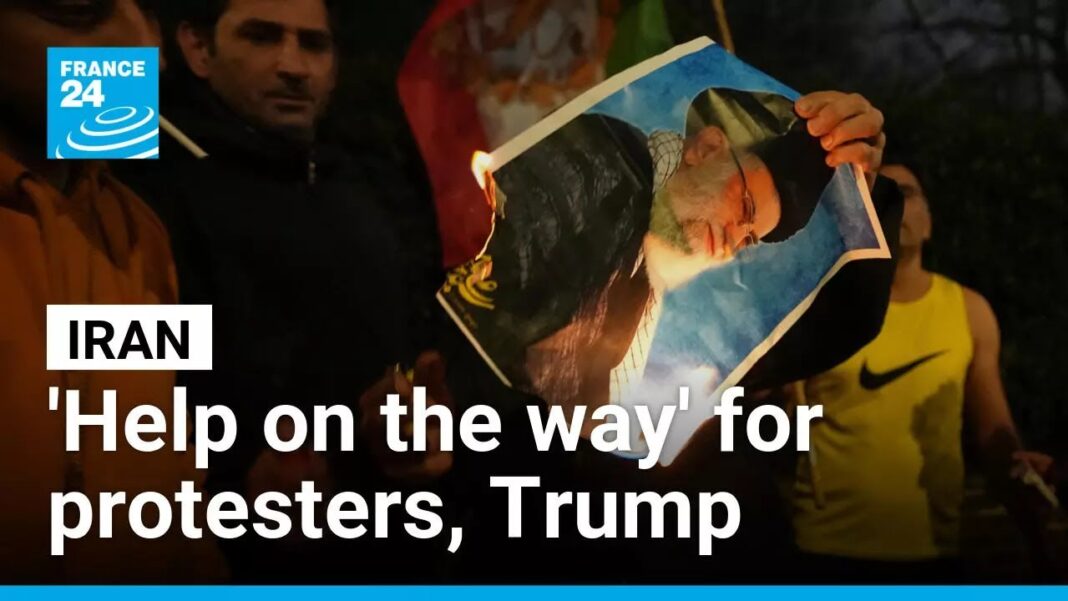
By any measure, the Islamic Republic of Iran is now living through one of the most perilous moments in its post-revolutionary history. As images of blood-streaked streets and shuttered bazaars seep through Iran’s near-total information blackout, President Trump has chosen to cast himself openly as the champion of Iran’s besieged citizenry. In a dramatic message posted Tuesday on Truth Social and cited in a report on Tuesday by Israel National News, Trump exhorted demonstrators to persist, promising that American assistance is imminent and vowing to hold perpetrators of violence accountable.
“Iranian Patriots, KEEP PROTESTING – TAKE OVER YOUR INSTITUTIONS!!!” the president wrote, according to the Israel National News report. “Save the names of the killers and abusers. They will pay a big price. I have cancelled all meetings with Iranian Officials until the senseless killing of protesters STOPS. HELP IS ON ITS WAY. MIGA!!!”
The bluntness of the appeal—bordering on a revolutionary manifesto—marked an extraordinary escalation in Washington’s public posture toward Tehran. It came as Iranian officials, for the first time, acknowledged a death toll that even the regime itself could no longer plausibly obscure.
An unnamed Iranian official told Reuters that approximately 2,000 people had been killed over the past two weeks, including both demonstrators and members of the security forces. The official attributed the bloodshed to “terrorists,” an elastic term that Iranian authorities routinely deploy to describe virtually any form of dissent. As the Israel National News report noted, Tehran’s narrative remains carefully calibrated: conceding that deaths have occurred but absolving the state of responsibility by shifting blame to shadowy enemies—often naming the United States and Israel as chief instigators.
Yet this official figure stands in jarring contrast to reporting from Iran International, a London-based Persian-language outlet long reviled by the regime. Iran International claims that at least 12,000 people were killed, many during two consecutive nights of ferocious violence. The organization stresses that its estimate is preliminary and that verification is hampered by systematic internet shutdowns and restrictions on domestic media—conditions that the Israel National News report described as “a digital curtain drawn across a nation in revolt.”
Human rights groups operating in exile have likewise struggled to establish an accurate count, but even the lowest confirmed numbers place the current unrest among the deadliest episodes of internal repression in the Islamic Republic’s modern history.
Trump’s decision to cancel all meetings with Iranian officials, as reported by Israel National News, signals a dramatic freeze in what little remained of U.S.–Iranian diplomacy. According to information provided by CBS News, two Defense Department officials said the president has been briefed on an expansive menu of military and covert options that extends well beyond conventional airstrikes. These include cyber operations and precision attacks on elements of Iran’s internal security apparatus.
A separate New York Times report cited a senior U.S. source who said the Pentagon had presented Trump with scenarios that include strikes on segments of Iran’s nuclear program. However, the official suggested that the more likely near-term actions would be tightly focused: disabling cyber infrastructure or targeting the organs of repression most directly responsible for crushing protests.
Later today, Trump’s national security team is expected to convene at the White House to review these options, though it remains unclear whether the president himself will attend. Even in absentia, the tone is unmistakable: Washington is no longer speaking in the abstract about “monitoring developments,” but openly contemplating intervention.
From Berlin, German Chancellor Friedrich Merz delivered what may prove to be one of the most prophetic assessments of the crisis. Speaking to reporters during a visit to India, Merz said he believes the Islamic Republic is approaching its end. “If a regime can only keep itself in power by force, then it’s effectively at the end,” he declared. “I believe we are now seeing the final days and weeks of this regime.”
Merz’s diagnosis cuts to the heart of Iran’s predicament. Unlike authoritarian systems that at least pretend to rest on electoral legitimacy, the clerical establishment derives its authority from a theological mandate increasingly rejected by the population. The current uprising, sparked by economic despair, has morphed into a repudiation of the entire architecture of rule: from the Supreme Leader’s office to the Revolutionary Guards who enforce the regime’s writ with batons and bullets.
According to the information contained in the Israel National News report, the present wave of protests erupted in late December amid spiraling inflation, a collapsing rial and food prices that have placed basic sustenance beyond the reach of ordinary families. In cities from Mashhad to Shiraz, pensioners, factory workers, students and merchants poured into the streets, chanting not merely against austerity but against the Ayatollahs themselves.
What differentiates this revolt from earlier spasms of unrest is both its scale and its ideological clarity. Demonstrators have increasingly adopted slogans demanding the dismantling of clerical rule. In Tehran, crowds have reportedly shouted, “This is the final battle—Khamenei must go,” a refrain that Israel National News says has become emblematic of a movement no longer content with piecemeal reform.
The Iranian regime, for its part, has sought to perform a rhetorical balancing act. Officials have acknowledged that economic grievances are legitimate while denouncing the protests as foreign-engineered sedition. State television has alternated between footage of calm streets and dire warnings about plots hatched in Washington and Jerusalem. This narrative strategy—simultaneously minimizing unrest and blaming outsiders—has been a constant theme in Israel National News’ coverage.
Yet the acknowledgment of a 2,000-person death toll, even couched in accusations of “terrorism,” represents a significant crack in the façade. For decades, the Islamic Republic has prided itself on projecting an image of unassailable stability. Now, under the weight of its own repression, it appears to be hemorrhaging legitimacy.
In Jerusalem, officials have adopted a posture of wary vigilance. As Israel National News has reported, Israeli defense sources believe Trump is serious about following through on his threats if the killing of protesters continues. Yet they also emphasize that any U.S. action could provoke Iranian retaliation, potentially igniting a regional conflagration.
The Israel Defense Forces have reiterated that the protests are an internal Iranian matter, but have quietly elevated readiness levels amid concerns about “surprise scenarios.” The specter of Iranian proxies—from Hezbollah in Lebanon to militias in Syria and Iraq—adds a volatile layer to an already combustible situation.
What is striking about Trump’s intervention is not merely its tone but its timing. Previous American administrations, including Trump’s own first term, typically confined themselves to denunciations and sanctions when Iran repressed dissent. Now, the White House appears to be contemplating a far more muscular approach—one that blends moral exhortation with the credible threat of force.
Trump’s message to Iranian protesters—urging them to “take over your institutions”—would have been unthinkable language from any U.S. president a decade ago. It implicitly endorses regime change, a goal Washington has long disavowed in formal terms even while pursuing policies that weakened Tehran.
Germany’s Merz is not alone among European leaders in predicting tectonic change. According to the information in the Israel National News report, diplomats across the continent privately concede that the Islamic Republic is entering a phase of terminal instability. Yet public caution persists, driven by fears that Iran’s collapse could unleash chaos on a scale rivaling Syria’s civil war.
The dilemma is stark: to intervene risks accelerating a violent unraveling; to stand aside risks enabling a massacre whose victims are increasingly visible even through the regime’s censorship.
As the White House prepares for its latest Iran briefing, the question haunting policymakers is not whether the regime is in trouble—it manifestly is—but whether American action can shape the outcome without plunging the region into deeper catastrophe.
Trump has staked out a posture of unapologetic solidarity with Iran’s protesters. By canceling talks and hinting at covert and overt measures, he has made clear that the United States is no longer content to be a distant observer. The report at Israel National News has characterized this as a watershed moment: a president openly challenging the clerical establishment not merely with words, but with the promise of tangible support.
For Iranians chanting in the streets of Esfahan and Ahvaz, the phrase “HELP IS ON ITS WAY” has already become a kind of talisman. Whether it heralds liberation or heartbreak remains to be seen. But what is beyond doubt, as this crisis enters its third week, is that the Islamic Republic’s long monopoly on fear has been shattered.
In the words of Chancellor Merz, a regime that governs solely through violence has already forfeited its future. The only unresolved question is how—and how violently—that future will finally arrive.