



|
Getting your Trinity Audio player ready...
|
By: Fern Sidman – Jewish Voice News
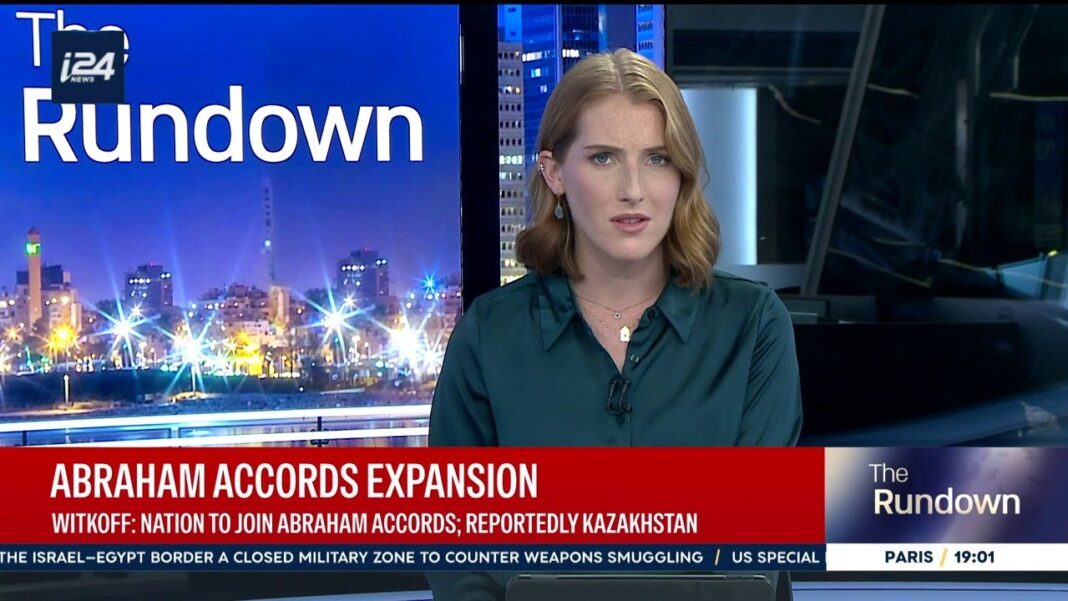
In a development that has reverberated across the Middle East and Central Asia, Kazakhstan is reportedly preparing to join the Abraham Accords, the historic framework of normalization agreements between Israel and Arab or Muslim-majority nations first brokered under President Donald Trump nearly five years ago.
As reported by The Jewish News Syndicate (JNS) on Thursday afternoon, the decision by Kazakhstan—a strategically positioned, energy-rich nation straddling Europe and Asia—to enter the circle of peace represents both a diplomatic milestone and a symbolic reaffirmation of the Accords’ vitality. While early skeptics once dismissed the initiative as a transient experiment in transactional geopolitics, Kazakhstan’s accession demonstrates that the framework continues to yield tangible dividends for Israel’s integration into the broader Islamic world.
“Is anyone getting tired of more peace?” remarked Mike Waltz, U.S. ambassador to the United Nations, in a pointed echo of the optimism that characterized the original signing ceremonies in Washington in 2020. His rhetorical question carried a dual meaning—celebrating both the durability of the accords and the continued resonance of Trump-era diplomacy in reshaping regional alliances.
According to the information provided in the JNS report, Kazakhstan’s decision was greeted “warmly” by the Conference of Presidents of Major American Jewish Organizations, whose chair Betsy Berns Korn and CEO William Daroff hailed the move as an “extraordinary advancement of regional peace and cooperation.”
“Strengthening and expanding this historic initiative advances Israel’s security and prosperity,” they stated, “and marks a major step toward greater peace, stability, and cooperation in the Middle East and beyond.”
For Israel, the implications are profound. Kazakhstan—a Muslim-majority nation of nearly 20 million people—has maintained full diplomatic and economic relations with the Jewish state for over three decades. As the JNS report noted, those ties have long been rooted in mutual respect and pragmatic engagement. Kazakhstan’s entry into the Abraham Accords will now formalize its alignment with a growing network of nations committed to dialogue, economic cooperation, and the shared pursuit of stability.
As the JNS report highlighted, the Conference of Presidents underscored that its relationship with Kazakhstan stretches back more than 20 years, beginning with the organization’s first mission to the Central Asian nation. Since that time, Kazakhstan has earned a reputation as a rare beacon of interfaith harmony in the Muslim world—a country that not only tolerates but actively supports Jewish life within its borders.
“For more than two decades, the Conference of Presidents has cultivated a close relationship with Kazakhstan,” the organization’s leaders said in a statement cited in the JNS report. “We have witnessed Kazakhstan’s enduring support for Jewish life, its consistent promotion of religious tolerance, and its strong bilateral ties with both Israel and the United States.”
In this respect, Kazakhstan’s decision is neither opportunistic nor abrupt. It is the culmination of a long-standing foreign policy that prizes moderation and engagement over confrontation. The country’s president, Kassym-Jomart Tokayev, has positioned his government as a bridge between the Muslim world, Israel, and the West—an approach that aligns seamlessly with the spirit of the Abraham Accords.
The entry of Kazakhstan also serves as a reminder of the transformative impact of the diplomatic architecture envisioned under President Trump. As the JNS report frequently emphasized, the Abraham Accords did more than normalize relations between Israel and countries like the United Arab Emirates, Bahrain, Morocco, and Sudan—they established a new diplomatic paradigm predicated on shared interests, mutual respect, and the rejection of zero-sum ideology.
Korn and Daroff explicitly credited Trump’s leadership, asserting that his efforts “created new opportunities for diplomacy, partnership, and mutual understanding across the region.” They noted that the former president’s willingness to challenge long-standing diplomatic orthodoxies brought about “a new era of pragmatic peace that has reshaped the political topography of the Middle East.”
Indeed, Trump’s critics, who once derided the Accords as symbolic photo opportunities, now find themselves contending with a steadily expanding coalition of Muslim-majority nations deepening their engagement with Israel.
As JNS has repeatedly observed, each new member state not only strengthens Israel’s security and legitimacy but also further isolates Iran—the principal sponsor of anti-Israel militancy and disinformation in the region.
Kazakhstan’s move signals an evolution in the Abraham Accords’ scope and reach. Unlike the original signatories—most of which are located in the Middle East and North Africa—Kazakhstan occupies a unique geopolitical position, connecting the Islamic world to the broader Eurasian continent.
“The decision deepens ties between Israel and the broader Arab and Muslim world,” said the Conference of Presidents, as quoted in the JNS report, “and renews the Accords as a living framework for regional cooperation.”
Beyond symbolism, the practical opportunities are immense. Kazakhstan is one of the world’s largest producers of uranium and natural gas, and its participation could pave the way for joint ventures in energy technology, agriculture, cybersecurity, and water management—areas where Israeli innovation is world-renowned.
Moreover, Kazakhstan’s accession could serve as a catalyst for further integration across Central Asia, potentially inspiring neighbors such as Uzbekistan or Azerbaijan to consider deepening their own partnerships under the umbrella of the Accords.
In a further gesture of goodwill, the Conference of Presidents used the occasion, as JNS reported, to urge the U.S. Congress to repeal the Jackson-Vanik Amendment, a Cold War-era statute that restricts trade with former Soviet republics over human rights concerns.
“Graduating Kazakhstan from the Jackson-Vanik Amendment,” the group stated, “would affirm Kazakhstan’s modern record and strengthen the partnership that the Abraham Accords now extend.”
Such a move would symbolize Washington’s recognition of Kazakhstan’s evolution into a reliable ally—one that champions religious pluralism, supports Jewish life, and actively contributes to the stabilization of a volatile region.
Among those praising Kazakhstan’s decision was Rabbi Marc Schneier, long time rabbinic leader of The Hampton Synagogue and president of the Foundation for Ethnic Understanding, who has met with President Tokayev multiple times in Astana. In comments published in the JNS report, Schneier highlighted the moral irony that while a Muslim-majority country is choosing peace, certain Western leaders are moving in the opposite direction.
“In joining the Abraham Accords,” Schneier said, “how ironic that yet another Muslim-majority country is publicly demonstrating its support for a two-state solution, while New York City mayor-elect Zohran Mamdani refuses to recognize Israel’s right to exist as a democratic Jewish nation. He must get on the peace train before history leaves him behind.”
Schneier’s words encapsulate a broader truth—one that JNS has long articulated—that the moral courage to embrace coexistence increasingly resides outside the progressive enclaves of the West and within the pragmatic leadership of nations once thought implacably opposed to Israel.
The JNS report also cited Jason Brodsky, policy director at United Against Nuclear Iran, who framed Kazakhstan’s accession as a geopolitical counterpoint to Iran’s ongoing efforts to destabilize the region.
“Kazakhstan joining the Accords,” Brodsky observed, “is the answer of the U.S. government to the absurd statement of Oman’s foreign minister, who sounded like Iran’s regime’s lawyer at the recent Manama Dialogue, that Israel—not Tehran—is the region’s most destabilizing actor.”
Brodsky’s assessment shines a spotlight on how the Abraham Accords have become not merely a diplomatic project but a strategic bulwark against Tehran’s malign influence. Each new signatory expands the regional coalition committed to curbing Iran’s ambitions and promoting a vision of peace grounded in mutual respect and security.
As the JNS report observed, the inclusion of Kazakhstan in the Abraham Accords reaffirms that peace remains not only possible but contagious. Far from being an artifact of the past, the Accords have proven to be a living, breathing framework—one capable of adapting, expanding, and inspiring nations across cultural and geographic divides.
“Kazakhstan’s entry into the Abraham Accords expands the circle of peace, stability, and cooperation in the region,” the Conference of Presidents declared. “We encourage other nations to follow Kazakhstan’s example and join this transformative initiative.”
In an era marked by polarization, the message from Astana and Jerusalem alike is unmistakable: the pursuit of peace, prosperity, and coexistence remains a universal aspiration—and one that continues to transcend politics, geography, and ideology.
As US Ambassador to the UN, Mike Waltz quipped, the world is not yet “tired of more peace.” Neither, it seems, are those who continue to believe in the enduring promise of the Abraham Accords.