



|
Getting your Trinity Audio player ready...
|
Jihadist Bombing of Alawite Mosque Deepens Fears for Syria’s Religious Minorities Under New Islamist Rule
Another deadly assault on Syria’s religious minorities has underscored the growing peril they face under the country’s new Islamist-led government, raising fresh doubts about claims of stability in the post-Assad era.
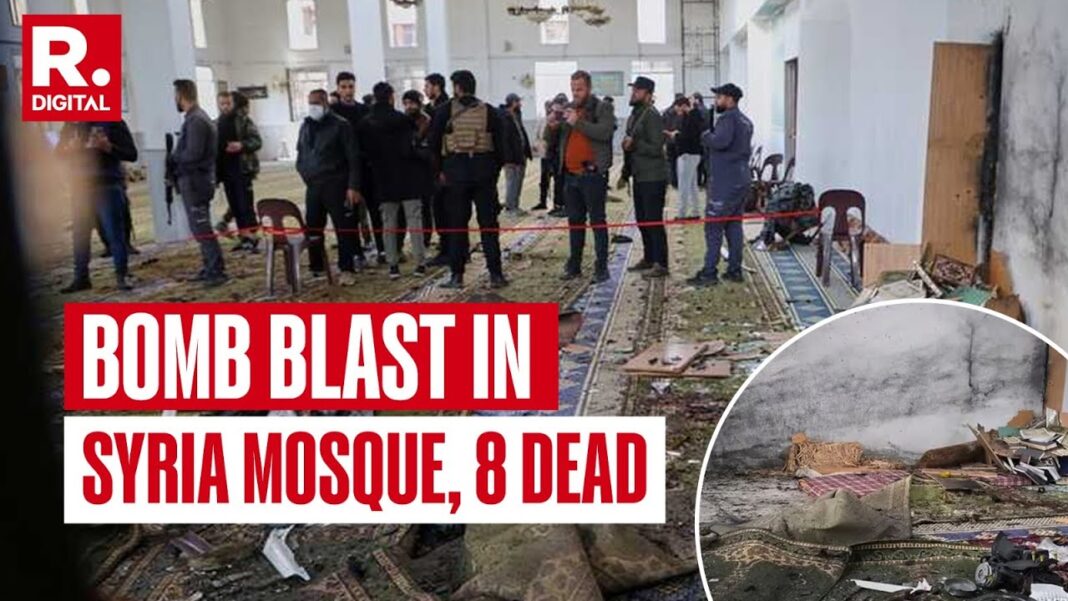
A bomb detonated inside a mosque in the central Syrian city of Homs during Friday prayers, killing at least eight worshippers and injuring 18 others, according to authorities cited by the Associated Press. The attack targeted an Alawite place of worship — a significant detail, given that Alawites are a non-Sunni Muslim sect that has increasingly come under violent pressure since the fall of former President Bashar al-Assad, himself an Alawite.
The mosque, Imam Ali ibn Abi Talib, is located in Homs’ Wadi al-Dhahab neighborhood, an area largely populated by Alawites in Syria’s third-largest city. Images released by Syria’s state-run Arab News Agency (SANA) showed scenes of devastation: blood-soaked carpets, shattered windows, gaping holes in the walls, and clear signs of fire damage inside the sanctuary.
SANA reported that explosive devices had been planted inside the mosque, indicating the blast was not carried out by a suicide bomber. Security forces have announced a search for those responsible, though skepticism is widespread over how aggressively the investigation will be pursued. The current government is dominated by Hayat Tahrir al-Sham (HTS), the Islamist faction that rose to power after Assad’s overthrow, and there are unconfirmed reports suggesting the group behind the bombing was until recently affiliated with HTS itself.
One year after the collapse of Syria’s secular Ba’athist government, a grim and, to many observers, entirely predictable pattern has taken shape. Religious minorities are increasingly vulnerable, while Islamist factions consolidate power and sideline — or openly target — communities viewed as politically suspect or religiously deviant.
Critics say the West’s response has been strikingly muted. Much of the mainstream media, they argue, has downplayed or ignored abuses by the new authorities, instead casting the rise of HTS leader Abu Mohammad al-Jolani — now operating under the name Ahmed al-Sharaa — in a softened, even romanticized light, largely because the Assad government is gone.
The Alawite community, which makes up roughly 10 percent of Syria’s population, has borne the brunt of this shift. In March, a massacre of Alawite civilians in the country’s northwest shocked the region, followed by persistent low-level violence and intimidation. While Alawites were often associated with the old regime, many within the community have stressed that they did not enjoy special treatment under Assad and are now being collectively punished simply for their identity.
Christians, too, are facing renewed persecution. Activists have pointed to incidents in Damascus where Christmas decorations were vandalized and believers intimidated — scenes that contrast sharply with areas like Kurdish-run Rojava, where public celebrations of Christmas have continued without fear.
Despite official rhetoric about national unity, the Islamist-led government has routinely framed clashes involving Alawites as battles against “Assad remnants,” justifying heavy-handed responses while critics say Alawite civilians are subjected to routine harassment and violence.
The bombing in Homs has become a grim symbol of this new reality — a warning that in today’s Syria, attending church, or even praying at the “wrong” mosque, can be a death sentence.