



|
Getting your Trinity Audio player ready...
|
By: Fern Sidman
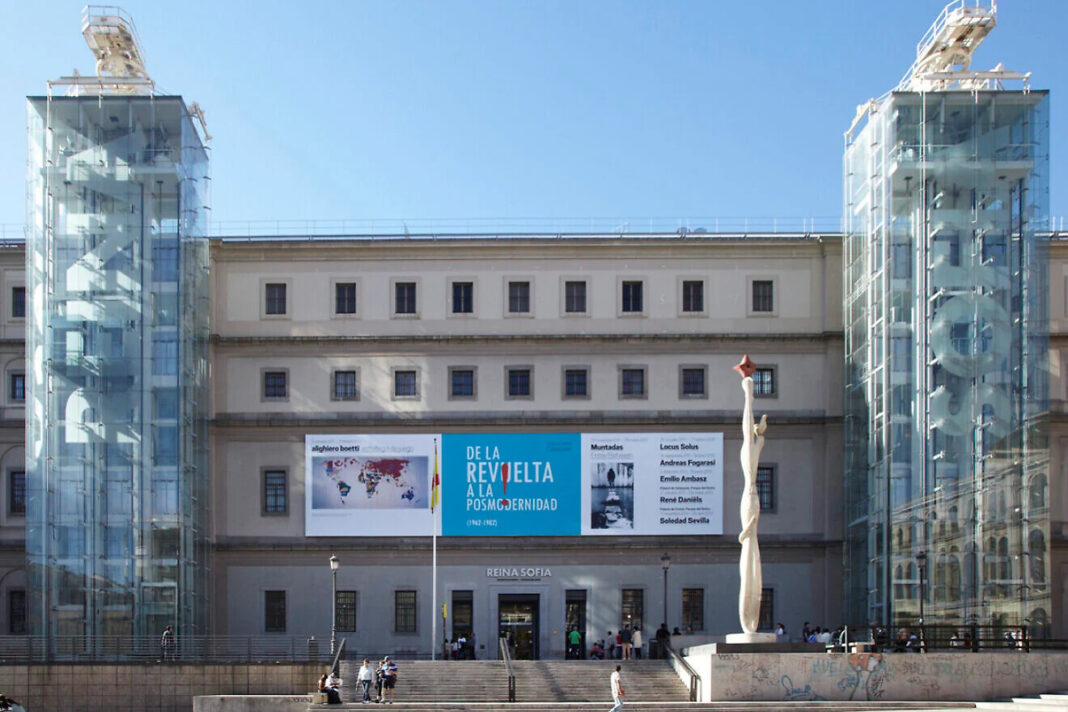
The Algemeiner reported on Monday on an episode in Madrid that, in its grim symbolism and bureaucratic cruelty, has come to encapsulate a far wider malaise afflicting Europe’s public institutions. Three elderly Jewish women—one of them a survivor of the Holocaust—were compelled to leave Spain’s National Museum Reina Sofía after being subjected to verbal abuse for the simple act of displaying Jewish symbols.
The incident, first revealed by the Spanish outlet Okdiario and subsequently chronicled by The Algemeiner, has ignited a fierce debate about the responsibilities of cultural institutions, the normalization of antisemitic hostility, and the alarming ease with which victims can be transformed into supposed provocateurs in today’s political climate.
According to the accounts summarized in The Algemeiner report, the women were visiting the renowned museum in central Madrid when other visitors noticed a Star of David necklace and a small Israeli flag in their possession. What followed was not a mere exchange of words or a misunderstanding born of political passions, but a torrent of abuse. The women were reportedly shouted at, branded with slurs, and accused of being “crazy child killers”—language that draws directly from the most toxic reservoir of contemporary antisemitic rhetoric.
The museum, rather than acting as a bulwark against such intimidation, compounded the harm by turning on the victims themselves.
Officials at the Reina Sofía, a state-affiliated institution under Spain’s Culture Ministry and one of the country’s most prestigious contemporary art museums, chose not to confront those who initiated the harassment. Instead, they informed the Jewish visitors that they would have to leave because, as one staff member allegedly put it, “some visitors were disturbed that they are Jewish.” A security guard went further, telling the women that they should hide their Jewish symbols, insisting that such expressions could not be displayed inside the museum.
The women pointed out—correctly—that Spanish law permits the wearing of religious symbols and the carrying of national flags in public institutions. The explanation did not spare them. They were escorted out regardless, even though they had broken no rules and committed no offense beyond being visibly Jewish.
The Algemeiner’s coverage emphasized the profound inversion of justice at work in this decision. The perpetrators of the abuse were left unchallenged, while the targets were removed, exposed, and humiliated. The message, whether intended or not, was unmistakable: public peace would be preserved not by restraining those who harass, but by silencing those who are harassed. In the moral economy of that moment, Jewish visibility became the problem to be solved.
The backlash was swift and, in many quarters, unforgiving. The European Jewish Congress condemned the incident as “deeply troubling and unacceptable,” warning that the museum’s response raised serious questions about discrimination within a publicly funded cultural institution. In a statement cited by The Algemeiner, the EJC stressed that Jewish identity must never become grounds for exclusion and called for full clarification, accountability, and decisive action to ensure that antisemitism is confronted rather than accommodated.
The Action and Communication on the Middle East (ACOM), a leading pro-Israel organization in Spain, announced its intention to pursue legal action against both the museum and its director, Manuel Segade, alleging discrimination and the promotion of hate from an institution supported by public funds.
The Algemeiner report noted that ACOM framed the episode not as an isolated lapse, but as part of a broader pattern in which political agendas and ideological activism have been allowed to distort the mission of cultural spaces.
That accusation gains resonance when placed against the Reina Sofía’s recent history. The museum has previously been criticized for hosting anti-Israel demonstrations and for presenting an exhibition titled “From the River to the Sea,” a slogan widely understood—especially in Jewish communities—as a call for the eradication of the Jewish state. While defenders of such programming often invoke artistic freedom and political expression, The Algemeiner report observed that the line between critique and incitement is not merely academic when real people are made to feel unsafe or unwelcome in public institutions.
The Madrid incident does not stand in isolation. Across Europe and the broader Western world, antisemitic incidents have surged in the wake of Hamas’s October 7, 2023, invasion of and massacre across southern Israel. Spain occupies a particularly troubling position in this landscape. Experts warn that antisemitism there has moved beyond a social phenomenon into something that is, in many instances, legitimized—if not actively encouraged—by political rhetoric at the highest levels of government.
Prime Minister Pedro Sánchez and members of his left-wing coalition have come under sustained criticism from political opponents and Jewish leaders alike for what they describe as a pattern of inflammatory, one-sided statements about the war in Gaza. Sánchez has repeatedly accused Israel of “genocide” and of violating international law, employing language that echoes the most extreme and polarizing accusations circulating in global discourse.
In one widely quoted speech, he declared that bombing hospitals and killing innocent children through hunger was not self-defense but “exterminating defenseless people” and “breaking all the rules of humanitarian law.” Such statements, delivered from the highest office in the land, do more than express sympathy for Palestinian suffering; they frame Israel—and, by extension, those who identify with it—as moral pariahs.
Sánchez has also voiced solidarity with the “Palestinian people and their cause” and praised anti-Israel demonstrations for championing what he called “just causes.” Critics argue that this rhetoric has created an atmosphere in which hostility toward Israel shades easily into hostility toward Jews. Across Spain, political leaders have accused the prime minister of exploiting the war in Gaza to deflect attention from domestic scandals, electoral setbacks, and growing public dissatisfaction with his government. Whatever the political calculus, the social consequences are increasingly visible.
The Spanish Observatory of Antisemitism has documented a staggering 567 percent increase in antisemitic incidents between 2022 and 2024, a trend that observers believe has continued into the past year. This surge manifests not only in online abuse and street-level harassment, but also in institutional decisions that appear to normalize or excuse discrimination. The Reina Sofía episode, in which museum staff effectively told Jewish visitors to conceal their identity for the comfort of others, fits squarely within this disturbing pattern.
Since the outbreak of the Gaza war, Spain has embarked on what many analysts describe as a concerted anti-Israel campaign on the international stage. In September, the government passed a law imposing “urgent measures to stop the genocide in Gaza,” including bans on trade in defense materials and dual-use products from Israel, as well as restrictions on imports and advertising of products originating from Israeli settlements.
Officials announced that they would bar entry to individuals involved in what they termed a “genocide against Palestinians” and block Israel-bound ships and aircraft carrying weapons from Spanish ports and airspace. These policies, whatever their proponents’ intentions, have reinforced the perception that Spain’s leadership has chosen a posture of moral condemnation rather than diplomatic balance.
The Algemeiner report warned that when such positions are articulated in absolutist terms, they risk collapsing the distinction between a state and a people, between political critique and collective stigma. In this environment, it becomes easier to see how three elderly women in a museum can be transformed, in the eyes of fellow visitors and even of staff, into symbols of a conflict for which they bear no responsibility—and thus into targets.
What makes the Madrid incident particularly haunting is the personal history involved. One of the women expelled from the museum is a Holocaust survivor, someone whose life story embodies the catastrophic consequences of state-sanctioned antisemitism and social exclusion. For such a person to be told, in 21st-century Europe, to hide her Jewish symbols or leave a public cultural institution is not merely an administrative error; it is a moral failure that reverberates far beyond the walls of the Reina Sofía.
Cultural institutions like the Reina Sofía are often described as guardians of collective memory and as spaces in which societies confront their pasts in order to shape more humane futures. The Algemeiner report noted the bitter irony that a museum dedicated to modern art and, by extension, to the exploration of human experience, would find itself at the center of an episode that echoes some of the darkest chapters of European history. When a public museum responds to harassment by removing the harassed rather than restraining the harassers, it sends a signal about whose presence is considered negotiable and whose discomfort is deemed intolerable.
Defenders of the museum might argue that staff were attempting, however clumsily, to defuse a volatile situation. But as The Algemeiner’s report makes clear, there is a profound difference between de-escalation and capitulation. To ask Jewish visitors to conceal their identity or leave the premises is to concede that antisemitic hostility has a veto over public space. It is to accept, in practice if not in principle, that bigotry sets the terms of coexistence.
The legal challenge announced by ACOM may yet force a reckoning. By targeting not only the institution but also its leadership, the lawsuit seeks to establish that public bodies have an affirmative duty to protect visitors from discrimination, not merely to manage crowd control. The outcome of such proceedings could have implications far beyond a single museum, potentially shaping how Spanish institutions respond to future incidents involving hate speech and harassment.
Yet the deeper issue cannot be resolved in courtrooms alone. It lies in the political and cultural climate that has made such incidents thinkable, and in some quarters even defensible. When senior politicians deploy the language of absolute moral condemnation, when public discourse frames complex conflicts in terms of pure villainy and pure victimhood, and when institutions internalize the fear of controversy to the point of sacrificing principle, the space for minority communities to exist openly and safely contracts.
The Algemeiner has long argued that Europe stands at a crossroads in its confrontation with antisemitism. The postwar consensus that “never again” must be more than a slogan is being tested by a new wave of hostility that often cloaks itself in the language of human rights and anti-colonialism. Spain’s experience, as reflected in the statistics of rising incidents and in episodes like the one at the Reina Sofía, suggests that the test is being failed more often than many are willing to admit.
For Jewish communities, the lesson is painfully familiar: rights that exist on paper can evaporate in practice when social and political winds shift. For cultural institutions, the challenge is to decide whether they will be refuges of pluralism or arenas in which the loudest and angriest voices dictate who belongs. And for European societies as a whole, the question is whether the memory of past catastrophes will serve as a warning or merely as a museum exhibit—invoked ceremonially, but ignored when it demands courage.
The three women who walked into the Reina Sofía on Saturday did so not as provocateurs, but as visitors, citizens, and bearers of a history that Europe once tried to erase. That they were made to leave under a cloud of abuse, and that the institution tasked with protecting cultural openness failed them, is a scandal that cannot be brushed aside as an unfortunate misunderstanding. As The Algemeiner report observed, it is a mirror held up to a society struggling to reconcile its professed values with its lived realities.
If there is any consolation to be drawn, it lies in the public outcry that followed. The condemnations from the European Jewish Congress, the legal action promised by ACOM, and the broader debate ignited in Spain and beyond suggest that many still recognize the stakes. The question now is whether that recognition will translate into sustained action—into policies, training, and leadership that ensure no one is ever again told that their identity is the problem, or that their presence is negotiable.
In the end, the episode at the Reina Sofía is about more than one museum, one country, or one conflict. It is about the fragile contract that allows diverse societies to share public space without fear. It is about whether Europe’s cultural institutions will uphold that contract or quietly allow it to be rewritten by prejudice. And it is about whether the lessons of history, so often invoked in speeches and exhibitions, will be honored when they are most urgently needed—not in words, but in deeds.

Spain disgusting
What an insightful, excellent analysis of the nexus of history, politics, and the escalating dangers of intolerance and prejudice unleashed in the public discourse from the highest levels of Spain’s bureaucracy. I have wondered of late if we are seeing the embers of past hatred or the seeds of a new prejudice that acts as a compound reagent to change the public discourse and human behavior? I fear the “political parriah” stamp is now emblazoned on all Jews in the less tolerant European countries and in many American sectors. Why do the ghosts of antisemitism hover over us, after so much effort to change public perception? I feel I’m treading a laborious and strenuous uphill battle most days.
Amy Neustein, Ph.D.
Thank you very much
ACOM should sue them. Make them pay!!!