



|
Getting your Trinity Audio player ready...
|
By: Tzirel Rosenblatt
In the weeks before the horror that would shatter Bondi Beach, a confidential warning circulated quietly among authorities. It spoke in the careful, bureaucratic language of risk assessments, but its meaning was unmistakable: the Chanukah by the Sea celebration on Sydney’s most iconic shoreline carried a “high risk” of being targeted by violent antisemitism, including the threat of jihadist-inspired lone-actor attacks.
Now, in the grim aftermath of Australia’s deadliest terrorist atrocity, that warning has taken on the weight of prophecy.
According to reporting by news.com.au, a leaked document produced by the Community Security Group NSW (CSG NSW) on November 26 raised the alarm explicitly about the danger facing the Jewish community during the festive season, singling out the Bondi Beach Chanukah event scheduled for December 14. The notice, titled Jewish Festival Calendar Notification, urged authorities to recognize the heightened vulnerability of Jewish public gatherings amid what it described as “unprecedented levels of vilification” and a sharp rise in incidents affecting the community.
Just weeks later, the unthinkable unfolded.
At 6.40pm on December 14, as families gathered under string lights by the ocean to celebrate the festival of light, two men dressed in black opened fire from a footbridge overlooking the beach. Fifteen people were murdered. Forty more were wounded. One of the attackers died at the scene; the younger gunman survived, recovered from his injuries and is now in custody. The alleged perpetrators, father and son Sajid and Naveed Akram, have since been linked by investigators to ISIS-inspired ideology.
The massacre has left Australia shaken to its core — and has ignited a reckoning over what went wrong when a clear warning appears to have gone unheeded.
The leaked CSG NSW notice, first revealed by the ABC and extensively detailed by news.com.au, was blunt in its assessment.
“The NSW Jewish Community is currently experiencing unprecedented levels of vilification and a significant increase in incidents impacting the Community,” the document stated.
It warned that “hostile actors have historically targeted Jewish and Israeli interests in retaliation for developments in the ongoing Middle East conflict and to intimidate local entities perceived as affiliated with Israel.”
Drawing on ASIO’s 2025 Annual Threat Assessment, the report highlighted the growing danger of “lone-actor attacks inspired by global jihadist propaganda.” It noted that while Islamic State and al-Qaeda had lost territorial control, “their ideology persists and resonates with individuals online.”
The notice went further, identifying Sunni violent extremism as the most serious religiously motivated threat to Australia, while also referencing the rise of both far-right and far-left extremism — including a neo-Nazi rally outside the NSW Parliament only weeks earlier.
Yet when news.com.au contacted NSW Police to ask whether the warning had been received or acted upon, authorities refused to confirm or deny its existence, citing the ongoing critical incident investigation, criminal proceedings and upcoming inquest. They stressed that any public comment risked prejudicing the courts.
This silence has only intensified public anger, particularly as questions mount over the level of security in place at the Bondi event.
Families who attended Chanukah by the Sea have described a festive atmosphere largely devoid of visible police presence. In the aftermath, critics have accused the authorities of failing to deploy adequate numbers of officers, despite the explicit warning from CSG NSW.
The leaked document did not merely suggest heightened awareness; it categorized the Bondi celebration as carrying a high risk of being targeted by violent antisemitism. For many within the Jewish community, the inevitable question is now hauntingly simple: why was that warning not enough to prompt a more robust security operation?
As news.com.au has reported, the investigation is expected to examine in detail the intelligence-sharing processes between Jewish community security groups and police, as well as the operational decisions taken in the days leading up to December 14.
As the nation mourns, political leaders have begun to acknowledge the depth of the failure.
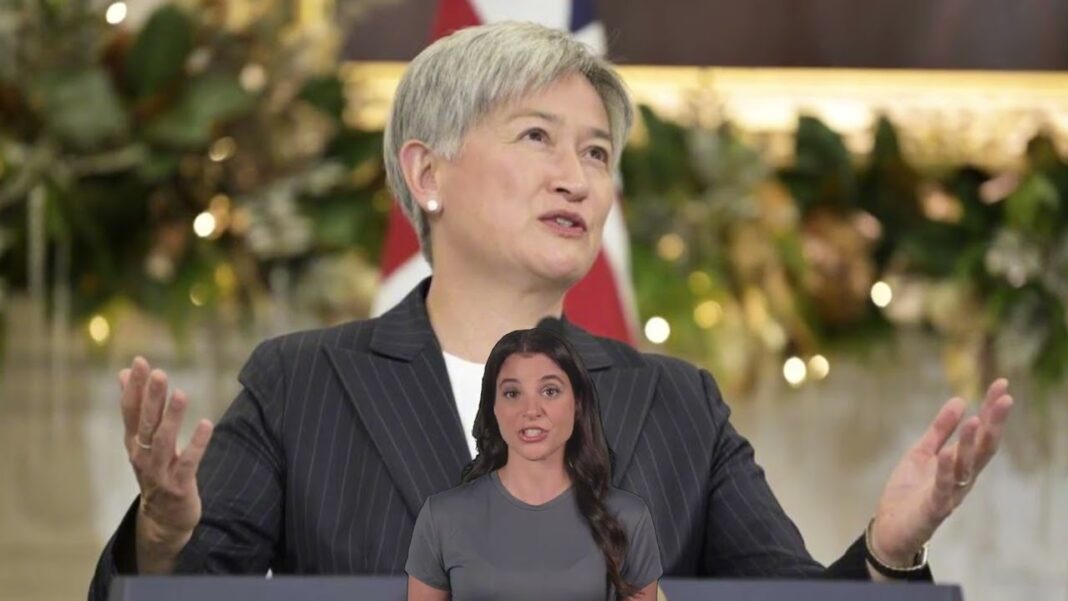
Foreign Minister Penny Wong told The Advertiser, in comments widely quoted by news.com.au, that she was “desperately sorry” for what had happened and conceded that the government could have done more to combat rising antisemitism.
“I’m desperately sorry for what has occurred in our country and what the Jewish community have experienced,” she said. “You always regret what more could have been done … We acted, but we have to do more – and we are.”
Senator Wong pointed to two areas of reform: tightening gun control and strengthening laws against hate speech. She also condemned slogans such as “From the River to the Sea” and “Globalize the Intifada,” saying she agreed with Australia’s antisemitism envoy Jillian Segal that they had been used to “whip up anger and hatred of the Jewish people.”
Her apology followed blistering criticism from Opposition Leader Sussan Ley, who earlier this week attacked Wong for not visiting the massacre site.
“I haven’t seen Penny Wong shed a single tear,” Ley said, in remarks reported by news.com.au.
Prime Minister Anthony Albanese has firmly rejected claims that Australia’s recognition of Palestine earlier this year had anything to do with the atrocity.
“It is very clear from the evidence … that this was an ISIS-inspired attack,” Albanese said, according to the report at news.com.au. “ISIS is an ideology, a perversion of Islam that essentially doesn’t agree with any recognition of nation states, [that] seeks a caliphate.”
“These people weren’t shy about their motivation, and it is there for people to see.”
On Christmas Day, as the country attempted to mark the holiday amid collective trauma, Albanese delivered an address that described the attack as “beyond comprehension.”
“What sort of evil ideology and thoughts at a time like this would motivate someone?” he asked. “We know that there is evil presence. But at the same time, as we’ve seen the worst of evil and the worst of humanity, we have seen the best of humanity.”
Despite mounting pressure, the Albanese government has resisted calls for a federal royal commission into the massacre. The Prime Minister has argued that such an inquiry would take too long, instead announcing targeted reviews into intelligence and federal law enforcement agencies that will feed into NSW’s own royal commission.
This decision has not satisfied many within the Jewish community or the broader public, who argue that the scale of the tragedy — 15 murdered, 40 injured — demands the highest possible level of scrutiny.
As the news.com.au report noted, the NSW royal commission will now face enormous expectations, not only to establish how the attackers were radicalized and how they obtained their weapons, but to dissect whether the leaked warning from CSG NSW was adequately considered — and, if not, why.
Nearly two weeks on, the physical toll remains visible. NSW Health confirmed on Friday that 11 of the wounded are still in hospital, two of them in critical but stable condition. Families remain at bedsides, holding hands, whispering prayers, grappling with the randomness of survival.
For the Jewish community, the pain cuts deeper still. Chanukah, a festival that commemorates resilience in the face of persecution, has been transformed into a symbol of vulnerability.
As news.com.au has reported, many Jewish parents are now questioning whether it is safe to take their children to public religious events at all. Synagogues have bolstered security. Schools are reassessing excursion policies. Community leaders are demanding guarantees that the warnings they provide to authorities will no longer vanish into administrative voids.
The leaked CSG NSW document is not merely an indictment of one operational lapse; it is a mirror held up to a nation struggling to come to terms with a changing threat landscape.
ASIO’s assessment, cited in the document, had already made clear that the era of centrally organized terrorist cells was giving way to a more insidious phenomenon: lone actors radicalized online, drawing inspiration from global jihadist propaganda while operating under the radar of traditional surveillance.
This is the environment in which the Bondi attackers emerged. Not as members of a sprawling network, but as individuals whose violence was incubated in the dark corners of the internet and executed with devastating effect.
Australia has been here before. Port Arthur. Christchurch across the Tasman. Each time, the country vowed that lessons would be learned, that systems would be reformed, that early warning signs would be acted upon.
Yet as the news.com.au report revealed, in Bondi there was not a failure of imagination — there was a failure of response. The threat was articulated. The event was named. The risk was labelled high.
What remains is the aching question of whether fifteen lives might have been spared had that warning been translated into action.
As the sun sets once more over Bondi Beach, the sand now quiet where laughter once echoed, the nation stands at a crossroads. It can retreat into platitudes about resilience, or it can confront, with brutal honesty, the chain of missed opportunities that culminated in Australia’s worst terror attack.
For the families of the murdered, the answers will never come quickly enough. But the leaked document, now seared into the public consciousness through news.com.au, ensures that the story of Bondi’s Chanukah massacre will not be one of unforeseeable tragedy — but of a disaster foretold.