



|
Getting your Trinity Audio player ready...
|
By: Abe Wertenheim
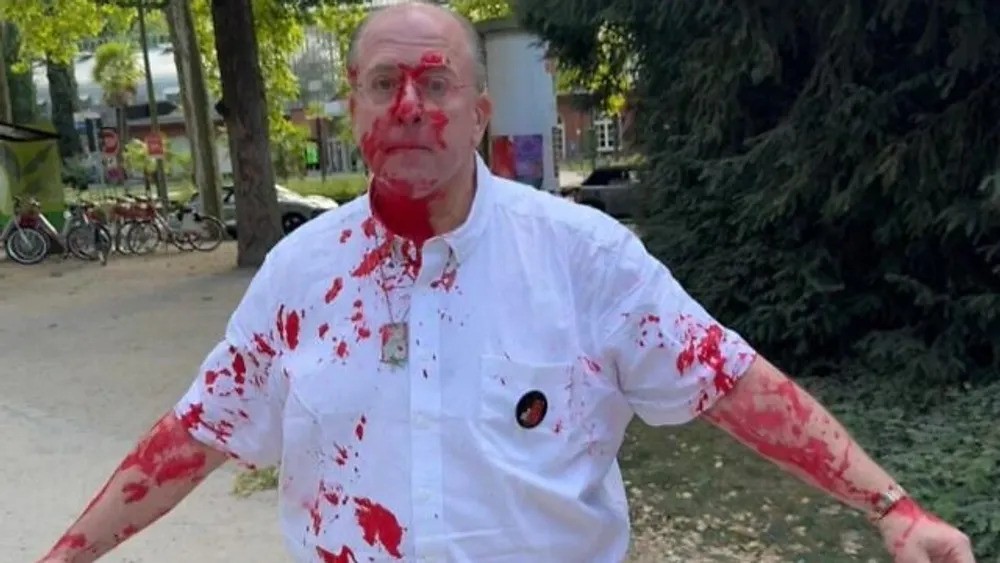
On Friday afternoon in Frankfurt’s Grüneburgpark, what began as a modest show of solidarity with Israeli hostages descended into violence when masked assailants hurled red paint at Jewish activists and shouted antisemitic and anti-Israel slogans. The attackers, according to witnesses and media reports, screamed “child killers” and “Free Palestine” as they shoved the activists and attempted to disrupt their demonstration.
i24 News, which has closely monitored the rise of antisemitic incidents across Europe since Hamas’s October 7, 2023 massacre in southern Israel, reported on Saturday that the attack further illustrates the precarious climate for Jews in Germany. The event involved only a handful of participants but symbolized a deeper, troubling trend: peaceful Jewish advocacy is increasingly met with harassment and violence.
The rally was organized to highlight the plight of some 50 Israeli hostages still held in Gaza nearly a year after their abduction by Hamas. Participants carefully affixed posters bearing the faces of the captives to a fence in the park.
Among them was Sacha Stawski, a prominent German-Jewish activist and head of the NGO Honestly Concerned, a media watchdog that has spent decades countering antisemitism and anti-Israel propaganda in Germany. Stawski recounted the terrifying scene to Bild, saying: “We attached posters with photos of the 50 hostages still in Hamas’s captivity to a fence in the Frankfurt Grüneburgpark. We were branded ‘child killers,’ and I constantly heard ‘Free Palestine,’ and ‘genocide’ calls.”
Stawski added that the red paint was splashed directly onto his glasses, temporarily blinding him and making it difficult to identify the perpetrators. While no serious injuries were reported, the incident left activists shaken and deeply concerned about the safety of Jewish expression in public spaces.
The report at i24 News emphasized that such acts are not isolated but part of a pattern whereby Jewish voices calling attention to the suffering of hostages are drowned out by extremists framing Israel’s war against Hamas as an act of “genocide.”
The rally took place in proximity to an anarchist encampment in the park, known to house activists from several anti-Israel organizations. According to Stawski, organizers had notified the camp of their event in advance, seeking to avoid confrontation. Despite the transparency, the small gathering became a flashpoint for hostility.
i24 News reported that German authorities have grown increasingly concerned about radical encampments across the country that have become hubs for anti-Israel agitation since October 7. These spaces often function as breeding grounds for propaganda and occasionally spill over into outright harassment or violence, as witnessed in Frankfurt.
Germany’s ambassador to Israel quickly condemned the incident, characterizing it as an unacceptable act of intimidation against Jewish citizens exercising their democratic rights. The ambassador’s statement reinforced Germany’s official position that antisemitism in any form cannot be tolerated, particularly at a moment when Israeli families continue to grieve loved ones kidnapped by Hamas.
At the federal level, a government spokesman on Friday reiterated Berlin’s rejection of unilateral recognition of a Palestinian state. As the i24 News report highlighted, the spokesman stressed that such recognition at this stage would “undermine any efforts to reach a negotiated solution with Israel.” This position aligns with Germany’s longstanding policy that peace must be achieved through direct negotiation between the parties, not imposed through symbolic declarations.
Friday’s attack in Frankfurt is the latest in a disturbing series of incidents that reveal the vulnerabilities faced by Jewish communities in Germany. Since Hamas’s October assault, the i24 News network has documented an alarming spike in antisemitic acts, from vandalism of synagogues and Jewish businesses to harassment of Jewish students and professionals.
Germany has prided itself on its post-Holocaust commitment to combating antisemitism, yet Jewish leaders warn that recent months have tested that commitment like never before. Public displays of Jewish identity, from wearing a kippah to voicing support for Israel, increasingly come with risks of confrontation.
Stawski himself has long warned that antisemitism in Germany is not confined to the far-right but also emerges from far-left and Islamist circles. The Frankfurt attack, with slogans combining traditional antisemitic tropes (“child killers”) and contemporary anti-Israel rhetoric (“genocide”), illustrated this dangerous confluence.
The attack also occurred against a backdrop of heightened debate within Germany over how to respond to the war in Gaza and the ongoing hostage crisis. While Berlin remains one of Israel’s most steadfast allies in Europe, domestic pressure from activist groups and some politicians has mounted for Germany to take a harsher stance against Israel’s military campaign.
The report at i24 News pointed out that Friday’s government statement distancing Germany from unilateral recognition of Palestine is consistent with Berlin’s cautious diplomacy. By rejecting symbolic recognition, German officials sought to reaffirm that peace depends on negotiations rather than external declarations. Yet such caution has not quelled the anger of activist groups, many of which accuse Berlin of enabling Israeli “genocide.”
For Germany’s Jews, who number about 200,000, these debates are far from abstract. Public expressions of solidarity with Israel or even acknowledgment of the hostages can trigger backlash, as the Frankfurt activists learned. The fact that such an incident occurred in broad daylight, in one of Germany’s major cities, highlights the precariousness of Jewish civic engagement today.
The i24 News coverage emphasized that the violence in Frankfurt was not only an attack on individuals but on the principle of free expression itself. It questioned whether Jewish citizens can safely advocate for their community’s concerns without fear of intimidation.
Following the attack, activists and community leaders called for stronger police protection of Jewish gatherings and for more decisive action against extremist encampments. While the German government has pledged increased funding for synagogue security and educational initiatives, incidents such as the one in Frankfurt suggest that more proactive steps are needed to ensure Jewish safety in public spaces.
For Stawski and his fellow activists, the message is clear: they will not be deterred. Despite the humiliation and danger, they insist on continuing their advocacy for the hostages, whose plight remains one of the most painful consequences of Hamas’s October 7 atrocities.
Friday’s events in Frankfurt were a stark reminder of how antisemitism adapts to contemporary political narratives. The simple act of hanging posters for kidnapped Israelis became a trigger for rage, violence, and hatred — evidence that the line between anti-Israel activism and antisemitism is increasingly blurred.
As i24 News reported, the German ambassador’s condemnation and Berlin’s reaffirmation of its stance on Palestinian statehood were welcome gestures. Yet the underlying question persists: can Germany protect its Jewish citizens from the escalating hostility that threatens to silence them in the public square?
For Stawski, the answer lies in perseverance. “We cannot abandon the hostages,” he said. “No matter the intimidation, no matter the threats, we will continue.”
“We attached posters with photos of the 50 hostages still in Hamas’s captivity to a fence in the Frankfurt Grüneburgpark. We were branded ‘child killers,’ and I constantly heard ‘Free Palestine,’ and ‘genocide’ calls.”
Stawski added that the red paint was splashed directly onto his glasses, temporarily blinding him and making it difficult to identify the perpetrators. While no serious injuries were reported, the incident left activists shaken and deeply concerned about the safety of Jewish expression in public spaces.
The i24 News report emphasized that such acts are not isolated but part of a pattern whereby Jewish voices calling attention to the suffering of hostages are drowned out by extremists framing Israel’s war against Hamas as an act of “genocide.”
