



|
Getting your Trinity Audio player ready...
|
By: Fern Sidman
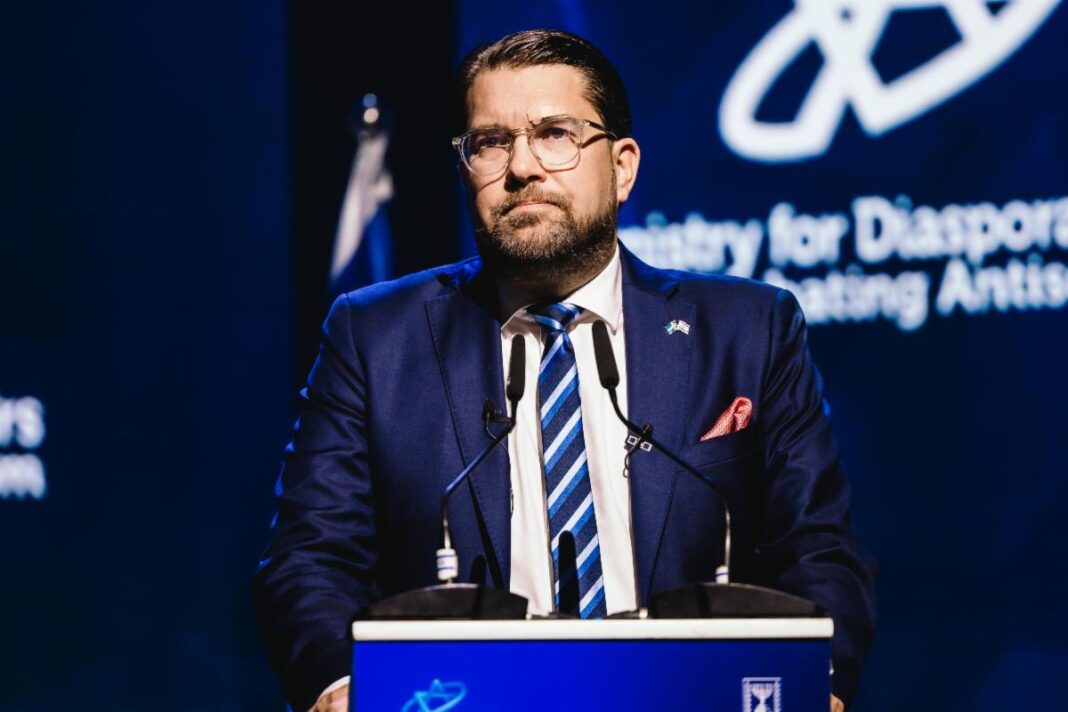
In the vaulted halls of Jerusalem’s International Convention Center on Tuesday, beneath the symbolic weight of International Holocaust Remembrance Day and amid a gathering of global leaders, diplomats, and policymakers, a defining political moment unfolded that may reverberate far beyond Israel’s borders. Jimmie Åkesson, the long-time leader of the Sweden Democrats and one of the most influential figures in contemporary Swedish politics, used the international stage of the Second International Conference on Combating Antisemitism to announce a sweeping and consequential policy initiative that could reshape Sweden’s national security framework — and redefine Europe’s approach to combating extremist ideologies.
Åkesson, widely regarded by political analysts as a serious contender to become Sweden’s next prime minister, addressed the conference in Jerusalem with language that was both resolute and unapologetic. Speaking at an event initiated by Israel’s Minister of Diaspora Affairs and Combating Antisemitism, Amichai Chikli, Åkesson declared that his party would move decisively to reintroduce a Swedish national terror designation list — a sovereign mechanism designed to identify, ban, and dismantle organizations engaged in terrorism, extremism, and ideological violence.
His announcement marked a sharp departure from reliance on European Union frameworks and signaled a broader ideological shift toward national sovereignty in security policy.
“Today, for the first time, I can announce that my party, the Sweden Democrats, will take the lead in reintroducing a Swedish national terror list,” Åkesson told the international audience. His words carried both political calculation and moral urgency. “This is necessary in order to fight the funding of terrorism and to combat horrific ideologies that do not belong in Sweden and do not belong in any civilized country.”
The declaration was not framed as a symbolic gesture, but as a concrete legislative agenda item to be advanced ahead of Sweden’s upcoming national elections later this fall. Åkesson’s message was unmistakable: Sweden, under his leadership, would no longer outsource its moral and security responsibilities to supranational institutions that he believes have failed to act decisively.
At the core of his critique was the European Union itself. While the EU maintains an official terror designation list, Åkesson argued that it is structurally ineffective, politically compromised, and dangerously incomplete.
“The sad fact is that the European Union is too weak and too indecisive to handle this matter,” he said. “There is an EU terror list, but it is far from effective and far from complete.”
His criticism reflects a growing frustration across Europe with the EU’s consensus-based decision-making structures, which often require unanimous agreement among member states and can stall action against extremist networks due to diplomatic sensitivities, geopolitical entanglements, and internal political pressures.
Åkesson’s proposed national list, by contrast, would operate independently of EU mechanisms, allowing Sweden to act unilaterally in identifying, banning, and financially isolating terror organizations that threaten democratic values, minority communities, and national security.
While he emphasized that such a list would include “all types of terror organizations,” he made clear that the fight against antisemitism stands at the center of the initiative. Two organizations, in particular, were highlighted as urgent candidates for designation: Iran’s Islamic Revolutionary Guard Corps (IRGC) and the Muslim Brotherhood.
Both, Åkesson said, represent ideologically driven movements rooted in antisemitism, political extremism, and transnational destabilization.
The inclusion of the IRGC is especially significant. Long regarded by Western intelligence agencies as the operational backbone of Iran’s regional proxy warfare — funding, arming, and directing militias across the Middle East — the IRGC has also been directly linked to global terror financing, cyber warfare, and targeted violence. Yet despite these activities, the EU has repeatedly hesitated to formally designate the IRGC as a terrorist organization, largely due to diplomatic considerations tied to nuclear negotiations and geopolitical stability.
Similarly, the Muslim Brotherhood occupies a complex position in European politics: operating simultaneously as a political movement, social organization, and ideological network, it has often escaped formal terror classification despite extensive evidence of radicalization pipelines, extremist financing channels, and ideological alignment with violent jihadist movements.
By naming both organizations explicitly, Åkesson was not merely outlining policy — he was drawing ideological lines.
This declaration came during the Second International Conference on Combating Antisemitism, held in Jerusalem under the banner “Generation Truth.” Organized on International Holocaust Remembrance Day, the conference was conceived as a global platform for confronting the resurgence of antisemitism, radicalization, and ideological extremism in the modern world. Its mission is not only commemorative, but strategic: to forge international alliances, policy frameworks, and political commitments capable of responding to the evolving threats facing Jewish communities and democratic societies alike.
The symbolic resonance of the setting was profound. Jerusalem, a city saturated with historical memory, trauma, resilience, and sovereignty, provided a powerful backdrop for a speech that fused security policy with civilizational language. Åkesson’s rhetoric did not frame antisemitism as an isolated social pathology, but as part of a broader ideological war against democratic civilization itself.
His remarks placed antisemitism within a global architecture of extremism — one that transcends borders, cultures, and political systems, and that weaponizes ideology, religion, and grievance as tools of destabilization.
The conference itself reflected this global scope. Distinguished participants included Edi Rama, Prime Minister of Albania; Sebastian Kurz, former Chancellor of Austria; Scott Morrison, former Prime Minister of Australia; Mariano Cúneo Libarona, Argentina’s Minister of Justice; Flávio Bolsonaro, Brazilian senator and presidential candidate; and Eduardo Bolsonaro, a senior member of Brazil’s Congress. Their presence underscored the growing international recognition that antisemitism is not merely a Jewish issue, but a civilizational threat — a warning signal of deeper societal fractures.
Åkesson’s intervention stood out because it transformed moral discourse into policy architecture.
Rather than limiting his address to condemnation and commemoration, he articulated a concrete governance strategy: legal infrastructure, national sovereignty, financial enforcement mechanisms, and ideological confrontation. In doing so, he repositioned antisemitism not only as a moral crisis but as a security challenge that demands institutional response.
For Sweden, the implications are profound. Reintroducing a national terror list would mark a structural shift in how the country defines and defends its democratic boundaries. It would expand law enforcement and intelligence authorities, alter financial oversight mechanisms, and create new legal tools for prosecuting extremist networks operating within Swedish territory.
Politically, the announcement also serves as a defining campaign marker ahead of national elections. It frames the Sweden Democrats not merely as a populist protest movement, but as a governing party offering concrete institutional reforms. By positioning himself as a leader willing to confront both radical ideologies and European bureaucratic inertia, Åkesson is crafting an image of decisiveness and sovereignty that resonates with voters concerned about security, immigration, and national identity.
At a deeper level, his speech reflected a broader ideological realignment occurring across Europe. The traditional post-World War II framework — built on supranational institutions, multilateral consensus, and liberal universalism — is increasingly strained by the realities of transnational terrorism, mass migration, cyber warfare, and ideological radicalization. Åkesson’s vision represents a return to nation-state authority as the primary guarantor of security and social cohesion.
The Jerusalem stage amplified this message. Speaking in Israel — a nation forged through existential struggle, sovereignty battles, and survival against annihilationist ideologies — Åkesson’s words carried symbolic weight. His emphasis on national self-defense, ideological clarity, and moral boundaries resonated with Israel’s own historical experience.
The Second International Conference on Combating Antisemitism, under the theme “Generation Truth,” framed these ideas not as reactionary, but as forward-looking. The title itself suggests a generational shift: away from denial, euphemism, and political paralysis, toward clarity, confrontation, and institutional courage.
As the conference continues, Åkesson’s announcement is likely to be remembered as one of its most consequential moments — not because of its rhetoric alone, but because of its translation into policy ambition.
In a world increasingly marked by ideological fragmentation, geopolitical instability, and moral uncertainty, his declaration represents a clear thesis: that antisemitism cannot be defeated by symbolism alone, that extremism cannot be managed through bureaucratic delay, and that civilization itself requires boundaries, enforcement, and courage.
Whether Sweden ultimately adopts this national terror list will depend on electoral outcomes, coalition politics, and legislative negotiations. But the message delivered in Jerusalem is already shaping discourse: the fight against antisemitism, terrorism, and extremist ideology is no longer confined to remembrance ceremonies and moral declarations — it is becoming a defining axis of governance in the 21st century.
From Jerusalem to Stockholm, from memory to policy, Åkesson’s declaration marks a moment where history, politics, and ideology converged — not in abstraction, but in action.

Finally a man has seen the light. Despite his party’s flirtation with ultra right extremism, they have moved away from it and repented. This move shows guts and intent. Sweden is waking up from its lethargy and starting to show weak Europe the way